Multiple energy plants
Energy plant distribution assumptions: supply options, network share and heating power coverage for networks with multiple feed-in points
Overview
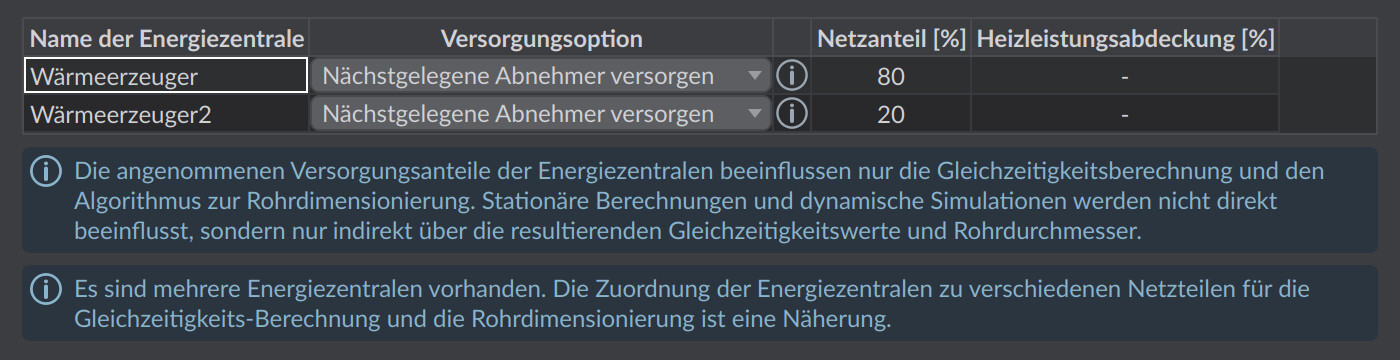
For networks with multiple energy plants it must be defined which plant supplies which consumers or which share of the heating power. These distribution assumptions are needed only for pipe sizing and the simultaneity calculation – not for the thermo-hydraulic calculation (steady-state calculation and dynamic simulation), where the load distribution follows physically from the hydraulic model. For the sizing they control the load aggregation of pipe sizing and the calculation of simultaneity; the assignment of the energy plants to network areas is thereby an approximation.
Opening
- Menu Network > Energy plant distribution assumptions … - opens the Edit energy plants dialog
- alternatively the Energy plant distribution assumptions tab in the Size pipes dialog
Settings per energy plant
The dialog shows a table with all energy plants (source nodes) of the active network:
| Column | Meaning |
|---|---|
| Energy plant name | Display name of the source node (not editable) |
| Supply option | Choice between Supply nearest consumers and Supply entire network |
| Info icon | Tooltip explaining the chosen supply option |
| Network share [%] | Editable only with Supply nearest consumers: share of the total network demand assigned to this plant |
| Heating power coverage [%] | Editable only with Supply entire network: share of each consumer’s peak load that this plant covers |
Supply nearest consumers
The plant supplies only the consumers nearest to it in the network. The consumers are assigned to the respective nearest plant based on network distance until its network share of the total demand is reached. Suitable for distributing the load geographically across several energy plants for the sizing: each consumer is attributed to the plant nearest to it. This assignment is purely a sizing assumption for the load aggregation of pipe sizing and simultaneity; it changes neither the network geometry nor does it permanently divide the network into areas.
Supply entire network
The plant supplies all consumers in the network and covers the specified percentage of the peak load at each consumer (heating power coverage). Suitable for a base-load or peak-load plant that supplies the entire network with a defined power share.
Validity rules
Before pipe sizing the settings are checked. Invalid configurations block the calculation:
- Each plant needs a set supply option.
- The network share of each plant with the option Supply nearest consumers must lie in the range (0, 100] %; the sum of all network shares must equal exactly 100 %.
- The heating power coverage of each plant with the option Supply entire network must lie in the range (0, 100] %; the sum of all coverages must not exceed 100 %.
For invalid settings the dialog shows an error message with the affected points; the Automatically correct energy plant settings button restores a valid default configuration (e.g. normalizing the network shares to 100 %). If consumers are assigned to no plant by the chosen coverages, a warning with the affected buildings appears after sizing.
Effect on sizing and calculation
From the distribution assumptions, two load scenarios are determined for each route: the load from the assignment to the nearest plant and the load from supplying the entire network. For sizing, the maximum of both scenarios is applied to each route - each route is thus sized for the most unfavorable assumed supply case.
Important in practice
The distribution assumptions are a pure sizing approximation - they define how the load is aggregated onto several feed-in points for pipe sizing, not how the network is later actually operated. Because the more unfavorable of the two scenarios is decisive per route, the pipes are also sized to carry the load if one plant fails and another one takes over. The actual operation is only represented by the steady-state calculation or the dynamic simulation.
The assumed coverages affect only the simultaneity calculation and the pipe sizing. The steady-state calculation and the dynamic simulation are not directly affected, only indirectly via the resulting simultaneity values and pipe diameters.