Fluids and More Databases
Heat-transfer media, heating curves, schedules as well as plant and heat-exchange databases in VICUS Districts
Overview
Besides the pipe database, network planning uses further databases: fluids (heat-transfer media), boundary conditions for the heat exchange of the pipes, plants with their components, schedules and heating curves. All of them are edited through the shared database dialogs - for the general operation see Database concept.
Fluids
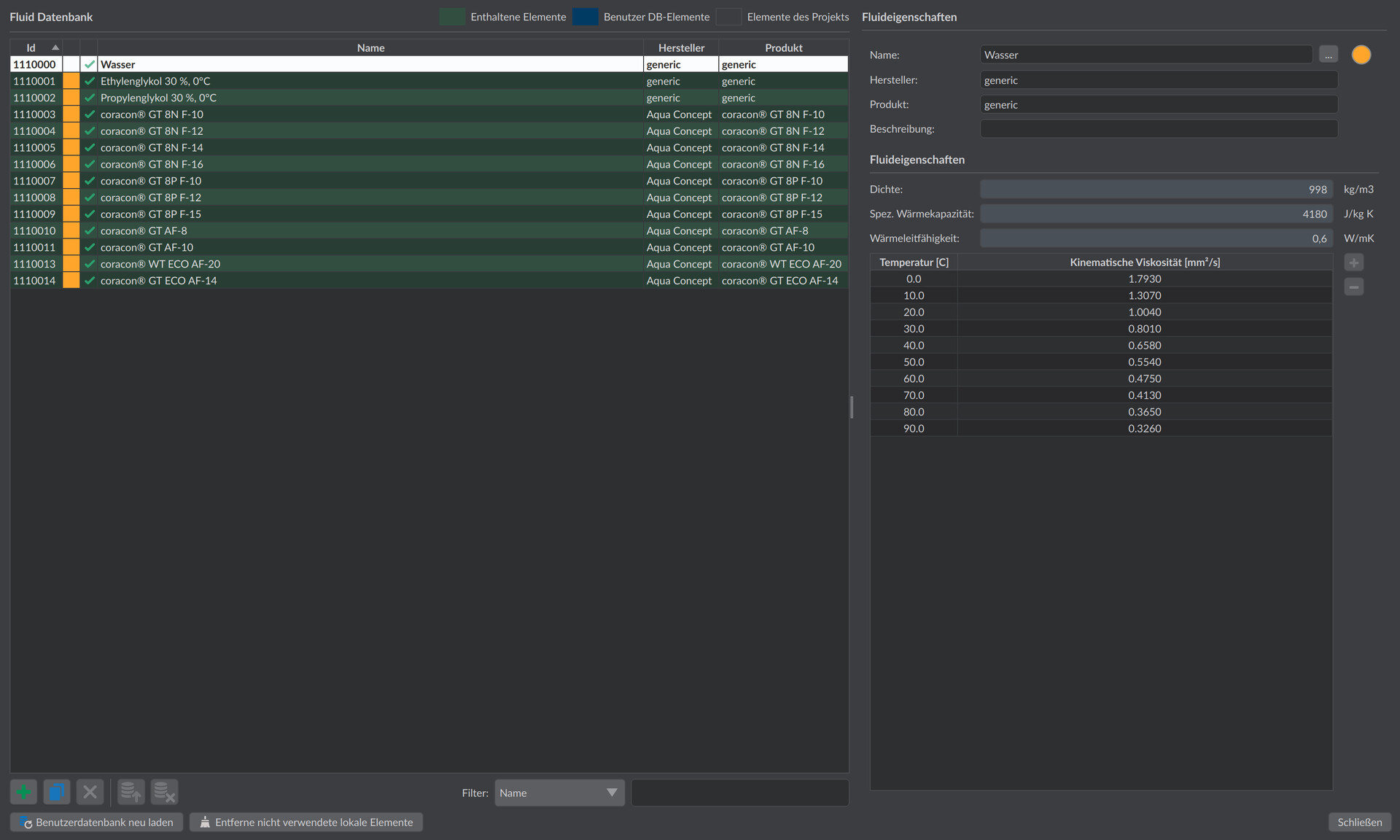
Opened via menu Databases > Media/Fluids … The fluid is assigned per network in the network properties and applies to all routes of the network.
| Parameter | Unit | Meaning |
|---|---|---|
| Density | kg/m³ | Density of the medium |
| Spec. heat capacity | J/kgK | Heat capacity; determines the power transported per mass flux and temperature difference |
| Thermal conductivity | W/mK | Thermal conductivity of the medium |
In addition, each fluid contains a viscosity table (columns Temperature [C] and Kinematic viscosity [mm²/s]): value pairs between which linear interpolation is applied. The temperature-dependent viscosity feeds directly into the pressure-loss calculation - especially for brine media and low temperatures (cold district heating), the viscosity rises considerably. Support points are added or removed via the buttons + and - next to the table.
Important in practice
For cold district heating and brine media, the pressure-loss calculation stands or falls with the viscosity table. Store enough support points across the temperature range actually operated – especially near the freezing point, the viscosity rises sharply. Too coarse a table with only one or two values otherwise leads to significantly underestimated pump pressures.
Predefined among others are Water, Ethylene glycol 30 % and Propylene glycol 30 % (material values at 0 °C) as well as a range of manufacturer heat-transfer fluids (coracon GT/WT). Built-in fluids are read-only and can be adjusted as a copy.
Heat Exchange of Pipes
Opened via menu Databases > Heat exchange of pipes … This database defines the thermal boundary condition with which buried pipes exchange heat with their environment. The available model types are Ground model, Constant temperature as well as user-defined temperature time series (from values or from a file); optionally an outer heat transfer coefficient in W/m²K can be specified.
Details on the model types and on the coupled ground model can be found under Heat-exchange types and Ground model.
Plants and Network Components
Opened via menu Databases > Plants … The plant database contains the hydraulic circuits for energy plants and transfer stations. Via the menu of the add button, you create new entries as:
- Simplified consumer - transfer station with a fixed pressure loss
- Simplified energy plant - pump and ideal heat generator
- Detailed plant - freely configurable circuit in the plant editor
The individual building blocks of a plant (pumps, heat pumps, heat exchangers, valves, etc.) are network components with their own database; they are edited and assigned directly in the plant editor. See Plant concept, Plant editor and Components.
Schedules
Opened via menu Databases > Schedules … Schedules describe time-dependent quantities across two tabs:
| Tab | Content |
|---|---|
| Daily cycles | Periods within the year, assignment of the weekdays (Monday-Sunday) to daily profiles and hour-by-hour daily profiles; interpolation either linear or constant |
| Annual schedules | Continuous annual time series, entered directly or referenced from a TSV file |
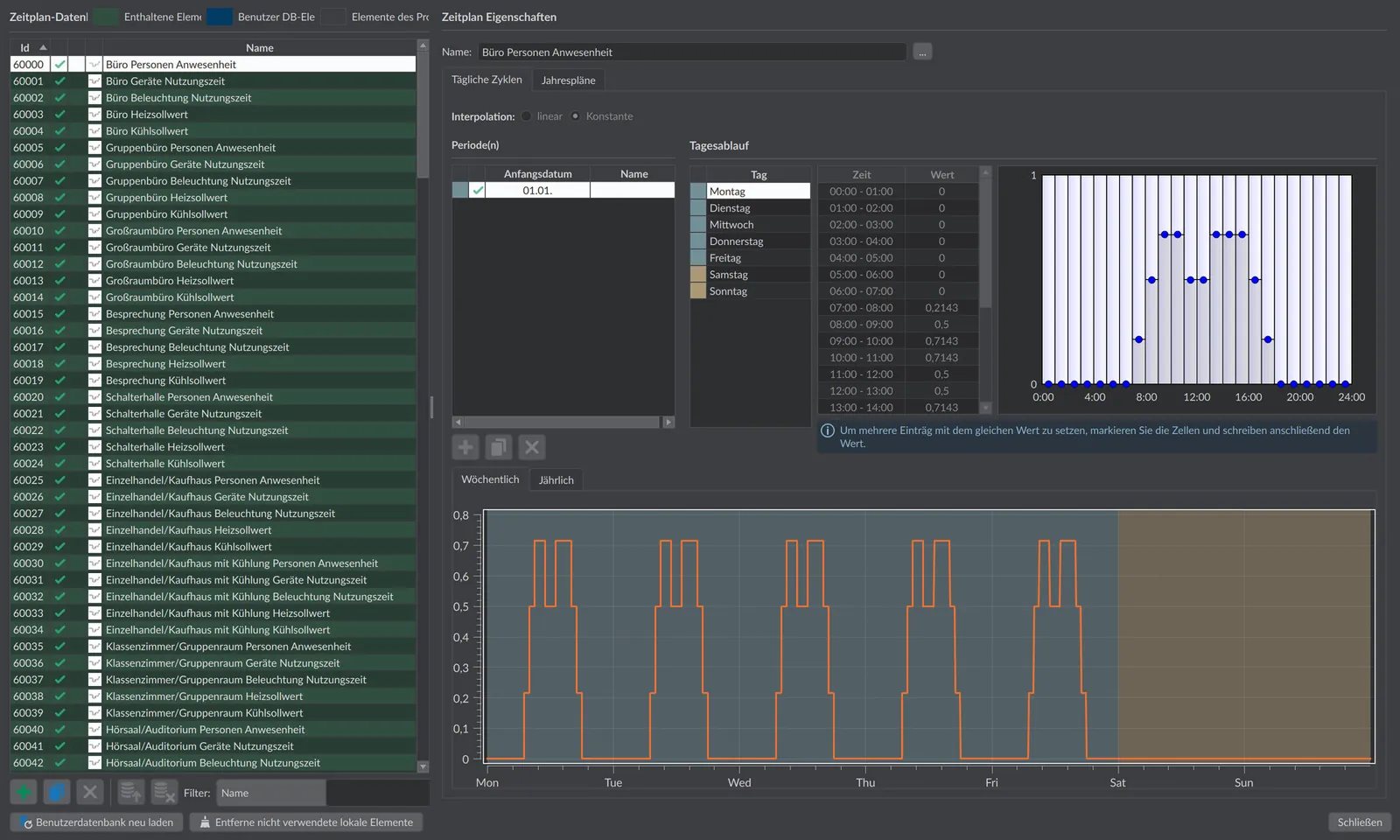
In the network context, schedules are used for time-dependent setpoints and boundary conditions of plant components, e.g. time-dependent heat-exchange temperatures or heating powers - see Components and Heat-exchange types.
Heating Curves
Opened via menu Databases > Heating curves … A heating curve describes a setpoint temperature as a function of the outdoor temperature – as the supply temperature of the network for the heat generator or as the heating curve of the building on the secondary side of the transfer station. Curve types, application types and the assignment to the generator or transfer station are described in detail under Heating curves.