Simple heat exchanger
The simple heat exchanger as a simplified consumer model: heat flux from building demand, optional outlet temperature limit, heat deficit outputs.
Overview
The simple heat exchanger is the simplified consumer model: the heat flux extracted from the network is prescribed directly as a boundary condition from the building demand. Heat-exchanger physics (transfer area, secondary side) is not represented – the model extracts the required heat flux independent of the temperature conditions.
In the typical consumer plant, the heat exchanger is combined with a controlled valve that controls the temperature difference across the heat exchanger to the design spread (ΔT control). The mass flux of the consumer thus follows the heat demand.
How it works
- The required heat flux is the current heating demand of the assigned building (demand profile or constant demand).
- Without further settings, this heat flux is always fully extracted from the network – even if the supply temperature would actually be too low for it. The outlet temperature can then drop unrealistically low.
- Optionally, the heating curve of the building limits the outlet temperature: the outlet temperature may then not fall below the return temperature of the heating curve, and the extracted heat flux is capped accordingly:
If the supply temperature of the network is already below the return temperature of the heating curve, no heat is transferred.
Important in practice
Without the heating-curve limitation activated, the simple heat exchanger extracts the demand always fully – even at too low a supply temperature, whereby the return temperature drops unrealistically low. For pure sizing networks this is uncritical. As soon as you want to investigate undersupply, activate the limitation or switch to the transfer station.
Parameters
| Parameter | Unit | Default | Meaning |
|---|---|---|---|
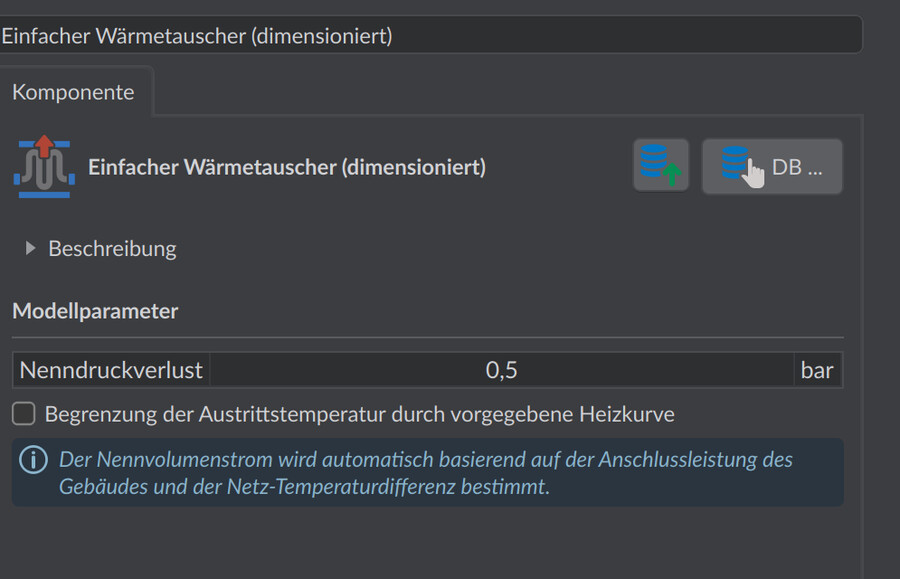
| Nominal volume flow | m³/h | 2 | Reference volume flow for the pressure loss; for the sized variant automatically from the connection load |
| Nominal pressure loss | bar | 0.5 | Pressure loss at the nominal volume flow (quadratic scaling) |
| Fluid volume | L | 3 | Fluid volume of the heat exchanger |
| Limit outlet temperature by heating curve | – | off | Activates the limitation by the return temperature of the building heating curve |
Output quantities
With temperature limitation activated, the model additionally provides:
| Quantity | Meaning |
|---|---|
| RequiredBuildingHeatFlux | Heat flux required by the building |
| HeatDeficitAbsolute | Heat flux that cannot be delivered because of too low a supply temperature |
This allows undersupply to be detected even though the model itself does not represent transfer physics.
Classification
The simple heat exchanger is the robust standard model for networks whose supply temperature lies in the design range: quick to parameterize, numerically well-behaved, and the return temperature follows directly the controlled spread. Where undersupply scenarios, lowered network temperatures or building-specific spreads are to be investigated, the transfer station is the appropriate model – the comparison is contained in Consumer model selection.