Summer Overheating Simulation Software (DIN 4108-2)
Dynamic verification via overheating degree hours
When the simplified solar-gain coefficient method is not passed, only the simulation verification per § 8.4 DIN 4108-2 reaches the goal. The dynamic building simulation determines the overheating degree hours per room and represents shading, thermal mass and night ventilation in a time-resolved way. VICUS BUILDINGS delivers exactly this verification – with direct geometry import and a 3D workflow that follows familiar CAD tools. The methodical fundamentals are covered in our article on summer thermal protection per DIN 4108-2.
Four steps to verification
Model the building
Read geometry from IFC, DXF or PDF, or build it directly in the 3D environment. Glazing, orientation and shading become the basis of the thermal model.
Set boundary conditions
Parameterize summer climate region, usage profiles, shading (FC value) and night ventilation – from bundled databases or project-specific.
Simulate overheating degree hours
Calculate the operative room temperature hour by hour across the full year and evaluate the overheating degree hours per critical room against the limit value.
Verification & report
Document that the verification per § 8.4 DIN 4108-2 is passed and export it as a traceable, customizable report for approval.
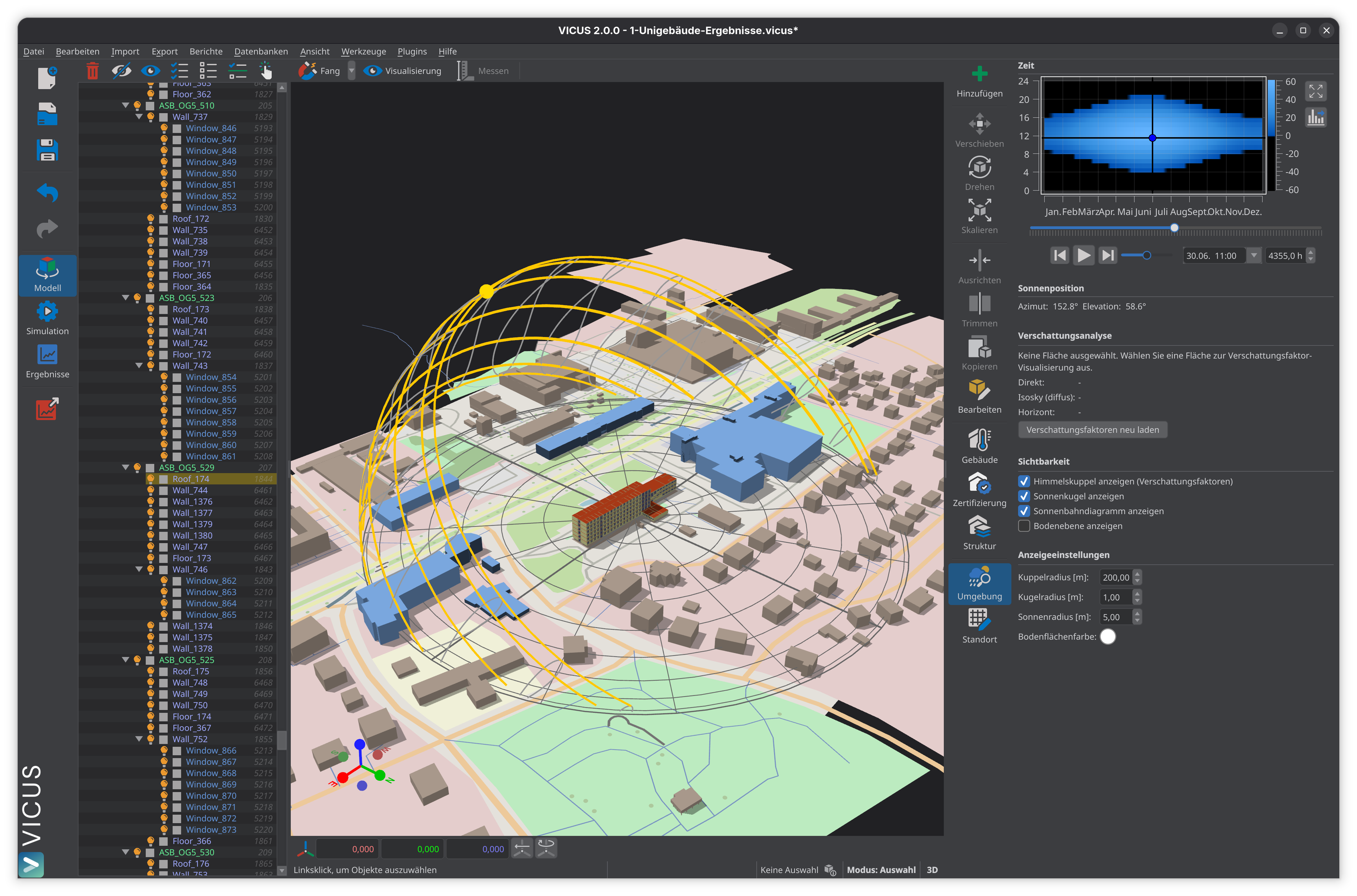
What the simulation in VICUS BUILDINGS does
- Overheating degree hours: hourly evaluation of the operative room temperature per critical room against the limit (residential: 1200 Kh at 25 °C).
- Evaluate measures physically: size shading (FC value), thermal mass and night ventilation in combination instead of assuming lump-sum values.
- Summer climate region: assessment for the governing region A, B or C per DIN 4108-2.
- Geometry import: IFC, DXF and PDF import instead of double modeling – take glazing and shading directly from the design.
- Approval-ready report: export results as a traceable, customizable verification report.
Frequently asked questions
Run the verification in your own project
Try VICUS BUILDINGS free for 30 days – or let us show you the summer thermal protection verification in a personal demo.