Seasonal Storage in Cold District Heating Networks
Ground as seasonal storage in 5GDHC networks: borehole fields, collectors, agrothermal fields, regeneration, heating/cooling balance, long-term cooling.
Table of Contents
In a cold district heating network, seasonal storage means that heat from the summer half-year is held in the ground and extracted again by the decentralised heat pumps in winter. The storage medium is usually not a tank but the subsurface itself: the soil around the uninsulated pipe network, around borehole fields and around horizontal collectors. How well this works depends on the heating and cooling balance of the neighbourhood, on the type of ground source and on regeneration over the entire service life.
This article extends the fundamentals of cold district heating to the storage side. It covers which sources actually store heat, how to set up the annual balance and why the design has to span several decades.
The ground as a storage medium
Water-saturated soil has a volumetric heat capacity of roughly 2.0 to 2.8 MJ/(m³·K) and a thermal conductivity of about 1.5 to 2.5 W/(m·K); dry sands and gravels are considerably lower. One cubic metre of soil therefore stores about 6 to 8 kWh for a temperature swing of 10 K. The low conductivity is both an advantage and a drawback: heat stays close to the heat exchangers, but it can only be charged and discharged slowly.
In the upper metres, the undisturbed ground temperature follows the annual cycle of the air temperature, damped and phase-shifted. At 1 to 2 m depth it varies between roughly 3 and 17 °C in Central Europe. Below about 10 to 15 m the annual cycle has decayed; the temperature there is around 1 to 2 K above the mean annual air temperature and rises with the geothermal gradient by about 3 K per 100 m.
For storage, this results in a clear distinction:
- Shallow systems (pipe network, horizontal collectors, agrothermal fields) are closely coupled to the ground surface. They are regenerated naturally every year by sun, air temperature and rainfall, but they also lose injected heat back to the surface.
- Deep systems (borehole fields) lie below the zone of seasonal fluctuation. Natural regeneration occurs almost exclusively through heat conduction from the surrounding rock. In return, injected heat is largely retained for months, especially inside densely spaced fields.
Heat sources and their storage effect
Pipe network
The uninsulated network lies at 1 to 2 m depth and exchanges heat with the soil all year round. In winter, when the brine is colder than the ground, it absorbs heat. Typical designs achieve heat gains of 50 to 120 kWh per metre of trench and year (supply and return combined; details in dimensioning of 5GDHC networks). In summer, the network releases heat to the soil during cooling operation. The storage effect is limited because the trench zone is narrow and tightly coupled to the surface; the network acts more as an additional, self-regenerating source.
Horizontal collectors and agrothermal fields
Horizontal ground collectors at 1.5 to 3 m depth draw most of their energy from the annual warming of the soil by sun and rainfall. Summer heat injection from cooling raises the soil temperature at the start of the heating season, but a large share of this heat is lost again through the surface. Collectors are therefore regenerating sources rather than seasonal storage in the strict sense. Typical extraction yields are 60 to 70 kWh/(m²·a) for single-layer and 80 to 100 kWh/(m²·a) for two-layer collectors.
In agrothermal systems, collector pipes are ploughed into farmland by machine, usually at about 2 m depth. The land remains cultivable. Thermally, an agrothermal field behaves like a large horizontal collector: high surface regeneration, little storage effect for injected heat. Points to consider are freezing of the soil around the pipes and effects on soil moisture and farming, which have to be agreed contractually with the landowners.
Borehole fields
Borehole heat exchangers usually reach 50 to 200 m depth. In a field with 5 to 8 m spacing, the temperature fields of the individual boreholes overlap after a few years. Without regeneration the field therefore cools down in the long term even if each borehole is correctly sized on its own. Conversely, this thermal interaction is exactly what enables storage: the more compact the field and the smaller its surface-to-volume ratio, the more of the heat injected in summer is available again in winter.
Borehole fields thus become borehole thermal energy storage (BTES) when the neighbourhood can inject relevant amounts of heat. Design then shifts from extraction rate per metre towards the question of which temperature range the storage passes through over the year.
| Source | Depth | Natural regeneration | Storage effect for injected heat | Land requirement |
|---|---|---|---|---|
| Pipe network | 1–2 m | high (surface) | low | none additional |
| Horizontal collector | 1.5–3 m | high (sun, rainfall) | low to medium | large |
| Agrothermal field | approx. 2 m | high | low | very large, remains farmland |
| Borehole field | 50–200 m | low (conduction only) | high, especially in the field centre | small |
| Aquifer storage (ATES) | typically 20–300 m | groundwater flow | high at low flow velocity | small (wells) |
Regeneration: injecting heat deliberately
Regeneration means any heat input into the source beyond natural ambient heat. In cold district heating networks the main options are:
- Passive building cooling: buildings cool directly via a plate heat exchanger connected to the network. The heat enters the network and the source without compressor work. Residential buildings usually deliver small amounts; offices, retail, laboratories and care facilities considerably more.
- Active cooling: the heat pump operates as a chiller. The cooling load plus the electrical drive power enter the network. This increases regeneration but costs electricity.
- Unglazed solar absorbers and PVT collectors: at network temperatures of 5 to 20 °C they operate at high efficiency because heat losses to the environment are small. PVT collectors also cool the PV modules, slightly improving electricity yield.
- Waste heat: commercial refrigeration (e.g. supermarkets), data centres, air compressors or processes with recooling demand at temperatures too low for conventional networks but directly usable for cold networks.
- Dry coolers and air heat exchangers: in summer they transfer heat from the outdoor air into the network. They are easy to retrofit but need fan power and installation space.
- Wastewater and surface water: usually year-round sources, but combined with a borehole field they can also be used for summer charging.
Timing is decisive: regeneration heat should be injected in summer and early autumn so that the storage enters the heating season at a high temperature.
Heating and cooling balance of the neighbourhood
Storage design starts with an annual balance on the network side, not on the building side. Heat pumps only extract the share of heating energy that does not come from electricity:
With passive cooling, the cooling load enters the network directly; with active cooling, the drive energy is added:
Sources and regeneration measures must cover the remaining difference, minus the heat gains of the pipe network:
Worked example
| Quantity | Residential neighbourhood | Mixed neighbourhood with offices and retail |
|---|---|---|
| Heating incl. domestic hot water | 2,000 MWh/a | 2,000 MWh/a |
| SPF of heat pumps | 4.0 | 4.0 |
| Extraction from network | 1,500 MWh/a | 1,500 MWh/a |
| Cooling (passive) | 100 MWh/a | 600 MWh/a |
| Network gains (3 km × 80 kWh/(m·a)) | 240 MWh/a | 240 MWh/a |
| Demand from sources and regeneration | 1,160 MWh/a | 660 MWh/a |
| Balance ratio injection/extraction | 7 % | 40 % |
The example shows the orders of magnitude: purely residential neighbourhoods are strongly extraction-dominated and need large collector areas, long borehole fields or active regeneration. Mixed neighbourhoods can reduce source demand significantly because the cooling loads of non-residential buildings act as storage charging. A monthly or hourly balance is still required, because cooling and heating occur at different times and the storage has to bridge exactly this shift.
Ground and sources in VICUS Districts
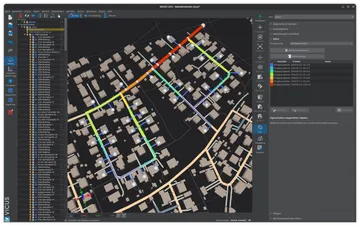
The ground is spatially discretised along the pipe route and computed over several operating years, coupled with the thermo-hydraulic network simulation. Borehole heat exchangers and horizontal ground collectors are integrated as components in the network model and simulated with the same ground model. The COP of each decentralised heat pump is calculated in every time step from the actual network and building temperatures. This makes it possible to track how source and network temperatures develop from year to year.
Aquifer and ice storage in context
Aquifer thermal energy storage (ATES)
ATES uses water-bearing layers via at least one well doublet with a warm and a cold well. In summer, water from the cold well is pumped for cooling and reinjected warmed into the warm well; in winter, the flow direction is reversed. ATES is widespread in office and residential districts in the Netherlands but still rare in Germany; a well-known example is the cold and heat storage of the parliament buildings in Berlin.
For cold district heating networks, ATES is attractive when heating and cooling loads are of similar size and the subsurface has thick aquifers with low groundwater flow. Prerequisites are a hydrogeological survey, a water-law permit and a balanced energy budget, since authorities usually require thermal neutrality over the years. Hydrochemistry (precipitation, corrosion) and well ageing are operational risks. Further storage types are covered in Thermal Energy Storage.
Ice storage
Ice storage uses the latent heat of fusion of water, 334 kJ/kg or about 93 kWh per cubic metre. The heat pump extracts heat from the water until it freezes; regeneration comes from solar-air absorbers, ground contact through the tank wall or summer cooling that melts the ice again. The storage volume typically lasts a few weeks, not an entire heating season. At neighbourhood scale, ice storage therefore serves rather as a buffer source for individual buildings or as a capacity reserve during cold spells. As the sole seasonal storage for a residential neighbourhood, the required volumes would be very large.
Design over the service life
Long-term ground cooling
For borehole fields, the decisive year is not the first but the last. With net extraction, the mean subsurface temperature drops over the years and only slowly approaches a new equilibrium. Design is therefore usually carried out for a period of 25 to 50 years, for example with step-response functions (Eskilson g-functions) or numerical models. The simplified tables of VDI 4640 Part 2 apply only to small systems; neighbourhood-scale borehole fields require a calculation with simulation tools over the full service life.
A field that operates at a mean brine temperature of 6 °C in its first year can be several kelvin colder after 25 years without regeneration. Each kelvin reduces the heat pumps’ COP by roughly 2 to 3 %, and the antifreeze limits of the brine move closer.
Design parameters
| Parameter | Typical approach | Remarks |
|---|---|---|
| Design period | 25–50 years | Borehole fields: final state governs |
| Minimum brine temperature | Design to brine and antifreeze limits | Antifreeze typically down to −10 … −15 °C |
| Deviation of borehole inlet from undisturbed temperature | VDI 4640-2 guideline: ±11 K weekly mean, ±17 K at peak load | Regional regulations may be stricter |
| Annual balance of borehole field | Limit net extraction or plan regeneration | Check balance ratio over the service life |
| Borehole spacing | 5–8 m within the field | Smaller spacing: more storage, faster cooling without regeneration |
| Collectors | Extraction per m² and year | Regeneration mainly natural |
Sensitivities
Results react strongly to the thermal conductivity of the subsurface. For borehole fields of medium size and above, a thermal response test on a pilot borehole is common practice. Further uncertainties are the actual cooling demand of the buildings, the build-out path of the neighbourhood and future climate conditions: warmer summers increase cooling loads and thus regeneration, warmer winters reduce extraction. A variant calculation with pessimistic and optimistic assumptions is useful for permitting and financing.
Summary
In cold district heating networks the ground acts as seasonal storage, but not every ground source stores equally well. Horizontal collectors, agrothermal fields and the pipe network regenerate mainly naturally and retain injected heat only to a limited extent. Borehole fields store effectively but, without regeneration, cool down over decades. Design therefore starts with a network-side heating and cooling balance and ends with a multi-year simulation that verifies the final state after 25 to 50 years. Mixed neighbourhoods with cooling demand and targeted regeneration via solar absorbers, PVT or waste heat noticeably reduce the required source size.
Further reading: Low-Temperature District Heating: Fundamentals — operating principle and system components, Dimensioning 5GDHC Networks — hydraulics and ground coupling in detail, Prosumers in District Heating Networks — buildings that both draw and feed in heat, Thermal Energy Storage — overview of storage technologies in heat networks.
References and Standards
- VDI 4640 Part 2 (2019): Thermal use of the underground — Ground source heat pump systems. Beuth Verlag.
- Eskilson, P. (1987): Thermal Analysis of Heat Extraction Boreholes. Doctoral thesis, Lund University.
- Buffa, S. et al. (2019): 5th generation district heating and cooling systems: A review of existing cases in Europe. Renewable and Sustainable Energy Reviews, 104, pp. 504–522.
- Fleuchaus, P.; Godschalk, B.; Stober, I.; Blum, P. (2018): Worldwide application of aquifer thermal energy storage — A review. Renewable and Sustainable Energy Reviews, 94, pp. 861–876.
- Bertermann, D.; Wienke, J.; Müller, J.; Böck, S.; Lach, G.; Steinhäuser, H. (2019): Oberflächennahste Geothermiesysteme als Quelle für kalte Nahwärmenetze. bbr — Leitungsbau, Brunnenbau, Geothermie, pp. 62–65.
- Hirsch, H. (2024): Modelling of Fifth Generation District Heating and Cooling Networks Coupled to Ground Heat Exchangers. Doctoral thesis, TU Dresden.
Frequently Asked Questions
How does seasonal storage work in a cold district heating network?
Does the annual ground balance have to be neutral?
How can borehole fields be regenerated?
When do aquifer or ice storage systems make sense?
Related Articles
Cold district heating (5GDHC) explained: operating principle, heat sources, decentralized heat pumps and network hydraulics of 5th-generation networks.
5GDHC simulation and dimensioning of cold district heating networks: passive vs. active networks, pressure-loss criteria and ground coupling.
How do prosumer concepts work in district heating networks? Heat feed-in, bidirectional networks and operating models
Advantages and disadvantages of cold district heating (5GDHC): under 3 % heat losses and free cooling versus decentralized heat pumps and more complex planning.
Disclaimer: The content of this page is for general information purposes only and does not constitute legal, planning or engineering advice. All information is provided without guarantee. Despite careful research, VICUS Software GmbH assumes no liability for the accuracy, completeness or timeliness of the information provided. Third-party product names and trademarks are mentioned for informational purposes only and are the property of their respective owners.