Pipe Systems Compared
Overview and comparison of pipe systems for thermal networks: KMR, MMR, PMR, PE pipes, ductile cast iron, GRP, and SMR
Table of Contents
Seven pipe system families are available for thermal networks. The pre-insulated bonded pipe (KMR) is the district heating standard (up to 160 degC, system limit PN 25). The flexible corrugated metal pipe (MMR) serves service connections, and the cost-effective plastic medium pipe (PMR) local heating up to 95 degC. PE pipes without insulation cover anergy networks up to 50 degC, ductile cast iron pipes and GRP pipes handle special mechanical or corrosive requirements, and the steel casing pipe (SMR) carries high-temperature transmission lines up to 400 degC. Since the pipe network typically makes up 50 to 60% of total investment costs (VDI 2067), the system choice is one of the most consequential planning decisions.
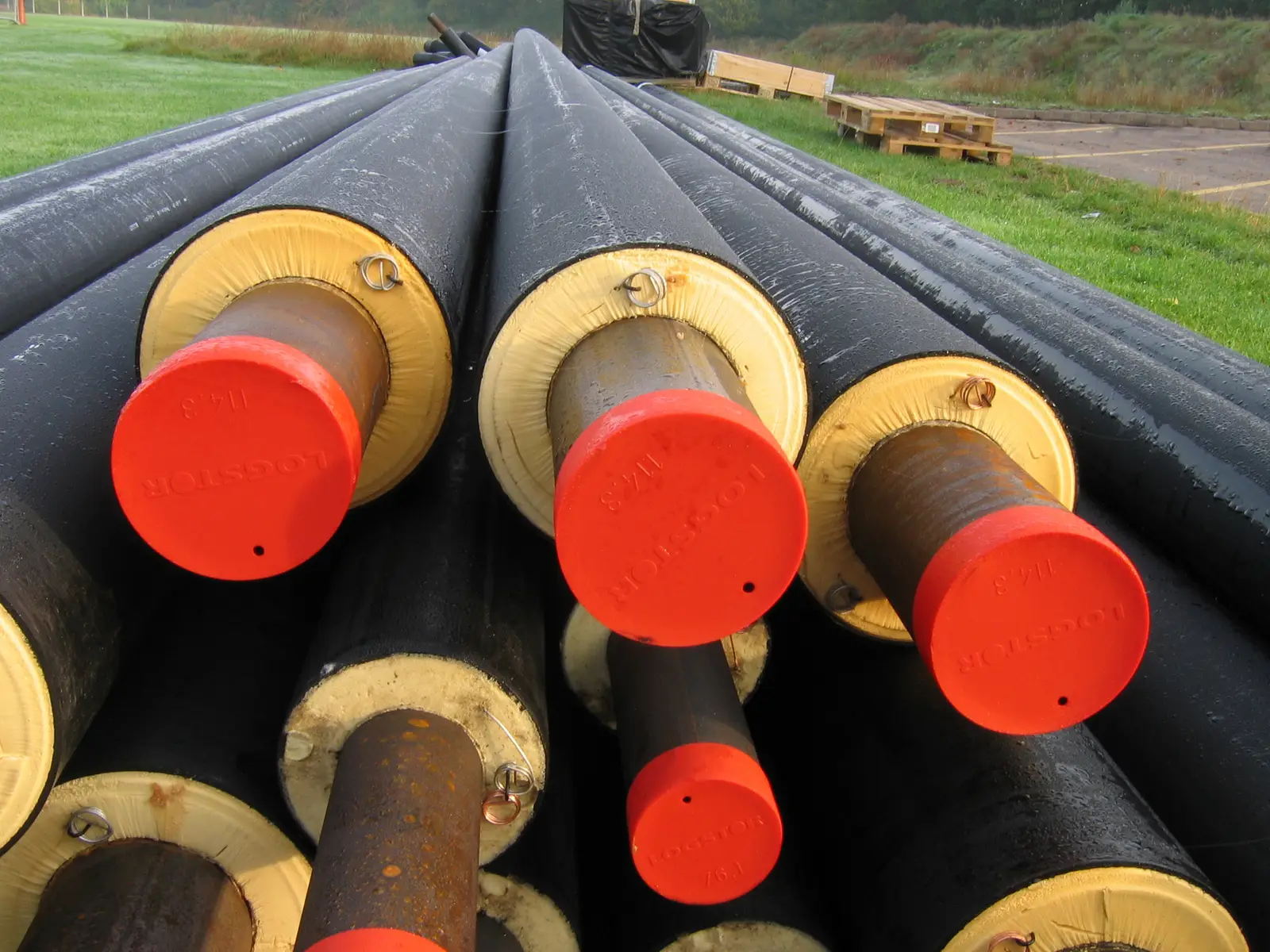
Photo: Mike1024 · public domain · via Wikimedia Commons
Pre-insulated Bonded Pipe (KMR)
The pre-insulated bonded pipe (Kunststoffverbundmantelrohr, KMR) is the standard system in district heating pipeline construction. It consists of a steel carrier pipe, PUR foam insulation, and an outer casing made of HDPE (high-density polyethylene). It is standardized according to SN EN 253.
KMR pipes are rated for operating temperatures up to 160 degC and operating pressures up to PN 25. PN 25 is the system limit of the pipe itself; distribution networks built from KMR are usually designed to PN 16, because the valves, heat meters and transfer stations installed in them rarely carry higher pressure ratings and it is the weakest component on the path that governs the permissible operating pressure. Nominal diameters range from DN 20 to DN 1200. They are delivered as straight lengths of 6, 12, or 16 m. Connection is made by welding the steel pipes; the joints are then post-insulated with PUR joint foam and shrink sleeves.
One characteristic matters above all: KMR pipes are not self-compensating. Thermal expansion has to be taken up by measures such as expansion pads, L- or Z-bends, or pre-stressing through cold bending. The thermal expansion of a steel pipe is:
where K for steel. For a 100 m long pipe with a temperature difference of 100 K, this results in an expansion of approximately 120 mm.
The expected service life is at least 30 years. KMR systems are available with integrated leak detection (copper wire in the insulation), enabling early identification of damage.
Corrugated Metal Pipe (MMR)
The corrugated metal pipe (Metallmediumrohr, MMR) uses a flexible, corrugated copper or steel pipe as the carrier pipe, surrounded by PUR insulation and a PE casing. The operating limits match those of KMR at up to 160 degC and PN 25, and so does the usual network design of PN 16.
Its flexibility is the decisive advantage. MMR pipes are delivered as coils, typically up to DN 50 in lengths of up to 1000 m, which removes many joints and eases installation in curved routes or confined spaces. The corrugated carrier pipe is self-compensating: the corrugations absorb the thermal expansion, so elaborate expansion measures are unnecessary.
MMR pipes are particularly suitable for service connections and smaller distribution networks (network topology) where frequent changes of direction occur and short construction times are required.
Plastic Medium Pipe (PMR)
In the plastic medium pipe (Kunststoffmediumrohr, PMR), the carrier pipe is made of cross-linked polyethylene (PEX) or polybutylene (PB). The PUR insulation and PE casing follow the familiar design.
In the standard variant, PMR pipes are rated for a maximum of 95 degC and PN 6. Reinforced versions achieve 115 degC at PN 10 to PN 16. These figures are system limits; in practice, local heating networks built from PMR are designed to PN 6 to PN 10, so the pressure rating becomes the limiting quantity far earlier here than with KMR. Nominal diameters extend to DN 150; delivery is predominantly as coils.
Connection is made via press fittings, which significantly reduces installation effort compared to welding and requires no specialized welding qualification. PMR pipes are self-compensating and less expensive to purchase than KMR. They are preferably used in local heating networks with moderate temperatures.
PE Pipe
Polyethylene pipes (PE 100, PE-RC) are used without thermal insulation. They are rated for medium temperatures up to about 50 degC and pressure classes PN 10, PN 16 or PN 25.
Dispensing with insulation makes PE pipes a good fit for low-temperature and anergy networks, where the temperature difference to the surrounding soil is small and heat losses barely matter. The material is chemically resistant and flexible, it stands up well to handling, and it lends itself to trenchless installation such as ploughing or horizontal directional drilling. Connection is by electrofusion or butt welding.
PE pipes are an economically attractive solution for cold networks with long pipe runs, for example for connecting groundwater wells or borehole heat exchanger fields. Low pipe costs are one of the key advantages of cold district heating networks.
Ductile Cast Iron Pipes
Ductile cast iron pipes are made of spheroidal graphite cast iron and are likewise used without thermal insulation. They stand out for very high pressure resistance (25 to 100 bar) and mechanical toughness. Nominal diameters run from DN 80 to DN 700, and connection is by push-fit joints.
A particular advantage is the long service life of up to 140 years, as demonstrated by experience from the drinking water supply sector. Ductile cast iron pipes are suitable for trenchless installation by horizontal directional drilling and are resistant to settlement and ground movement.
Their use in thermal networks is limited to low-temperature applications. They are an option where special requirements for mechanical load-bearing capacity exist, such as crossings beneath traffic routes or in difficult ground conditions.
Glass Fibre Reinforced Plastic Pipe (GRP)
GRP pipes consist of an epoxy resin-based carrier pipe fitted with PUR insulation and a PE casing. They are rated for temperatures up to 160 degC and pressures up to PN 16.
The key advantage over steel pipes is corrosion resistance. GRP pipes are therefore particularly suitable for networks with corrosive media, such as geothermal plants with high salt content in the thermal water. Connection is made via adhesive joints or mechanical couplings.
Steel Casing Pipe (SMR)
The steel casing pipe (Stahlmantelrohr, SMR) uses a steel casing instead of a PE casing. The annular space is fitted with vacuum insulation, which enables particularly low heat losses. SMR systems are rated for temperatures up to 400 degC and pressures up to PN 64.
Due to the high costs and the elaborate installation procedure, SMR pipes are primarily used in large district heating transmission lines and industrial steam networks. The vacuum insulation requires regular monitoring of the vacuum.
Comparison Table
The system limit column gives the highest nominal pressure rating the pipe system itself permits. The usual network design column gives the rating that networks of this type are actually designed to in practice — regularly below the system limit, because the permissible operating pressure is governed not by the pipe but by the weakest component on the path. Both figures are gauge pressures against the atmosphere: PN 16 means 16 bar gauge and therefore roughly 17 bar absolute. Checking absolute pressures from a hydraulic calculation against the nominal pressure rating without converting stays about 1 bar on the safe side; the background is covered in Meeting Operating Pressure Limits in Heat Networks.
| Pipe System | Max. Temperature | System limit | Usual network design | Nominal Diameters | Remarks |
|---|---|---|---|---|---|
| KMR | 160 degC | PN 25 | PN 16 | DN 20 — 1200 | Standard system, welded joints, not self-compensating |
| MMR | 160 degC | PN 25 | PN 16 | up to DN 50 | Coil supply, self-compensating, ideal for service connections |
| PMR | 95 degC (115 degC) | PN 6 (PN 10 — 16) | PN 6 — PN 10 | up to DN 150 | Press fittings, cost-effective, for local heating |
| PE Pipe | 50 degC | PN 10 — 25 | project-specific | wide range | Without insulation, for anergy networks, trenchless installation |
| Ductile Cast Iron | low | 25 — 100 bar | project-specific | DN 80 — 700 | Without insulation, push-fit joints, service life up to 140 years |
| GRP | 160 degC | PN 16 | project-specific | project-specific | Corrosion-resistant, for geothermal applications |
| SMR | 400 degC | PN 64 | project-specific | project-specific | Vacuum insulation, very low losses, expensive |
Pipe database in VICUS Districts:
VICUS Districts contains an extensive pipe database with product data from all common manufacturers. The thermal and hydraulic properties are stored for every pipe system: thermal conductivity of the pipe wall, roughness of the inner surface, wall thickness and insulation properties. KMR, PMR, steel pipes and plastic pipes can therefore be compared directly and their effects on pressure loss and heat loss assessed in the simulation.
Selection Criteria
The right pipe system depends on several project-specific conditions. The maximum operating temperature is the first filter: high-temperature networks above 100 degC require KMR, MMR, GRP or SMR, whereas low-temperature and anergy networks also admit PMR, PE or ductile cast iron. Operating pressure becomes decisive for long transmission lines and large geodetic elevation differences (see the following section). Leak detection is not offered by every system, and for large networks it is an essential criterion. Where customer density is high and service connections are numerous, flexible systems such as MMR and PMR ease installation. Large nominal diameters above DN 200 narrow the choice to KMR and SMR, since flexible systems reach only limited diameters. If the network is to grow in phases, a system that makes branches and extensions simple pays off. And on confined routes in city centres or crossing areas, flexible systems or trenchless methods are often the only economical option; see civil works.
Choosing the pressure rating over large elevation differences
The geodetic component feeds straight into the choice of pressure rating: 10 m of elevation difference correspond to roughly 1 bar. At the low point, the highest operating pressure decides the nominal pressure rating required; at the high point, the lowest decides whether the minimum pressure above the vapour pressure is still maintained — how much of the pressure window topography consumes is worked through in Meeting Operating Pressure Limits in Heat Networks. In steep terrain the choice therefore often falls on a higher-rated system, or on a split into several pressure zones, even where temperature and nominal diameter would allow a cheaper system. Which elevation data are sound enough for this is covered in terrain elevation and topography in network planning; the limits to be met are set out in Meeting Operating Pressure Limits in Heat Networks.
For a more detailed comparison of the systems, see Table 4.1 in the Planungshandbuch Thermische Netze 2.0 (Planning Handbook for Thermal Networks 2.0).
Selecting the right combination
No pipe system is optimal for every case. The right choice falls out of the operating parameters, the installation conditions and the economics taken together. Within a single network, several systems are often used side by side: KMR in the main network, MMR or PMR for service connections, PE pipes in cold sections. Sound planning and hydraulic analysis with software such as VICUS Districts help to find the right combination for each project.
Further reading: Pipe Dimensioning explains how to determine the appropriate nominal diameter from the selected pipe system family, Heat Loss Calculation shows the influence of insulation quality of different systems on network losses, and Dimensioning of 5GDHC Networks covers the special requirements for pipe systems in low-temperature and anergy networks.
References and Standards
- AGFW FW 401 — Installation and Statics of Pre-insulated Bonded Pipes in District Heating Networks
- DIN EN 253 — District Heating Pipes — Factory-insulated Bonded Pipe Systems — Pipes with PUR Insulation
- DIN EN 15632 — District Heating Pipes — Flexible Pipe Systems
Frequently Asked Questions
What is the standard pipe system for district heating?
When are flexible pipe systems like PMR or MMR suitable?
Which pipes are used for low-temperature and anergy networks?
Related Articles
Thermal network topology: pipe hierarchy, radial, ring, and meshed networks compared. System variants and selection criteria for planning.
Open-trench and trenchless installation of district heating pipes: route planning, trench profiles, bedding and the cost share of civil works in network projects.
Thermal expansion and stress in district heating pipes: calculation formulas, cold installation, pre-stressing and expansion compensation.
Disclaimer: The content of this page is for general information purposes only and does not constitute legal, planning or engineering advice. All information is provided without guarantee. Despite careful research, VICUS Software GmbH assumes no liability for the accuracy, completeness or timeliness of the information provided. Third-party product names and trademarks are mentioned for informational purposes only and are the property of their respective owners.