Building Simulation Software Comparison
EnergyPlus, IDA ICE, TRNSYS and VICUS Buildings: overview and comparison of the leading simulation programs
Table of Contents
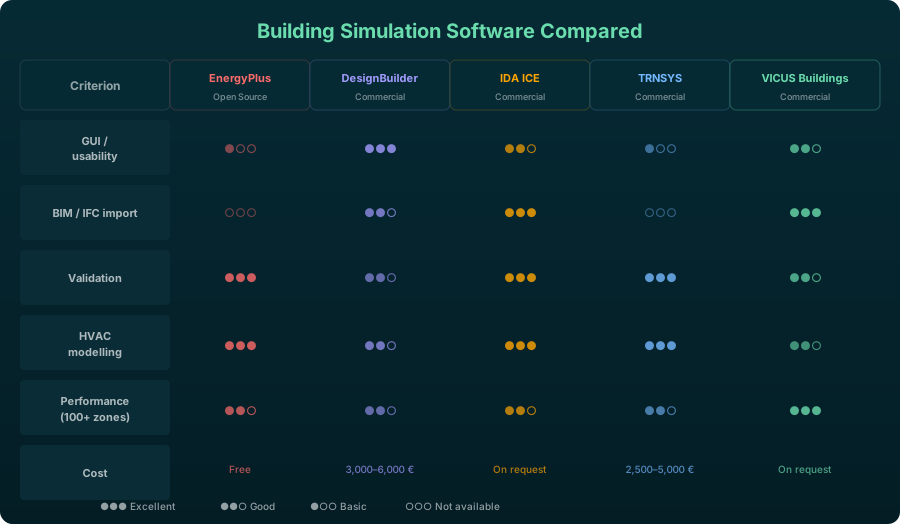
EnergyPlus, IDA ICE, TRNSYS and VICUS Buildings are the leading programs for dynamic building simulation. They differ in user interface, IFC import capabilities, validation scope, licence cost and target audience. EnergyPlus (free, text-based) is the physical reference, IDA ICE offers the broadest validation base with a graphical interface, TRNSYS leads in system simulation, and VICUS Buildings combines native IFC import with high performance for large models (> 100 zones). The choice significantly influences workflow effort and result quality across all planning phases.
The main programs at a glance
EnergyPlus
EnergyPlus is an open-source simulation engine developed by the U.S. Department of Energy (DOE). It forms the computational core for numerous applications worldwide and is considered a reference in building simulation. EnergyPlus is text-based: the building is described in a structured input file (IDF), the simulation is run via the command line and the results are output as CSV files.
Strengths: Extensive physical models for heat transfer, HVAC systems, daylighting and renewable energies. Large user community. Validated in accordance with ASHRAE Standard 140 and BESTEST. Free of charge.
Weaknesses: No native graphical user interface. The text-based input has a steep learning curve. Errors in the IDF file are hard to diagnose. No integrated BIM import.
DesignBuilder
DesignBuilder is a commercial graphical interface for EnergyPlus. It offers a 3D model editor in which the building can be drawn or imported as IFC/gbXML. The EnergyPlus input file is generated in the background and the simulation is started directly from the interface.
Strengths: Accessible user interface for EnergyPlus. Integrated templates for constructions, usage profiles and HVAC systems. Good visualisation of results. gbXML and IFC import.
Weaknesses: Commercial licence (approximately EUR 3,000–6,000 depending on module). Not all EnergyPlus features are accessible via the interface. Complex HVAC models still require text-based input.
IDA ICE
IDA Indoor Climate and Energy is a Swedish simulation software from EQUA Simulation AB. It uses an equation-based approach: all physical relationships are formulated as a system of equations and solved simultaneously. This enables flexible modelling in which users can intervene at component level.
Strengths: Intuitive graphical interface with 3D modelling. Extensively validated in accordance with ASHRAE 140, EN 15255, EN 15265, EN 13791, IEA SHC Task 34 and CIBSE TM 33. Good representation of HVAC systems. IFC import. Widespread in Scandinavia and increasingly in Central Europe. Integrated comfort evaluation in accordance with ISO 7730. Accredited for British Building Regulations.
Weaknesses: Commercial licence (costs in the medium to high range). The equation-based architecture can be computationally intensive for very large models. Some specialised models (e.g. ground heat exchangers) are less detailed than in specialised tools.
TRNSYS
TRNSYS (Transient System Simulation Tool) was developed at the University of Wisconsin-Madison and is maintained by an international consortium. It is a modular simulation program in which components (Types) are graphically interconnected. The focus lies on system simulation: TRNSYS can model buildings, solar systems, heat pumps, storage and controls in a single model.
Strengths: Extremely flexible due to its modular architecture. Large library of components. Particularly strong for system simulations (solar thermal, heat pumps, seasonal storage). Widely used in research. Validated in accordance with ASHRAE 140.
Weaknesses: The graphical interface (Simulation Studio) is functional but not modern. Building modelling is done through a separate interface (TRNBuild), which is considered to be not very intuitive. No native IFC import. Commercial licence (approximately EUR 2,500–5,000).
VICUS Buildings
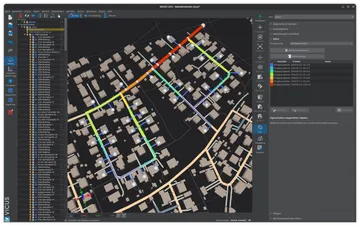
VICUS Buildings is a commercial simulation software developed at the Institute of Building Climatology at TU Dresden. It uses the NANDRAD simulation engine (a C++-based solver for transient indoor air models) and offers a graphical interface for building modelling. The focus is on efficient modelling of even large buildings with native IFC import.
Strengths: Validated in accordance with SimQuality and ASHRAE Standard 140. Native IFC import with geometric pre-processing. High-performance simulation engine that efficiently handles large models (> 100 zones). Extensive HVAC modelling (in beta) with FMU coupling for external system models. Verification of summer thermal protection in accordance with DIN 4108-2. Modern user interface. Active development. Free trial version available.
Weaknesses: Younger project with a smaller user community than EnergyPlus or TRNSYS. Documentation and tutorials are still being expanded.
FMU export from VICUS Buildings:
The software can be exported as an FMU (Functional Mock-up Unit) and thus coupled with other simulation tools such as TRNSYS or Modelica environments. The FMI interface supports both co-simulation and model exchange — ideal for comparative studies, hybrid simulation approaches or integration into higher-level energy system models.
Comparison table
| Criterion | EnergyPlus | DesignBuilder | IDA ICE | TRNSYS | VICUS Buildings |
|---|---|---|---|---|---|
| Licence | Open source | Commercial | Commercial | Commercial | Commercial |
| GUI | No (external) | Yes | Yes | Yes (functional) | Yes (modern) |
| IFC import | No (via third parties) | Yes (gbXML/IFC) | Yes | No | Yes (native) |
| 3D modelling | No | Yes | Yes | No (TRNBuild) | Yes (integrated) |
| Validation | ASHRAE 140, BESTEST | Via EnergyPlus | ASHRAE 140, EN 15255/15265, EN 13791, TM 33, IEA SHC Task 34 | ASHRAE 140 | SimQuality, ASHRAE 140 |
| DIN 4108-2 verification | No | No | Yes | No | Yes |
| Performance (large models) | Medium | Medium | Medium | Medium | High (> 100 zones) |
| HVAC modelling | Very extensive | Extensive | Extensive | Very extensive | Extensive (beta), FMU coupling |
| System simulation | Limited | Limited | Medium | Very strong | Limited |
| Learning curve | Steep | Moderate | Moderate | Steep | Low |
| Target audience | Research, specialists | Engineers, designers | Engineers, designers | Research, system design | Engineers, designers |
| Typical price | Free | EUR 3,000–6,000 | On request | EUR 2,500–5,000 | On request |
Which tool for which use case?
Energy consultancy and GEG-related questions
For energy consultants who need to demonstrate summer thermal protection in accordance with DIN 4108-2 or carry out comfort analyses, tools with a good graphical interface and IFC import offer the best workflow. DesignBuilder, IDA ICE and VICUS Buildings are all suitable here. How VICUS Buildings is used in energy consulting is described on the page software for energy consultants.
Research and development
Research projects that require specialised physical models, parameter studies or coupling with external tools benefit from the flexibility of EnergyPlus and TRNSYS. Both provide access to model parameters that remain hidden in graphical interfaces.
System design and plant simulation
When not only the building but also the HVAC technology is to be modelled in detail — for example, the combination of solar thermal, heat pump and stratified storage — TRNSYS is particularly well-suited due to its modular architecture. EnergyPlus also offers extensive HVAC models, but requires text-based input of the system components.
Large buildings and districts
For projects with many zones (office buildings, schools, hospitals), modelling efficiency is crucial. A native IFC import that quickly imports the geometry saves considerable time. VICUS Buildings and IDA ICE offer advantages here.
Education and getting started
For entry into building simulation, tools with low barriers to entry are well-suited. EnergyPlus with a graphical interface (e.g. OpenStudio or DesignBuilder in the trial version) is available free of charge. VICUS Buildings offers a free trial version with the full range of functions.
Validation and trustworthiness
The trustworthiness of a simulation software depends significantly on its validation. The most important validation standards are:
- ASHRAE Standard 140 — the most widely used standard internationally, with test cases for the building envelope, HVAC and ground coupling
- EN 15255 / EN 15265 — European standards for cooling load and energy demand calculation
- EN 13791 — validation of summer indoor temperature calculations
- IEA SHC Task 34 — research project with multi-zone and empirical test cases
- CIBSE TM 33 — accreditation for British Building Regulations
IDA ICE stands out due to its broadest validation base: it has completed and published all of the standards mentioned. EnergyPlus and TRNSYS cover ASHRAE 140 and IEA SHC Task 34. VICUS Buildings is validated through SimQuality and ASHRAE 140; the EN validations are in preparation.
A detailed description of all standards can be found in the article Validation standards for building simulation software.
Validation does not guarantee that any arbitrary model will deliver correct results. It ensures that the physical algorithms are correctly implemented. The quality of the results still depends on the quality of the input data, including realistic efficiency ratings and usage profiles, and on the competence of the user.
How to choose
The building simulation software comparison shows that there is no universally best tool. The choice depends on the question being addressed, the budget, the required modelling depth and the user’s prior knowledge. EnergyPlus remains the reference for physical accuracy and model diversity. IDA ICE and DesignBuilder offer the best compromise between performance and ease of use. TRNSYS is unsurpassed for system simulations. As building simulation software, VICUS Buildings offers an efficient workflow with native IFC import and a free trial version. What matters less is the tool itself than the understanding of the physical relationships and the careful preparation of the input data: every simulation program delivers only as good results as the assumptions on which it is based.
Further reading: Dynamic Building Simulation — fundamentals of the simulation method all these tools implement, Validation Standards for Building Simulation Software — testing methods that verify software accuracy, IFC Import for Building Simulation — how BIM models are imported into simulation tools.
References and Standards
- Crawley, D. B. et al. (2001): EnergyPlus: creating a new-generation building energy simulation program. Energy and Buildings, 33(4), pp. 319–331.
- ASHRAE Standard 140 — Standard Method of Test for the Evaluation of Building Energy Analysis Computer Programs
- Sahlin, P. et al. (2004): Whole-building simulation with symbolic DAE equations and general purpose solvers. Building and Environment, 39(8), pp. 949–958.
Frequently Asked Questions
What is the best building simulation software?
How much does building simulation software cost?
Which simulation software supports IFC import from BIM models?
Related Articles
Building simulation explained: dynamic vs. steady-state calculation, fields of application, result quantities and software for thermal building simulation.
Verification per DIN 4108-2: solar heat gain coefficient vs. dynamic building simulation — methods, overheating degree hours and the 1200 Kh limit.
From BIM model to simulation: how IFC files improve the workflow between CAD and building simulation
Comparison of steady-state energy demand calculation and dynamic simulation: methods, accuracy and fields of application
Disclaimer: The content of this page is for general information purposes only and does not constitute legal, planning or engineering advice. All information is provided without guarantee. Despite careful research, VICUS Software GmbH assumes no liability for the accuracy, completeness or timeliness of the information provided. Third-party product names and trademarks are mentioned for informational purposes only and are the property of their respective owners.