Cold District Heating: Costs and Economics
What does cold district heating cost? 5GDHC network cost per metre, boreholes per drilled metre, collectors, decentralized heat pumps and operating costs.
Table of Contents
The cost of cold district heating falls into four blocks: the uninsulated pipe network, the development of heat sources (borehole fields, collectors, waste heat), the decentralized heat pumps and transfer equipment in the buildings, and operation, which is dominated by electricity for heat pumps and circulation. Reference values for the network range from about 80–200 EUR/m (pipe and installation in a new development) to 500–1,500 EUR/m (route through paved areas); borehole heat exchangers cost around 50–120 EUR per drilled metre. Options can only be compared reliably via the levelized cost of heat of the overall system.
All figures in this article are ranges for preliminary cost estimates, for example in a feasibility study. They do not replace a quantity-based cost calculation or contractor quotes. Where a figure can only be supported as a rough order of magnitude, the text says so.
Cost structure at a glance
Compared with a conventional heat network, cold district heating shifts part of the investment from the network into the buildings: the usable temperature level is generated locally, and the network only carries ambient heat. The table below summarizes the cost blocks.
| Cost block | Unit | Reference value | Main cost drivers |
|---|---|---|---|
| Pipe network (PE, uninsulated), new development | EUR/m of route | approx. 80–200 EUR/m | Pipe size, joint installation with other utilities |
| Pipe network in paved areas / existing streets | EUR/m of route | up to approx. 500–1,500 EUR/m | Surface reinstatement, existing utilities, traffic management |
| Borehole heat exchangers | EUR/drilled metre | approx. 50–120 EUR/m | Geology, drilling method, borehole depth |
| Horizontal ground collectors | EUR/m² collector area | rough order of magnitude 15–40 EUR/m² | Area, installation method, earthworks |
| Decentralized brine/water heat pump | EUR/kW heating capacity | approx. 600–2,000 EUR/kW (strongly size-dependent) | Capacity class, domestic hot water, installation situation |
| House connection and transfer unit | EUR/connection | project-specific | Connection length, metering, shut-off and check valves |
The network values are consistent with the figures in the article on the pros and cons of cold district heating (80–200 EUR/m for plastic pipes versus 200–500 EUR/m for pre-insulated steel pipes) and in the fundamentals article (500–1,500 EUR/m of route). The difference lies in the system boundary: the low values describe pipe and installation under favourable conditions, the high values the complete route including civil works and surfaces in built-up areas.
Network investment costs
Pipe material and pipe size
Cold district heating networks use uninsulated pipes made of PE100-RC or PE-Xa (see pipe systems comparison). Compared with pre-insulated bonded pipes, there is no insulation, no casing, no leak detection and no welding of steel pipes. At the same time, pipe diameters are larger: because of the small temperature difference of 3–6 K, the network has to carry 7 to 13 times the volume flow for the same capacity. Dimensioning 5GDHC networks at 50–100 Pa/m therefore leads to larger cross-sections than in a warm network with the same connected load, which partly offsets the material cost advantage.
Civil works as the dominant cost item
In heat networks of every generation, civil works account for the larger share of route costs. The decisive factors are:
- Surface: unpaved areas and access roads at shell stage are considerably cheaper than asphalt or paving that must be reinstated.
- Joint installation: in new developments the network can be laid in a shared trench with the other utilities.
- Installation method: PE pipes allow trenchless methods such as ploughing or horizontal directional drilling (see pipe installation and civil works).
- Burial depth: cold networks are usually laid at about 1–2 m, which may require shoring and dewatering depending on the soil class.
For project-specific cost assumptions by pipe size and surface type, the German KWW technology catalogue for heat planning provides averaged values from reference projects. These were collected for conventional networks and can only be transferred to uninsulated PE networks with adjustment.
Heat source investment costs
Borehole fields
Typical market prices for borehole drilling in Germany are around 50–120 EUR per drilled metre, including the probe and grouting; prices in hard rock are at the upper end. A borehole field also requires:
- horizontal connecting pipes and manifold chambers,
- a thermal response test to determine the effective thermal conductivity,
- a water-law permit and, where applicable, notification under mining law,
- disposal of drilling mud and site setup.
Converting drilling costs to extraction capacity shows how much geology matters. With typical specific extraction rates of 30–60 W/m (design according to VDI 4640 Part 2), the calculation gives:
A spread of almost a factor of five explains why reliable subsurface data and a long-term simulation of the borehole field decide the cost. How the soil takes up and releases heat is covered in the article on soil and ground temperature.
Horizontal ground collectors
For horizontal collectors at individual buildings, costs of roughly 15–40 EUR/m² of collector area are quoted. For large collector fields of several thousand square metres serving cold networks, hardly any cost data have been published, so this figure should only be read as a rough order of magnitude. Large collectors benefit from mechanized installation but add costs for earthworks, header pipes and securing the land. With typical annual yields of 60–100 kWh/(m²·a) for single- and double-layer collectors, the available land largely determines whether collectors are more economical than boreholes.
The network as a heat source, and waste heat
One cost advantage that is easily overlooked in estimates: the uninsulated network itself takes up heat from the ground, typically 50–120 kWh/(m·a) per metre of route. In extensive networks this reduces the required size of the central source. Waste heat sources (commercial processes, data centres, wastewater) require heat exchangers and connecting pipes whose costs depend strongly on the site.
Building-side costs: decentralized heat pumps and transfer units
Every connected building receives a brine/water heat pump. Specific costs fall significantly with capacity. Data from the Danish Energy Agency (cited in the JRC status report 2025) give around 1,800–2,000 EUR/kW for ground-source heat pumps including installation at 5–7 kW (single-family house) and around 600–700 EUR/kW at 160–320 kW (apartment building), both in 2020 prices for the Danish market. For other markets these values are indicative only. When transferring them to cold district heating, check how far the source installation is included: in a cold network the building’s own borehole is not needed, because the network provides the source.
The transfer unit comprises shut-off valves, a heat meter and, depending on the hydraulic concept, check valves (passive network) or motorized valves and flow limiters (active network); where cooling is used, a plate heat exchanger for free cooling is added. Reliable lump-sum values per connection cannot be given; they have to be determined for each project.
Operating costs
Heat pump electricity
The largest ongoing cost item is heat pump electricity. It follows from the heat demand and the seasonal performance factor (SPF):
Example: a building with 10,000 kWh/a of heat demand and an SPF of 4.5 needs about 2,200 kWh/a of electricity. At an assumed heat pump tariff of 0.28 EUR/kWh (assumption, depending on tariff and year) this amounts to about 620 EUR/a. Because the source temperature in a cold network is higher than winter outdoor air, seasonal performance factors exceed those of air-to-water heat pumps; monitoring data from built networks show 4.5–5.0 for heating.
Pump electricity
Because of the high volume flows, pump electricity is a relevant cost factor. In well-designed networks it amounts to 5–8 % of heat pump electricity; in poorly dimensioned networks up to 20 % has been measured. The system SPF then drops from about 4.5 to below 3.5, and electricity costs rise accordingly. Hydraulic design therefore has a direct impact on cost.
Cooling, maintenance and metering
Passive cooling via a heat exchanger only requires circulation electricity; measured performance factors of 20–40 show that the cost per kilowatt-hour of cooling is low. In addition, there is maintenance of the decentralized heat pumps, upkeep of the network and sources, and metering and billing. VDI 2067 Part 1 provides factors for maintenance and operating effort.
Comparison with a conventional heat network
| Criterion | Warm network (3rd/4th generation) | Cold district heating (5GDHC) |
|---|---|---|
| Pipe system | pre-insulated steel or bonded plastic pipes | uninsulated PE pipes, larger diameters |
| Heat generation | central (boiler, large heat pump, solar thermal) | decentralized heat pump in every building |
| Heat source development | at the central plant | borehole field, collector, waste heat, the network itself |
| Distribution losses | 12–20 % in new developments, 20–40 % at low density | heat gains from the ground |
| Building connection | heat exchanger substation | heat pump with transfer unit |
| Cooling | only with a separate cooling network | possible in the same network |
| Largest operating cost item | fuel or electricity for central generation | electricity for decentralized heat pumps |
Comparing network costs alone is misleading because the system boundaries differ. In a warm network, generation sits in the central plant; in cold district heating it sits in the buildings. The two concepts only become comparable when the levelized cost of heat of the whole system is compared, including building-side heat pumps, electricity purchase and the benefit of cooling. At low heat line density the comparison shifts in favour of cold district heating, because distribution losses of warm networks rise sharply there.
Funding in Germany
The network and heat sources of cold district heating can be funded through the Federal Funding for Efficient Heat Networks (BEW): feasibility studies with up to 50 %, investment in new construction and transformation with up to 40 % of eligible costs. One restriction matters for the economics: the operating cost subsidy under Module 4 only applies to central heat pumps feeding into the network. Decentralized heat pumps in buildings do not receive it. Other programmes may apply to the building-side heat pumps depending on the set-up; the boundary has to be checked case by case. The BEW funding amount can be estimated with the BEW funding calculator.
Calculating the levelized cost of heat
For an assessment with the annuity method of VDI 2067, all payments over the assessment period are converted into annual annuities and related to the useful heat delivered:
with the annuities of capital-related (), demand-related (), operation-related () and miscellaneous costs (). For cold district heating, also includes the decentralized heat pumps, whose service life is shorter than that of the network and boreholes, and includes electricity for heat pumps and circulation. A first estimate can be made with the heat cost calculator; the method is explained in the article on economic analysis according to VDI 2067.
Quantities for the cost calculation from VICUS Districts
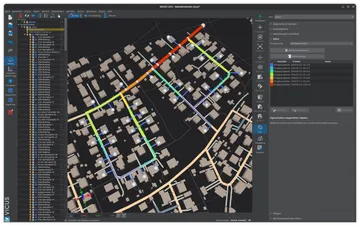
The quantities that drive the cost of cold district heating come from the design: pipe sizes from pipe dimensioning, pump electricity from the hydraulic annual simulation, the electricity demand of the decentralized heat pumps from the COP calculated in every time step from network and building temperatures, and the heat gains of the pipe network and ground collectors from the coupled ground model. This allows options — for example a passive versus an active network, or a borehole field versus a collector — to be compared economically on a consistent technical basis.
Putting the costs into perspective
Cold district heating is cheaper than a warm network on the network side, but shifts investment into the buildings and into source development. The largest uncertainties lie in civil works, in the geology of borehole fields and in pump electricity. Backing these three points early with quantities, subsurface data and an annual simulation yields a cost estimate that also holds up in a funding application.
Further reading: Low-Temperature District Heating: Fundamentals — operating principle and components, Dimensioning 5GDHC Networks — how pipe sizes and pump electricity are determined, BEW Funding — the modules of the German federal funding programme in detail.
References and Standards
- KWW — Kompetenzzentrum Kommunale Wärmewende (2024, continuously updated): KWW-Technikkatalog Wärmeplanung. dena, Halle (Saale).
- Volt, J.; Toleikyte, A.; Roca Reina, J. C. et al. (2025): Clean Energy Technology Observatory: Heat Pumps in the European Union — 2025 Status Report. JRC144191, Publications Office of the European Union (Table 3 based on Danish Energy Agency 2024).
- VDI 2067 Part 1 — Economic efficiency of building installations — Fundamentals and economic calculation
- VDI 4640 Part 2 — Thermal use of the underground — Ground source heat pump systems
- BMWK (2022): Richtlinie für die Bundesförderung für effiziente Wärmenetze (BEW). Bundesanzeiger; guidance documents at BAFA.
- Gjoka, K.; Rismanchi, B.; Crawford, R. H. (2023): Fifth-generation district heating and cooling systems: A review of recent advancements and implementation barriers. Renewable and Sustainable Energy Reviews, 171, 112997.
- Wirtz, M.; Kivilip, L.; Remmen, P.; Müller, D. (2020): 5th Generation District Heating: A novel design approach based on mathematical optimization. Applied Energy, 260, 114158.
- Buffa, S. et al. (2019): 5th generation district heating and cooling systems: A review of existing cases in Europe. Renewable and Sustainable Energy Reviews, 104, pp. 504–522.
- Hirsch, H. (2024): Modelling of Fifth Generation District Heating and Cooling Networks Coupled to Ground Heat Exchangers. PhD thesis, TU Dresden.
- Borehole drilling costs: typical market prices in Germany, 2025/2026 (drilling contractors and industry portals); to be replaced by quotes for each project.
Frequently Asked Questions
How much does a cold district heating network cost per metre?
What do borehole heat exchangers for a 5GDHC network cost?
Is cold district heating more expensive than a conventional heat network?
Is cold district heating eligible for BEW funding in Germany?
Related Articles
Cold district heating (5GDHC) explained: operating principle, heat sources, decentralized heat pumps and network hydraulics of 5th-generation networks.
5GDHC simulation and dimensioning of cold district heating networks: passive vs. active networks, pressure-loss criteria and ground coupling.
How do prosumer concepts work in district heating networks? Heat feed-in, bidirectional networks and operating models
Advantages and disadvantages of cold district heating (5GDHC): under 3 % heat losses and free cooling versus decentralized heat pumps and more complex planning.
Disclaimer: The content of this page is for general information purposes only and does not constitute legal, planning or engineering advice. All information is provided without guarantee. Despite careful research, VICUS Software GmbH assumes no liability for the accuracy, completeness or timeliness of the information provided. Third-party product names and trademarks are mentioned for informational purposes only and are the property of their respective owners.