Network Temperatures in District Heating Networks
Supply and return temperatures in district heating networks: calculation, influencing factors and optimisation
Table of Contents
Supply and return temperatures determine heat losses, pipe diameters, pump energy and the generation technologies available for a district heating network. Conventional networks (3rd generation) operate at 80—110 °C, low-temperature networks (4th generation) at 50—70 °C and cold district heating (5th generation) at only 5—25 °C — each 20 K reduction in mean network temperature cuts heat losses by 25—30 %.
Basic Terms: Supply, Return and Temperature Spread
The supply temperature is the temperature at which the heat transfer medium leaves the heat source and flows to the consumers. The return temperature is the temperature at which the cooled medium flows back from the consumers. The difference between the two temperatures is the temperature spread:
The temperature spread is one of the most important operating parameters. It directly determines the required mass flow for a given heat output:
A high temperature spread means lower mass flows, smaller pipes and less pump energy. At the same time, a high supply temperature requires more generator output and causes higher heat losses.
Temperature Levels of the Network Generations
The development of district heating can be divided into generations that differ essentially in their operating temperatures:
| Generation | Supply | Return | Spread | Era |
|---|---|---|---|---|
| 1st generation (steam) | 200+ °C | — | — | until 1930s |
| 2nd generation | 120 — 150 °C | 70 — 80 °C | 50 — 70 K | 1930 — 1970 |
| 3rd generation | 80 — 110 °C | 40 — 60 °C | 40 — 60 K | 1970 — 2020 |
| 4th generation (LowEx) | 50 — 70 °C | 25 — 40 °C | 20 — 35 K | from approx. 2015 |
| 5th generation (cold district heating) | 5 — 25 °C | 0 — 20 °C | 3 — 6 K | from approx. 2015 |
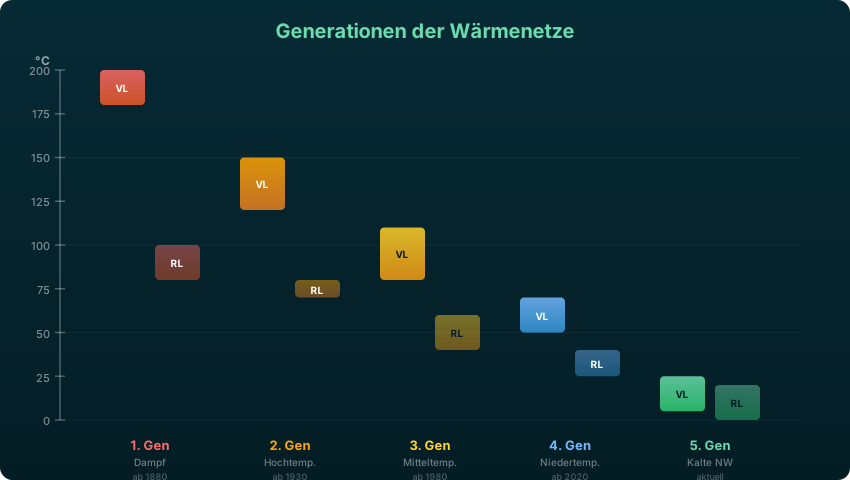
The trend clearly points towards lower temperatures. It is driven by several factors: better building insulation, the use of surface heating systems and the desire to efficiently integrate renewable heat sources (solar thermal, heat pumps, waste heat).
Influence of Network Temperatures on Heat Losses
The heat losses of a buried pipe are directly proportional to the temperature difference between the medium and the surrounding soil:
Reducing the mean network temperature by 20 K reduces heat losses by approximately 25 to 30 %. For the overall balance, the mean network temperature is the relevant quantity:
A network with 80/40 °C has the same mean temperature (60 °C) as one with 90/30 °C, even though the temperature spreads are very different. The heat losses of both networks would be virtually identical for the same pipe geometry.
Temperature Drop Along the Pipe
The supply temperature decreases on the way from the heat source to the consumer due to heat losses. The temperature drop in a pipe of length can be approximated as:
where is the heat transmission coefficient of the pipe per metre (in W/(mK)), the inlet temperature and the ground temperature. For small mass flows or long pipes, the temperature drop can be considerable. In a typical district heating network of DN 100 with a mass flow of 5 kg/s and a pipe length of 500 m, the temperature drop in the supply line is approximately 1 to 3 K.
Critical Case: Summer Part-Load Operation
In summer, heat demand drops to a minimum, often only domestic hot water preparation has to be covered. The mass flow is reduced accordingly, while the heat losses remain approximately constant. The consequence: the temperature drop in the network rises disproportionately. In unfavourable cases, the supply temperature at the most remote consumer can fall so low that domestic hot water preparation to 60 °C (hygiene requirement according to DVGW worksheet W 551) can no longer be guaranteed.
Countermeasures include a temporary increase of the feed-in temperature, the installation of circulation lines or the use of decentralised domestic hot water units (fresh water stations with reheating).
Mixing Temperatures at Network Nodes
In networks with several feed-ins or meshes, partial flows at different temperatures meet at nodes. The resulting mixing temperature follows from the energy balance:
For approximately equal specific heat capacities this simplifies to:
Mixing at nodes is particularly relevant when decentralised producers with different supply temperatures feed into the network (e.g. solar thermal with variable temperature alongside a biomass boiler with constant temperature).
Seasonal Temperature Control
Many networks are operated with a sliding supply temperature that depends on the outdoor temperature. The highest supply temperature is used in winter (e.g. 90 °C), the lowest in summer (e.g. 70 °C, limited by the requirements of domestic hot water preparation). The heating curve of the network defines this relationship:
with the outdoor temperature , the heating limit temperature and the design outdoor temperature .
Sliding temperature control considerably reduces the average heat losses, since in summer — when heat demand is low anyway — the network temperatures are also lower.
Return Temperature Optimisation
The return temperature is essentially determined by the consumer installations and is therefore more difficult to control than the supply temperature. High return temperatures are a widespread problem in existing networks and have several negative effects:
- Lower temperature spread and therefore higher mass flow
- Higher heat losses in the return line
- Lower efficiency of condensing boilers and heat pumps
- Reduced utilisation of solar thermal and waste heat
Measures to lower the return temperature include optimisation of the transfer stations, hydraulic balancing of building heating systems and contractual incentives (return temperature clauses in heat supply contracts).
Low-Temperature Networks: Opportunities and Challenges
The 4th generation of district heating (4GDH) targets supply temperatures of 50 to 70 °C. This enables the efficient integration of large heat pumps (efficiency ratings and COP), solar thermal energy and industrial waste heat. At the same time, challenges arise:
- Domestic hot water preparation requires at least 60 °C (Legionella prevention). If supply temperatures are close to this limit, decentralised reheating is necessary.
- The lower temperature spread requires larger pipe diameters or the use of booster heat pumps in buildings.
- Existing radiator systems are often designed for higher temperatures and must be adapted when converting the network.
Choosing the temperature level
The choice of network temperatures is a central design decision with far-reaching consequences. Lower temperatures reduce heat losses and enable the use of renewable heat sources, but require larger pipes and place higher demands on building installations. The optimal solution results from considering all interactions together, ideally supported by a thermo-hydraulic simulation such as VICUS Districts, which captures temperatures, mass flows and heat losses in their interplay.
Further reading: Heat Loss Calculation According to DIN EN 13941 — how temperature levels directly impact network losses, Low-Temperature District Heating: Fundamentals — the concept of networks operating near ground temperature, Heating Curves — control strategy linking outdoor temperature to supply temperature, Pipe Dimensioning in District Heating Networks — how temperature spread affects flow velocity and pipe sizing.
References and Standards
- AGFW FW 527 — Network Operating Modes and Temperatures in District Heating Networks
- Lund, H. et al. (2014): 4th Generation District Heating (4GDH). Energy, 68, pp. 1–11.
- Nussbaumer, T.; Thalmann, S. (2016): Planungshandbuch Fernwärme. EnergieSchweiz / Swiss Federal Office of Energy.
Frequently Asked Questions
What supply temperatures are typical in district heating networks?
Why is a low return temperature important in district heating?
What does a weather-compensated supply temperature mean?
Related Articles
District heating pipe sizing from flow velocity (0.5–2.5 m/s) and pressure gradient (100–200 Pa/m): DN reference values per line type, plus an online calculator.
Fundamentals of hydraulic calculation: pipe friction, local resistances and pressure distribution in district heating networks
Calculating heat losses in buried district heating pipes: methods, influencing factors and typical values
What is linear heat density and why is it the central metric for the economic viability of district heating networks?
Disclaimer: The content of this page is for general information purposes only and does not constitute legal, planning or engineering advice. All information is provided without guarantee. Despite careful research, VICUS Software GmbH assumes no liability for the accuracy, completeness or timeliness of the information provided. Third-party product names and trademarks are mentioned for informational purposes only and are the property of their respective owners.