Tariff Design and Heat Supply Contracts
Tariff structure, heat supply contracts, and technical connection requirements: Contractual foundations of thermal networks
Table of Contents
The heat supply contract governs the long-term partnership between heat supplier and consumer over a typical duration of 15 to 25 years. The tariff structure comprises a one-time connection fee, a consumption-independent base rate (CHF/kW), and a consumption-dependent energy rate (cents/kWh) — a structure used by approximately 75% of Swiss district heating networks. Price adjustment clauses link tariff components to energy carrier and consumer price indices, ensuring that heat prices reflect actual cost developments even over decades.
The Heat Supply Contract
The heat supply contract sets out the key agreements between supplier and customer:
- Heat price: tariff structure and price estimate over the contract duration
- Connection conditions: technical and spatial requirements for the building connection
- Connection capacity: maximum heat output provided in kW
- Security of supply: guaranteed availability and redundancy concept
- Contract duration and termination: minimum term, extension clauses, ordinary and extraordinary termination
- Funding opportunities: references to subsidy programs and their impact on the heat price
In practice, the contractual framework consists of four components: the actual heat supply contract, the General Terms and Conditions (GTC), the Technical Connection Requirements (TAV), and the tariff schedule. Together, these documents form the complete legal framework for heat supply.
General Terms and Conditions (GTC)
The GTC form the standardized contractual basis for a large number of consumers. They govern in particular:
- Definitions: uniform terminology for the entire contractual framework
- Construction, operation, maintenance, and ownership: responsibilities for the network, building connection line, and transfer station
- Heat supply and purchase obligation: mutual obligations of supplier and customer
- Liability: liability limitations and duties to mitigate damages
- Right of way, access, and usage rights: rights of the supplier on the customer’s property
- Changes to connection capacity: procedure for requested increases or reductions
- Change of ownership: regulation of contract transfer upon property sale
- Contract modifications: conditions and procedures for adjustments
Technical Connection Requirements (TAV)
The TAV define the minimum technical standard for all building installations in the network. Their purpose is to ensure the quality of the overall system and to prevent gross planning and execution errors on the customer side. The typical structure includes:
- Scope of application: which installations and connection situations the TAV apply to
- Definitions: technical terminology
- Technical fundamentals: heat transfer medium, supply and return temperatures, operating pressures, nominal pressure rating
- Equipment requirements: heat exchangers, combined valve (differential pressure/flow rate controller), and heat meter
- Secondary-side integration: requirements for heating, ventilation, and domestic hot water preparation
- Operational requirements: commissioning, maintenance, fault management
When developing the TAV, realistic requirements should be set. This applies particularly to the maximum return temperature, the approach temperature of the heat exchanger, and the permissible pressure losses. The TAV should not contain product specifications but rather define functional requirements that can be met independently of manufacturer.
Pricing and Tariff Structure
The tariff structure of a district heating network is typically divided into three to four price components:
One-Time Connection Fee
The connection fee is charged as a one-time amount (CHF) upon installation of the building connection. It covers the costs for constructing the building connection line and a proportional share of the transfer station costs. Payment is due upon completion and commissioning of the connection.
Annual Base Rate
The base rate is calculated in CHF per kW of subscribed connection capacity and is consumption-independent. It covers the fixed costs of the network, in particular capital costs (interest and amortization) and maintenance costs. Regardless of how much heat a customer consumes, they contribute their share of the infrastructure through the base rate.
Energy Rate
The energy rate is billed in cents per kWh of delivered heat and is consumption-dependent. It covers the variable costs, primarily fuel costs and auxiliary energy (pump electricity). The more heat a customer consumes, the higher this cost component becomes.
Metering Fee
Optionally, a metering fee may be charged, covering the costs for maintenance and periodic calibration of the heat meter.
Approximately 75% of tariff models in Switzerland use all three main components: connection fee, base rate, and energy rate. This three-part structure has proven to be fair and transparent, as it allocates both fixed and variable costs on a cost-causation basis.
Alternative Tariff Models
One alternative is return-temperature-dependent pricing. Here, not only the consumed energy (in kWh) is measured, but also the flow volume and the average return temperature of the customer are recorded.
This model creates a financial incentive for the customer to operate their building installation efficiently and to achieve the lowest possible return temperatures. A low return temperature means better cooling of the heat transfer medium, which benefits the entire network: lower flow rates, reduced pumping energy, and decreased network losses.
Operational economic analyses confirm that return-temperature-dependent tariffs present no disadvantage for the long-term operation of the network. On the contrary, they promote higher overall efficiency.
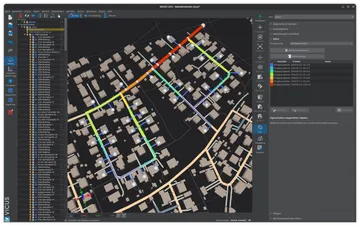
Tariff parameters from VICUS Districts:
The simulation delivers key figures that matter for tariff design: the return temperature per consumer (the basis for temperature-dependent tariffs), the connection load, the annual energy consumption and the load profile over time. These data allow costs to be allocated according to cause and incentive tariffs to be assessed.
Price Adjustment Clause
Since heat supply contracts run for many years, automatic price adjustment mechanisms are indispensable. The price adjustment clause links the tariff components to published indices, so that prices are adjusted to reflect actual cost developments without renegotiation.
Typically, two index groups are incorporated:
- Energy carrier index: e.g., the wood price index or the gas price index, weighted according to the fuel mix of the generation plant
- Consumer price index (CPI): reflects general inflation and indirectly captures labor costs, material costs, and service costs
A typical price adjustment formula for the energy rate is:
In this example, the energy rate is determined 80% by energy carrier costs (of which 85% wood and 15% gas) and 20% by general inflation. The weighting of energy carriers must be adjusted to match the actual fuel mix of the plant.
The price adjustment clause should be applied to both the base rate and the energy rate, albeit with different weightings. The base rate depends more heavily on capital and personnel costs (CPI), while the energy rate is primarily driven by fuel costs.
What Makes a Tariff Work
A transparent and fair tariff design is the foundation for a successful, long-term partnership between heat supplier and consumer. A clearly structured heat supply contract, practical GTC, realistic TAV and a comprehensible tariff structure together create trust and planning certainty for both parties. Price adjustment clauses with transparent index linkages ensure that heat prices reflect actual cost developments even over decades. Return-temperature-dependent pricing can further increase the efficiency of the entire network and thus contribute to sustainable and economical heat supply.
Further reading: Economic Analysis According to VDI 2067 describes the methodology for determining heat generation costs as the basis for tariff calculation, Return Temperature Optimization explains the analysis and improvement of customer integration as the basis for return-temperature-dependent tariffs, and Planning Phases of Thermal Networks places the contractual design within the overall project workflow.
References and Standards
- AVBFernwärmeV — Ordinance on General Conditions for the Supply of District Heating
Frequently Asked Questions
How is a district heating tariff structured?
What is a return-temperature-dependent tariff?
How does price adjustment work in heat supply contracts?
Related Articles
VDI 2067 for district heating networks: net present value, annuity, annual costs and LCOH — with service lives from Part 1 and worked examples.
Everything about the German federal funding for efficient district heating networks: requirements, rates and application
Disclaimer: The content of this page is for general information purposes only and does not constitute legal, planning or engineering advice. All information is provided without guarantee. Despite careful research, VICUS Software GmbH assumes no liability for the accuracy, completeness or timeliness of the information provided. Third-party product names and trademarks are mentioned for informational purposes only and are the property of their respective owners.