Anergy Networks and 5GDHC: Terms and Definitions
Anergy network, cold district heating, 5GDHC, LowEx and 4GDH: definitions, distinctions, single- and two-pipe systems and a 4GDH vs. 5GDHC comparison.
Table of Contents
An anergy network is a thermal network that carries water or brine close to ground temperature, typically in the range of about 5–25 °C, with decentralized heat pumps producing the usable temperature in the buildings. In Germany the same concept is usually called kalte Nahwärme, i.e. cold district heating; internationally the term 5GDHC (fifth generation district heating and cooling) is common, and in the UK “ambient loop” is also used. None of these terms is standardized, and they are not always delimited in the same way. This article sorts them out and compares fourth- and fifth-generation networks in a table.
Anergy network
The term comes from thermodynamics. Energy can be split into exergy, the part that can be converted into work, and anergy, the part that cannot. For heat at temperature with ambient temperature :
If the network temperature is close to ambient, the exergy share is almost zero: the network carries practically pure anergy. The missing exergy is supplied by the electricity of the heat pumps in the buildings. The term is used mainly in Switzerland, where many anergy networks have been built, for example on the Hönggerberg campus of ETH Zurich. The Swiss planning handbook for thermal networks assigns “anergy network” or “cold district heating” to networks mostly below 25 °C and explicitly notes that these terms are not used consistently. Swiss practice also uses “thermal site networking” (thermische Arealvernetzung) for linking heat and cooling consumers within a site. The term anergy network emphasizes the physical nature of the heat carried, not the size or generation of the network.
Cold district heating and cold networks
Cold district heating is the usual English rendering of the German kalte Nahwärme. “Cold” refers to the network temperature, which is below the temperature level used in the buildings; Nahwärme (“local heat”) refers to the typically neighbourhood-scale extent. A cold network is the physical pipe network, while cold district heating denotes the overall concept of source, network and decentralized heat pumps. Other names in use include “ambient temperature network”, “neutral-temperature network” and “low-temperature district heating and cooling”, without implying a technical difference.
5GDHC and 5GDH
5GDHC stands for fifth generation district heating and cooling. According to the widely cited definition by Buffa et al. (2019), a 5GDHC network is a thermal supply grid using water or brine as carrier and substations with water-source heat pumps, operated so close to ground temperature that it is unsuitable for direct heating. The low temperature allows direct use of waste heat and renewable sources with low exergy content, and because the substations can reverse their operation, the same network can provide heating and cooling at the same time.
Whether this constitutes a separate generation is disputed in the literature. Lund et al. (2021) classify such networks as a variant of the fourth generation, while Sulzer et al. (2021) propose a dedicated vocabulary for thermal networks. 5GDH (without the “C”) is used partly as a synonym and partly for concepts without cooling. For design purposes the label is secondary; what matters is the temperature level, the substation concept and the hydraulics.
Low-temperature networks, LowEx and 4GDH
Low-temperature networks of the fourth generation (4GDH, following Lund et al. 2014) operate with supply temperatures of about 50–70 °C. Heat arrives at the building ready for use and is transferred through a heat exchanger; it is generated centrally, for example by large heat pumps, solar thermal plants or waste heat. LowEx (low exergy) emphasizes the low exergy content of the distributed heat; the German district heating association AGFW, for example, uses it for networks in the range of about 20–60 °C. The term therefore overlaps with 4GDH and extends into the range of cold networks. Between 4GDH and 5GDHC there are networks at about 35–45 °C (often called ultra-low-temperature district heating) in which decentralized booster heat pumps only handle domestic hot water.
The article on network temperatures compares the temperature levels of all network generations.
Comparison: 4GDH and 5GDHC
| Characteristic | 4GDH (low-temperature network) | 5GDHC (anergy network, cold district heating) |
|---|---|---|
| Supply temperature | approx. 50–70 °C | approx. 5–25 °C |
| Return temperature | approx. 25–40 °C | approx. 0–20 °C |
| Temperature difference | approx. 20–35 K | approx. 3–6 K |
| Pipe system | insulated (pre-insulated bonded or flexible plastic pipes) | uninsulated (PE100-RC, PE-Xa) |
| Heat carrier | water | water or brine (water–glycol) |
| Generation of usable temperature | central | decentralized, by heat pumps |
| Building connection | heat exchanger substation | heat pump, optionally heat exchanger for free cooling |
| Distribution losses | approx. 8–15 % | heat gains from the ground possible |
| Cooling | only with a separate cooling network | possible in the same network |
| Flow and energy flow | directed, mostly unidirectional | directed or undirected, bidirectional possible |
| Typical sources | large heat pumps, solar thermal, waste heat, biomass | borehole heat exchangers, collectors, low-temperature waste heat, wastewater, cooling waste heat |
Directed, undirected, bidirectional: prosumers
The Swiss planning handbook separates two characteristics that are often mixed up in everyday usage:
- Fluid flow: in a directed network a central pump sets the flow direction. In an undirected network every consumer has its own pump and, depending on demand, draws water from the warm pipe for heating or from the cold pipe for cooling; the flow direction in individual sections can change.
- Energy flow: unidirectional means heat only flows from the source to the consumer. Bidirectional means consumers can also feed heat in.
Buildings that both draw and feed in heat are called prosumers. Typical examples are residential buildings that heat in winter and cool via the network in summer, or commercial users with process and cooling waste heat. Bidirectionality characterizes many, but not all, 5GDHC networks: purely residential districts without cooling are unidirectional in terms of energy. The German distinction between passive (undirected) and active (directed) networks largely corresponds to the fluid-flow characteristic.
Source network
Source network (German Quellnetz) emphasizes the network’s role from the heat pump’s point of view: it provides the heat source that would otherwise be a borehole or collector in a stand-alone installation. The term is used mainly in practice and by network operators and denotes the same concept as cold district heating.
Single-pipe, two-pipe and multi-pipe systems
Cold networks can be distinguished by the number of pipes:
- Single-pipe system: one pipe, usually laid as a loop. Buildings take water, cool or heat it and return it downstream into the same pipe. The temperature changes along the loop; the position and order of consumers affect their source temperature.
- Two-pipe system: a warmer and a colder pipe. Buildings in heating mode draw from the warm pipe and return cooled brine to the cold one; buildings in cooling mode do the opposite. This is the most common design in Germany and allows both passive and active hydraulics.
- Multi-pipe systems: three or more pipes, for example for separate temperature levels or a dedicated cooling pipe. They are rare because every additional pipe increases route costs.
How passive and active two-pipe networks differ hydraulically is explained in Dimensioning 5GDHC Networks.
Anergy networks in VICUS Districts
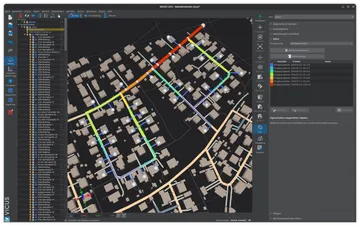
Anergy networks are modelled by combining low network temperatures, decentralized heat pumps at the substations and a heat source. The COP of every decentralized heat pump is calculated in each time step from the actual network and building temperatures. The network solver supports bidirectional mass flows, so the flow direction reverses naturally when buildings feed heat into the network.
The terms in practice
Anergy network, cold district heating, cold network, source network and 5GDHC essentially describe the same thing: a network close to ground temperature, uninsulated pipes and decentralized heat pumps. The differences lie in the perspective — thermodynamics, regional usage, network generation or the heat pump’s point of view. In tenders, feasibility studies and funding applications it is advisable to define the term once by temperature range, substation concept and number of pipes rather than relying on the label alone.
Further reading: Low-Temperature District Heating: Fundamentals — operating principle and components, Prosumers in District Heating Networks — feed-in and bidirectional hydraulics in detail, Network Temperatures — temperature levels of all network generations compared.
References and Standards
- Buffa, S.; Cozzini, M.; D’Antoni, M.; Baratieri, M.; Fedrizzi, R. (2019): 5th generation district heating and cooling systems: A review of existing cases in Europe. Renewable and Sustainable Energy Reviews, 104, pp. 504–522.
- Lund, H. et al. (2014): 4th Generation District Heating (4GDH). Energy, 68, pp. 1–11.
- Lund, H. et al. (2021): Perspectives on fourth and fifth generation district heating. Energy, 227, 120520.
- Sulzer, M.; Werner, S.; Mennel, S.; Wetter, M. (2021): Vocabulary for the fourth generation of district heating and cooling. Smart Energy, 1, 100003.
- Pellegrini, M.; Bianchini, A. (2018): The Innovative Concept of Cold District Heating Networks: A Literature Review. Energies, 11(1), 236.
- Nussbaumer, T.; Thalmann, S.; Zaugg, D.; Cueni, M. (2025): Planungshandbuch Thermische Netze. Version 2.0, EnergieSchweiz / Swiss Federal Office of Energy SFOE.
- Boesten, S.; Ivens, W.; Provost, M. (2019): 5GDHC: An integrated design approach for sustainable district energy systems. REHVA Journal, 2019(1).
- Zeh, R.; Stockinger, V. (2019): Kalte Nahwärme — Wärme- und Kälteversorgung der Zukunft für Quartiere. Ingenieur Spiegel, 2019.
Frequently Asked Questions
What is an anergy network?
Is an anergy network the same as cold district heating?
What is the difference between 4GDH and 5GDHC?
What is a two-pipe system in cold district heating?
Related Articles
Cold district heating (5GDHC) explained: operating principle, heat sources, decentralized heat pumps and network hydraulics of 5th-generation networks.
5GDHC simulation and dimensioning of cold district heating networks: passive vs. active networks, pressure-loss criteria and ground coupling.
How do prosumer concepts work in district heating networks? Heat feed-in, bidirectional networks and operating models
Advantages and disadvantages of cold district heating (5GDHC): under 3 % heat losses and free cooling versus decentralized heat pumps and more complex planning.
Disclaimer: The content of this page is for general information purposes only and does not constitute legal, planning or engineering advice. All information is provided without guarantee. Despite careful research, VICUS Software GmbH assumes no liability for the accuracy, completeness or timeliness of the information provided. Third-party product names and trademarks are mentioned for informational purposes only and are the property of their respective owners.