Heat Loss Calculation According to DIN EN 13941
Calculating heat losses in buried district heating pipes: methods, influencing factors and typical values
Table of Contents
Heat losses in buried district heating pipes range from 5 to 40 % of the energy fed in, depending on the network type, and are calculated according to DIN EN 13941 using thermal resistances of cylindrical layers (pipe, insulation, soil). The main levers are insulation thickness, medium temperature and soil conditions — lowering the supply temperature from 90 to 70 °C alone reduces losses by approximately 25 %.
Physical Fundamentals
The heat loss of a buried pipe is governed by heat conduction. The hot medium inside the pipe releases heat via the pipe wall, the insulation and the surrounding soil to the ground surface. The driving force is the temperature difference between the medium and the surroundings.
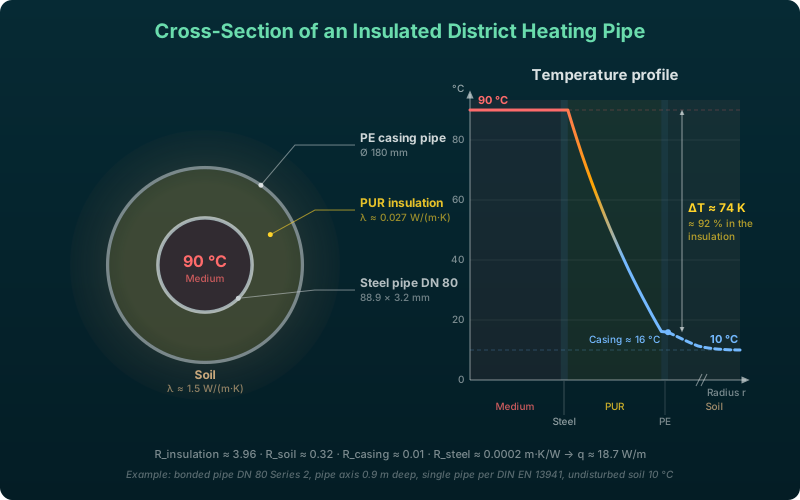
For a single, concentric pipe system (medium — pipe — insulation — casing — soil), the linear heat loss (in W/m) is:
The total thermal resistance is made up of the individual resistances of the layers.
Thermal Resistances of Cylindrical Layers
For a cylindrical layer (e.g. the thermal insulation), the thermal resistance per metre of pipe length is calculated as:
with the thermal conductivity of the material and the outer and inner diameters and of the respective layer. The thermal resistance of the insulation layer usually dominates the total resistance, since the thermal conductivity of the insulation ( — W/(mK) for PUR foam) is many times lower than that of the soil or the pipe material.
Thermal Resistance of the Soil
The surrounding soil represents an additional thermal resistance. For a single, horizontally buried pipe in homogeneous soil, DIN EN 13941 gives:
Here, is the cover depth (distance from the pipe centre to the ground surface), is the outer diameter of the casing pipe and is the thermal conductivity of the soil. Typical values for lie between 1.0 and 2.0 W/(mK), depending on soil type and moisture content.
Characteristics of Twin-Pipe Systems
In the common practice of laying supply and return pipes next to each other in the same trench, the warmer supply pipe influences the cooler return pipe and vice versa. This effect of thermal coupling must be taken into account in the calculation.
DIN EN 13941 introduces a coupling resistance which describes this mutual interaction. The heat losses of the supply and return lines then follow from a coupled system of equations:
Here and are the total resistances of each pipe (insulation, casing and soil) and is the coupling resistance for an axis spacing between the two pipes.
If both lines are warmer than the soil, they warm the surrounding soil for each other: supply and return each lose slightly less heat than an isolated pipe at the same temperature, with a much larger reduction for the return line. At very low return temperatures the return line can even absorb heat. For DN 100 (Series 1) at 80/50 °C, coupling reduces the total loss by about 5 %. Calculating the lines separately and adding the results is therefore slightly on the safe side.
The heat loss calculator for district heating pipes evaluates and directly for pre-insulated pipes DN 20 to DN 300 in insulation series 1 to 3 — as single pipes or with thermal coupling in a shared trench.
Influencing Factors for Heat Losses
Insulation Thickness
The insulation thickness has the greatest influence on the heat losses. Pre-insulated bonded pipes (KMR) according to DIN EN 253 are available in various insulation classes (Series 1, 2 and 3). The differences are considerable: a DN 100 pipe of Series 1 (standard insulation) loses about 20 W/m at a medium temperature of 80 °C, with Series 3 (reinforced insulation) about 15 W/m (single pipe, = 0.027 W/(mK), pipe axis 0.9 m deep, soil 10 °C).
Medium Temperature
The heat loss is directly proportional to the temperature difference between the medium and the ground surface. Lowering the supply temperature from 90 °C to 70 °C reduces the heat loss by approximately 25 %. This is one of the main advantages of low-temperature networks.
Burial Depth
A greater cover depth increases the soil resistance and thus reduces heat losses. At the same time, however, the soil temperature at burial depth rises, which partially offsets the effect. Typical burial depths are between 0.6 and 1.2 m (top of pipe). In practice, the choice of burial depth is driven more by frost protection requirements and excavation costs than by heat loss optimisation.
Soil Temperature
The soil temperature fluctuates seasonally. In central Europe, the undisturbed ground temperature at 1 m depth varies between approximately 3 °C in February and approximately 17 °C in August. An annual mean of approximately 10 °C can be assumed. In winter, heat losses are therefore higher than in summer — at the same time, heat demand is at its peak, which increases the relative loss share.
Soil Moisture Content
Moist soil conducts heat better than dry soil. The thermal conductivity of dry sand is approximately 0.4 W/(mK), while that of water-saturated sand is approximately 2.4 W/(mK). In areas with a high groundwater level, heat losses can therefore be considerably higher than computed using standard values.
Typical Loss Ranges
The following guide values provide an orientation for the relative heat losses of different network types:
| Network type | Relative heat losses |
|---|---|
| Large district heating network (urban) | 5 — 12 % |
| Local district heating network (new development area) | 12 — 20 % |
| Local district heating network (rural, low density) | 20 — 40 % |
| Low-temperature network (4th generation) | 8 — 15 % |
| Cold district heating | < 0 % (heat gains) |
For cold district heating, the effect is reversed: since the network temperature is below the soil temperature, the network absorbs heat from its surroundings. The pipes then act as a linear heat source. How these minimal distribution losses weigh up in a system comparison is covered in Advantages and Disadvantages of Cold District Heating.
Annual Heat Losses
For economic evaluation, not the instantaneous losses but the annual heat losses are decisive. These result from integrating the hourly losses over the entire year while accounting for the varying medium and soil temperatures. As a simplification, the annual heat loss per metre of route can be estimated as:
where is the mean linear heat loss taking into account the annual profile of the temperatures. For a DN 100 twin route with standard insulation (Series 1) and annual mean temperatures of 70 °C in the supply and 40 °C in the return, the result is about 220 kWh/(ma) for supply and return combined, or about 160 kWh/(ma) with Series 3.
Heat loss calculation in VICUS Districts:
The heat loss calculation goes beyond the steady-state approach of DIN EN 13941: a detailed soil model is solved coupled with the network simulation. The soil is discretised spatially along the route, so local ground temperatures, seasonal variations and the influence of neighbouring pipes are captured dynamically. This matters most for low-temperature district heating: because the network temperatures lie below the soil temperature, the model calculates the heat gains of the network from the ground and represents the long-term thermal depletion of the soil over several years of operation. The same coupled soil model also allows geothermal sources (borehole heat exchangers, ground collectors) to be simulated directly within the network model.
Putting the calculation to work
Heat loss calculation according to DIN EN 13941 provides the tools to quantify the thermal efficiency of buried pipes. The main levers are the insulation thickness, the medium temperature and the soil conditions. For a realistic assessment, the thermal coupling in twin-pipe systems and the seasonal variations must be taken into account. The results feed directly into the economic calculation and form an essential basis for the choice of network type and operating temperatures. In VICUS Districts, heat losses according to DIN EN 13941 are automatically calculated for every time step and included in the overall energy balance of the network.
Further reading: Network Temperatures in District Heating Networks — how temperature levels drive heat losses, Linear Heat Density — the economic context in which losses must be evaluated, Pipe Dimensioning in District Heating Networks — insulation class and pipe sizing decisions, Economic Analysis According to VDI 2067 — how heat losses translate into operating costs.
References and Standards
- DIN EN 13941 — District heating pipes — Design and installation of pre-insulated bonded pipe systems
- AGFW FW 401 Part 10 — Installation and Structural Analysis of Pre-insulated Pipes — Thermal Calculation
- AGFW FW 309 — Energy Evaluation of District Heating and Cooling
Frequently Asked Questions
How high are heat losses in district heating networks?
What factors influence the heat losses of buried district heating pipes?
How does DIN EN 13941 calculate heat losses?
Related Articles
District heating pipe sizing from flow velocity (0.5–2.5 m/s) and pressure gradient (100–200 Pa/m): DN reference values per line type, plus an online calculator.
Fundamentals of hydraulic calculation: pipe friction, local resistances and pressure distribution in district heating networks
What is linear heat density and why is it the central metric for the economic viability of district heating networks?
Supply and return temperatures in district heating networks: calculation, influencing factors and optimisation
Disclaimer: The content of this page is for general information purposes only and does not constitute legal, planning or engineering advice. All information is provided without guarantee. Despite careful research, VICUS Software GmbH assumes no liability for the accuracy, completeness or timeliness of the information provided. Third-party product names and trademarks are mentioned for informational purposes only and are the property of their respective owners.