Economic Analysis According to VDI 2067
VDI 2067 for district heating networks: net present value, annuity, annual costs and LCOH — with service lives from Part 1 and worked examples.
Table of Contents
VDI 2067 is the standard methodology for the economic assessment of district heating networks in Germany: it converts investment costs, energy costs, operating costs, and revenues into comparable annual costs using the annuity method, enabling direct variant comparison over observation periods of 20 to 30 years. The key performance indicator is the levelized cost of heat (LCOH), which typically ranges from 8 ct/kWh (gas boiler) to 20 ct/kWh (cold district heating) — depending on technology, heat density, and available funding.
Online calculator: levelized cost of heat (LCOH)
This calculator is also available as a standalone page: heat cost calculator (LCOH, VDI 2067).
Enter the investment, discount rate, energy and operating costs and the annual useful heat — the calculator determines the annuity factor, the price-dynamic annual costs per cost group and the levelized cost of heat using the annuity method, so supply variants can be compared in seconds. The article below explains the methodology in detail.
Annual costs and LCOH using the annuity method — all costs are converted into comparable uniform annual payments.
- Annuity factor a
- –
- Price-dynamic factor b
- –
- Total annual costs
- –
| Cost group | EUR/a | Share |
|---|---|---|
| Capital costs | ||
| Demand-related costs (price-dyn.) | ||
| Operation-related costs | ||
| Other costs | ||
| Total | 100 % |
Assumptions: annuity method per VDI 2067 with a single observation period T for all components — replacement investments, residual values and differing service lives are not modelled · funding as a one-off deduction from the investment (capital costs from the effective investment), operating costs as a percentage of the unfunded investment · energy costs price-dynamic via factor b, other costs without escalation. The tool is meant for quick variant comparisons and does not replace a full VDI 2067 economic analysis. Last updated: July 2026 (VDI 2067 Part 1:2012-09). VICUS Software accepts no liability for the correctness of the results.
Basic Principle of VDI 2067
VDI 2067 is based on the annuity principle: all costs and revenues are converted into uniform annual payments (annuities). This makes it possible to directly compare variants with different investment levels, service lives and cost profiles.
The central idea is straightforward. One-off investments, recurring annual costs and energy costs subject to price escalation are all converted into comparable annual costs over the observation period , using a uniform discount rate .
Cost Categories
VDI 2067 distinguishes four cost groups:
1. Capital Costs (Investment Costs)
The investment costs comprise all one-off expenditures for planning, procurement and construction of the plant:
- Heat generators (boilers, heat pumps, solar thermal systems)
- Pipe network (material costs, civil engineering, laying)
- Transfer stations
- Pumps, valves, control technology
- Planning costs (typically 10 to 15 % of construction costs)
The investment costs are converted into annual capital costs using the annuity factor :
with the discount rate (e.g. 0.03 for 3 %) and the observation period in years.
The annual capital costs are then:
Example: an investment of EUR 2,000,000 at and years yields:
2. Demand-Related Costs (Energy Costs)
Demand-related costs comprise the expenditures for the energy input (electricity, gas, biomass, ambient heat) and, where applicable, auxiliary energy (pump electricity). They depend on the annual energy demand and the specific energy prices:
where is the annual consumption of energy carrier and is the corresponding price.
When accounting for price escalation, the price-dynamic annuity factor is used:
with the annual price escalation rate for the respective energy carrier. The price-dynamic annual costs are then:
3. Operation-Related Costs (Maintenance and Servicing)
These costs include personnel, maintenance, repair and insurance. VDI 2067 recommends expressing these costs as a percentage of the investment costs:
| Component | Maintenance + Servicing (% of ) |
|---|---|
| Heat generator | 2.0 - 4.0 % |
| Pipe network | 0.5 - 1.0 % |
| Transfer stations | 1.5 - 2.5 % |
| Pumps | 2.0 - 3.0 % |
| Control technology | 1.5 - 2.0 % |
The annual operation-related costs are therefore:
4. Other Costs
This category includes, among others:
- CO costs (emissions trading, CO pricing)
- Administrative costs
- Insurance
- Lease payments and concession fees
CO costs in particular are becoming increasingly important. With the national emissions trading scheme, CO prices are rising continuously. Any economic analysis should therefore assume a realistic price trajectory that, over the observation period, lies significantly above today’s prices.
Simulation data for VDI 2067 from VICUS Districts:
The software does not contain an economic assessment module of its own. The simulation does, however, deliver all the physical input quantities needed for a calculation in accordance with VDI 2067: annual energy demand of the heat generators, pump electricity consumption, network losses, peak loads and full-load hours. The economic assessment can then be carried out on the basis of these results in an external calculation tool.
Revenues and Funding
Set against the costs are the heat revenues, the income from selling heat to consumers. In an economic analysis these are often calculated as an annuity of revenues:
In addition, funding (e.g. from the German Federal Funding for Efficient District Heating Networks, BEW) can substantially reduce the investment costs. Funding is accounted for as a one-off deduction from the investment costs:
where is the amount of funding received.
Net Present Value Method
As an alternative or complement to the annuity method, the net present value method (NPV) is frequently used. The net present value is the sum of all payments discounted to the reference point :
with the annual revenues , the annual costs and the residual value of the plant at the end of the observation period.
A project is economically viable if . When comparing several variants, the one with the highest net present value should be preferred.
Levelized Cost of Heat
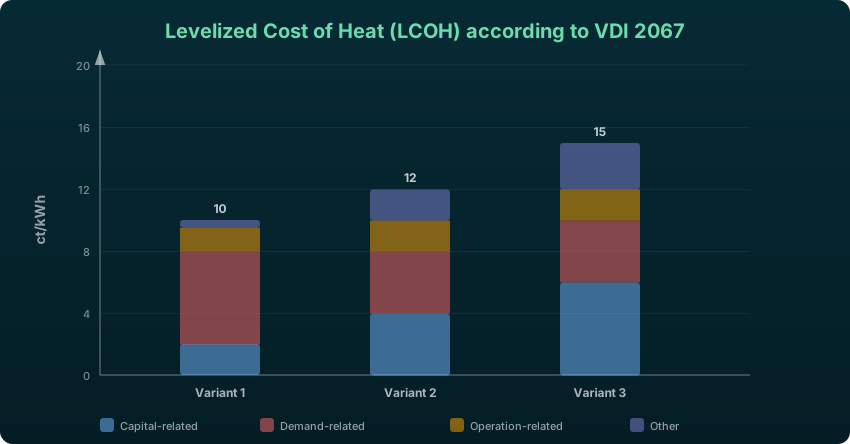
The levelized cost of heat (LCOH) is the key performance indicator for variant comparison. It expresses what a kilowatt-hour of heat costs on average over the entire observation period:
where is the useful heat delivered to consumers each year. Typical levelized costs of heat for various systems (as of 2025):
| System | LCOH (ct/kWh) |
|---|---|
| Gas boiler (existing) | 8 - 12 |
| Biomass boiler + network | 10 - 15 |
| Heat pump + low-temperature network | 12 - 18 |
| Cold district heating (decentralized HP) | 14 - 20 |
| Solar thermal + seasonal storage | 10 - 16 |
These values are highly site- and project-specific and serve only as guidance. Actual LCOH depends on heat density, network length, energy prices and the available funding landscape.
Service Life and Replacement Investments
An important aspect of VDI 2067 is the consideration of different service lives for the individual system components. While a pipe network has a lifetime of 40 to 50 years, heat pumps must be replaced after 15 to 20 years and control technology after 10 to 15 years. Replacement investments that fall within the observation period are accounted for as additional, discounted one-off payments:
Typical service lives according to VDI 2067:
| Component | Service Life |
|---|---|
| Pipe network (plastic) | 40 - 50 years |
| Pipe network (steel, pre-insulated) | 30 - 40 years |
| Heat pump | 15 - 20 years |
| Gas boiler | 18 - 20 years |
| Buffer storage | 20 - 25 years |
| Control technology | 10 - 15 years |
| Pumps | 12 - 15 years |
Sensitivity Analysis
No economic analysis is complete without a sensitivity analysis. This examines how changes in input parameters affect the result. The most important parameters for district heating networks are:
- Energy price development (especially electricity and gas prices)
- CO price development
- Discount rate
- Connection rate (how many potential consumers actually connect)
- Heat sales (influenced by the refurbishment rate of connected buildings)
Software such as VICUS Districts provides, through its annual thermohydraulic simulation, the physical input data — annual energy demand, network losses, pump electricity and load profiles — as a sound basis for the variant comparison; the economic analysis itself according to VDI 2067 is then carried out in an external calculation tool.
Making the Method Reliable
VDI 2067 offers a proven and transparent framework for the economic analysis of district heating networks. The annuity method makes one-off and recurring costs comparable, and accounting for price escalation ensures realistic results over long observation periods. A sound basis for decisions rests on three things: capturing all four cost groups completely, assuming realistic price developments, and validating the results through a sensitivity analysis. The levelized cost of heat, as the central performance indicator, enables direct comparison of different supply variants and forms the foundation for investment decisions and heat pricing models. VICUS Districts supplies the physical input data from the simulation, on which the economic analysis according to VDI 2067 builds in an external calculation tool, so that technical and economic assessment interlock consistently.
Further reading: BEW Funding — public funding that reduces investment costs in the economic analysis, Heat Loss Calculation According to DIN EN 13941 — quantifying losses that directly impact operating costs, Linear Heat Density — the key metric for economic assessment of network viability, Pump Sizing in District Heating Networks — pump energy as an operational cost factor in the VDI 2067 framework.
References and Standards
- VDI 2067 Part 1 — Economic efficiency of building installations — Fundamentals and economic calculation
- DIN EN 15459-1 — Energy performance of buildings — Economic evaluation procedure for energy systems in buildings
- AGFW FW 308 — Technical-economic parameters of district heating supply
Frequently Asked Questions
What are levelized cost of heat (LCOH) and how are they calculated?
How does the annuity method according to VDI 2067 work?
What are the typical service lives of district heating components according to VDI 2067?
Related Articles
Everything about the German federal funding for efficient district heating networks: requirements, rates and application
Tariff structure, heat supply contracts, and technical connection requirements: Contractual foundations of thermal networks
Disclaimer: The content of this page is for general information purposes only and does not constitute legal, planning or engineering advice. All information is provided without guarantee. Despite careful research, VICUS Software GmbH assumes no liability for the accuracy, completeness or timeliness of the information provided. Third-party product names and trademarks are mentioned for informational purposes only and are the property of their respective owners.