Cold District Heating in Existing Neighbourhoods
Cold district heating for existing buildings: flow temperatures, radiators, heat pump SPF at 55–65 °C, routing in built-up streets and phased expansion.
Table of Contents
Cold district heating in existing neighbourhoods is technically feasible if the connected buildings can be heated with flow temperatures of at most about 55 °C or can be brought there with limited effort. Compared with a new development, three things change: the decentralised heat pumps work with a larger temperature lift and hence a lower seasonal performance factor (SPF), the pipe route has to fit into an already occupied street space, and land for horizontal ground collectors is scarce. Whether the concept works in a specific neighbourhood is decided by a building-by-building survey of flow temperatures combined with an assessment of the available heat sources.
Most realised cold district heating networks supply new developments with underfloor heating. The existing building stock, however, accounts for the bulk of heat demand, and with municipal heat planning the question of which existing areas suit a cold network is moving to the fore.
Requirements on the building side
Determining the required flow temperature
What matters is not the configured heating curve but the flow temperature the building actually needs on the design day. Radiators in existing buildings are often generously sized, because they were designed for the original, higher heat demand while the envelope has since been partly improved. Proven methods:
- Room-by-room heat load and radiator output: heat load per room according to EN 12831, radiator output at reduced flow temperature converted using the radiator exponent. The most critical room determines the building’s flow temperature.
- Reduction test: lower the heating curve step by step during a cold period and observe whether all rooms hold their set point.
- Consumption analysis: check the heat load against several years of fuel consumption and heating degree days.
Radiator output is converted approximately as
A radiator delivering its rated output at 75/65/20 °C provides only about 50 % of it at 55/45/20 °C. If the room’s heat load has since dropped by a third and the radiator was oversized anyway, this may be sufficient.
Achieving low-temperature readiness
Where individual rooms drive the flow temperature up, targeted measures are usually cheaper than a general increase:
- replacing individual radiators with deeper models or fan convectors
- hydraulic balancing and heating curve adjustment
- insulating the top floor ceiling, replacing windows in critical rooms
- increasing flow rates by reducing the temperature spread on the heating side
The effect is substantial: every kelvin of lower flow temperature improves the heat pump’s COP by roughly 2 to 3 %. The article Temperature Reduction in Existing Networks describes the checks for heating surfaces, hot water and controls in more detail.
Classification by renovation status
| Building condition | Typical flow temperature on design day | Suitability for cold district heating |
|---|---|---|
| New build / high-efficiency, underfloor heating | 30–35 °C | very good |
| Comprehensively renovated, radiators | 45–55 °C | good |
| Partly renovated (windows, roof), some radiators replaced | 55–60 °C | good to limited, case-by-case check |
| Unrenovated, built before 1978, original radiators | 65–75 °C | limited, measures or high-temperature HP needed |
| Listed building, special use, process heat | > 70 °C | separate solution, possibly separate supply |
The values are indicative. In individual buildings the actual required temperature often deviates considerably, usually downwards.
Heat pumps at 55 to 65 °C flow temperature
Effect on the seasonal performance factor
A heat pump’s COP depends on the temperature lift between source and sink. A rough estimate using the Carnot efficiency shows the order of magnitude:
With a Carnot efficiency of 0.5, a network temperature of 8 °C and an approach temperature of 5 K at both evaporator and condenser:
| Heating flow temperature | Temperature lift (internal) | COP (estimate) |
|---|---|---|
| 35 °C | 37 K | approx. 4.2 |
| 45 °C | 47 K | approx. 3.4 |
| 55 °C | 57 K | approx. 2.9 |
| 65 °C | 67 K | approx. 2.6 |
These are not manufacturer figures, but they show the trend: between underfloor heating in a new build and 65 °C in an unrenovated building, the heat pump loses about a third of its efficiency. At the same time, the flow temperature drops over the year with the heating curve, so the SPF is higher than the COP at the design point. The article Heating Curves explains this relationship in detail.
Field measurements confirm that heat pumps can work efficiently in existing buildings. In Fraunhofer ISE’s project WPsmart im Bestand, twelve ground-source heat pumps in existing buildings achieved SPFs of 3.3 to 4.7, averaging 4.1. A cold network offers the heat pump similar or slightly higher source temperatures than a single borehole, so these values can serve as a reference.
Domestic hot water
In existing buildings, domestic hot water is often the real temperature constraint. Large systems as defined in the German DVGW worksheet W 551 require at least 60 °C at the storage outlet and at least 55 °C in the circulation return. Options include heat pumps with natural refrigerants (e.g. R290) that reach these temperatures, two-stage systems with a separate hot water heat pump, or apartment stations and fresh water modules that reduce circulation requirements. The variants differ considerably in electricity consumption and space requirements; see Domestic Hot Water in District Heating.
High-temperature customers and mixed neighbourhoods
Existing neighbourhoods are rarely homogeneous. Different building ages, individual large consumers and non-residential buildings are typical. For buildings that will require high flow temperatures for the foreseeable future, there are several approaches:
- High-temperature heat pump on the network, possibly two-stage, with a lower SPF
- Bivalent operation: the heat pump covers base load, an existing boiler takes the few peak-load hours until renovation measures take effect
- Separate supply: large consumers with process heat stay outside the cold network or are supplied via a dedicated sub-network
Non-residential buildings are often an advantage in existing areas. Supermarkets, offices, medical practices or small data centres have cooling demand and feed heat into the network as prosumers. In mixed neighbourhoods this reduces the need for additional heat sources, which is particularly valuable where open land is scarce.
Routing and civil works in existing areas
Occupied street space
In a new development the network is laid together with the other utilities in open ground. In existing areas, gas, water, sewer, power and telecom lines already occupy the street cross-section. Because of the small temperature spread, cold networks need larger nominal diameters than conventional heat networks of the same capacity, but they require no insulation and no compensation of thermal expansion, and they allow flexible PE pipes. Typical planning tasks:
- utility records and cross-section planning per street section, observing distances to drinking water pipes (warming in summer, cooling in winter)
- house connections through front gardens and basement walls, space for the heat pump and transfer unit in the basement
- surface reinstatement, traffic management and construction time windows
Civil works and surface reinstatement often account for the larger part of network costs in existing areas. Combining the network with already planned road, sewer or fibre-optic works is economically favourable. PE pipes can also be installed by trenchless methods such as horizontal directional drilling, for instance to cross roads, railway lines or watercourses. Installation basics are described in Pipe Installation in District Heating.
Line density and linear heat density
Existing neighbourhoods have higher heat demand per metre of route than new developments. For a cold network this cuts both ways: investment per MWh falls, but flow rates and thus diameters and pumping power rise. At 4 K spread, 1 MW of extraction already requires a mass flow of about 60 kg/s. Networks in existing areas are therefore more often designed as active networks with a central pump, and heavily loaded sections are carefully sized for pressure loss. The relationship between heat density and network economics is explained in Linear Heat Density in District Heating.
Heat sources without open land
Horizontal collectors are usually ruled out in dense existing areas. Options include:
- borehole fields beneath car parks, sports grounds or green spaces
- wastewater heat from main sewers with sufficient dry-weather flow
- surface water and groundwater, subject to water-law permits
- waste heat from businesses, refrigeration plants and data centres
- dry coolers or air heat exchangers as a supplementary source in the shoulder seasons
The pipe network’s heat gains from the ground also contribute in existing areas, with rather higher summer soil temperatures under sealed surfaces. How sources and ground behave over the years is covered in Seasonal Storage in Cold District Heating Networks.
Phased development
An existing neighbourhood is rarely connected in one go. Owners decide at different times, often when their old heating system fails. Consequences for planning:
- Anchor customers first: municipal buildings, housing companies and businesses with cooling demand provide a solid base load.
- Network sized for final build-out, sources modular: the route is dimensioned for the target state, because later parallel civil works are expensive. Borehole fields, wastewater heat exchangers or dry coolers are added in stages.
- Realistic connection rates: economic calculations with variants for 50, 70 and 90 % connection rates avoid oversizing the sources.
- Account for the renovation roadmap: falling heat loads from future renovations reduce source demand and raise the SPF.
Hydraulically, the network must work at every build-out stage. Especially with low connection rates in the initial phase, minimum flow rates, temperatures at the network end and the operating points of the central pump need to be checked.
Existing neighbourhoods in VICUS Districts
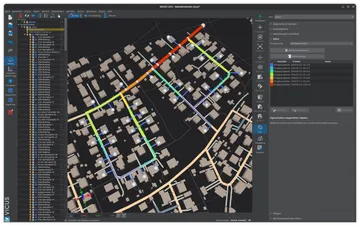
Pipe routes can be created from PDF or DXF plans or OpenStreetMap data. The COP of each decentralised heat pump is calculated in every time step from the actual network and building temperatures, so different flow temperatures of existing buildings feed directly into electricity demand and network balance. Passive and active networks can be compared and pumping energy evaluated over the operating year.
Link to municipal heat planning
Germany’s Heat Planning Act (Wärmeplanungsgesetz, WPG) obliges the federal states to have heat plans drawn up: by 30 June 2026 for municipalities with more than 100,000 inhabitants and by 30 June 2028 for all others. The plans divide the municipal area into prospective heat supply areas, in particular heat network areas and areas for decentralised supply.
Cold district heating does not fit neatly into this grid. It is a heat network, but heat generation takes place decentrally in the buildings. This gives planners several starting points:
- Areas of medium heat density: where a high-temperature network is uneconomic because of low linear heat density, but individual air-source heat pumps hit noise, space or heritage limits, a cold network is an option worth examining.
- Source potentials: the inventory and potential analysis of heat planning records wastewater, waste heat and geothermal energy. These data are a direct basis for selecting the sources of a cold network.
- Building requirements: under the German Buildings Energy Act (GEG), new heating systems must in principle use at least 65 % renewable energy. An electric heat pump on a cold network generally meets this requirement.
- Funding: feasibility studies and investment in heat networks can be supported via the federal funding for efficient heat networks (BEW).
How municipal utilities implement heat planning in their supply areas is described on the page municipal heat planning.
Conclusion
Cold district heating is not a standard solution for existing neighbourhoods, but in many of them it is a realistic option. The prerequisite is a building-by-building check of the flow temperatures actually needed, which in existing buildings are often lower than assumed. Buildings at 55 to 65 °C can be supplied by heat pumps, albeit with a lower SPF; individual high-temperature customers need dedicated solutions. The largest cost drivers are civil works and the development of sources without open land. Phased development with anchor customers, a network sized for final build-out and modularly growing sources keep the project manageable.
Further reading: Low-Temperature District Heating: Fundamentals — operating principle and components, Cold District Heating (5GDHC): Pros & Cons — comparison with conventional networks, Temperature Reduction in Existing Networks — preparing buildings for lower system temperatures.
References and Standards
- Gesetz für die Wärmeplanung und zur Dekarbonisierung der Wärmenetze (Wärmeplanungsgesetz — WPG) of 20 December 2023, BGBl. 2023 I No. 394.
- Gebäudeenergiegesetz (GEG) of 8 August 2020, last amended by the act of 16 October 2023, § 71.
- EN 12831-1:2017: Energy performance of buildings — Method for calculation of the design heat load.
- DVGW W 551 (2004): Drinking water heating and drinking water piping systems; technical measures to reduce Legionella growth.
- Fraunhofer ISE (2020): WPsmart im Bestand — field study of heat pumps in existing buildings, results summarised in TGA Fachplaner.
- Buffa, S. et al. (2019): 5th generation district heating and cooling systems: A review of existing cases in Europe. Renewable and Sustainable Energy Reviews, 104, pp. 504–522.
- BMWK; BMWSB (2024): Leitfaden Wärmeplanung (heat planning guideline). German Federal Ministry for Economic Affairs and Climate Action / Federal Ministry for Housing, Urban Development and Building.
Frequently Asked Questions
Can cold district heating supply existing buildings?
What seasonal performance factor do heat pumps achieve in existing buildings?
What is different about pipe laying in existing neighbourhoods?
How does cold district heating relate to municipal heat planning?
Related Articles
Cold district heating (5GDHC) explained: operating principle, heat sources, decentralized heat pumps and network hydraulics of 5th-generation networks.
5GDHC simulation and dimensioning of cold district heating networks: passive vs. active networks, pressure-loss criteria and ground coupling.
How do prosumer concepts work in district heating networks? Heat feed-in, bidirectional networks and operating models
Advantages and disadvantages of cold district heating (5GDHC): under 3 % heat losses and free cooling versus decentralized heat pumps and more complex planning.
Disclaimer: The content of this page is for general information purposes only and does not constitute legal, planning or engineering advice. All information is provided without guarantee. Despite careful research, VICUS Software GmbH assumes no liability for the accuracy, completeness or timeliness of the information provided. Third-party product names and trademarks are mentioned for informational purposes only and are the property of their respective owners.