Efficiency Ratings and Assessment
Definition and assessment of efficiency ratings in thermal networks: Instantaneous and annual utilization efficiency, weighted assessment of heat and electricity
Table of Contents
The net annual utilization rate is the most meaningful metric for assessing heat generation plant efficiency, as it accounts for part-load operation, start-up losses, and auxiliary energy consumption over an entire operating year. For heat pumps in network applications, the COP typically ranges from 3.0 to 5.0 depending on source and supply temperatures, while CHP plants achieve overall efficiencies of 85 to 95%. Plants with cogeneration or heat pumps require a weighted assessment of heat and electricity to correctly reflect the different thermodynamic values of both energy forms.
Efficiency and Utilization Rate
Instantaneous Efficiency
The efficiency describes the ratio of useful energy to supplied energy at a given point in time:
where is the usable heat output and is the heat input from fuel.
Determination can be carried out in two ways:
- Indirect method: based on losses calculated from flue gas measurement, . Yields the combustion efficiency.
- Direct method: from measured heat production and simultaneously supplied fuel energy. More meaningful, but requires the plant to be in a steady state.
Annual Utilization Rate
The utilization rate refers to a longer observation period (typically one year) and thus also accounts for start-up losses, standstill losses, and part-load operation:
where is the annual useful heat produced [kWh/a] and is the annual fuel energy supplied [kWh/a].
The annual utilization rate is always lower than the instantaneous efficiency at full load, since part-load operation and standstill periods reduce overall efficiency.
Gross and Net Values
For both efficiency and utilization rates, a distinction is made between gross and net values:
- Gross values account for the output without deducting the plant’s own consumption
- Net values deduct the plant’s auxiliary energy consumption (e.g., electricity for fuel drying, pumps, fans)
For evaluating a heat generation system, the net annual utilization rate is the most meaningful metric.
Plants with Electricity Generation
For combined heat and power plants (CHP, ORC, steam turbine), the overall efficiency is described via separate efficiency ratings for heat and electricity:
where:
- = heat production efficiency
- = electricity production efficiency
- = electrical output
Typical Values by Plant Type
| Plant Type | |||
|---|---|---|---|
| Heating plant (wood boiler) | 0.85 — 0.92 | — | 0.85 — 0.92 |
| Wood CHP with ORC | 0.65 — 0.75 | 0.10 — 0.18 | 0.80 — 0.90 |
| Wood-fired power plant (steam) | 0.50 — 0.65 | 0.15 — 0.30 | 0.80 — 0.90 |
| CHP (natural gas/biogas) | 0.50 — 0.60 | 0.30 — 0.40 | 0.85 — 0.95 |
Weighted Assessment of Heat and Electricity
Heat and electricity are not equivalent: electricity is thermodynamically more valuable (higher exergy content) and generally has a higher market value. For a fair comparison of different generation technologies, a weighted assessment is therefore applied.
A simple approach uses a power-to-heat ratio :
The higher the power-to-heat ratio, the more electricity is generated per unit of heat. For primary energy assessment, the generated electricity is credited with a primary energy factor of the electricity mix.
Overall Annual Utilization Rate
For the annual assessment, the following applies analogously:
CHP plants are typically designed for the base heat load demand in order to achieve high full-load hours (> 5,000 h/a). This ensures full utilization of the waste heat and thus a high overall utilization rate.
Efficiency of Heat Pumps
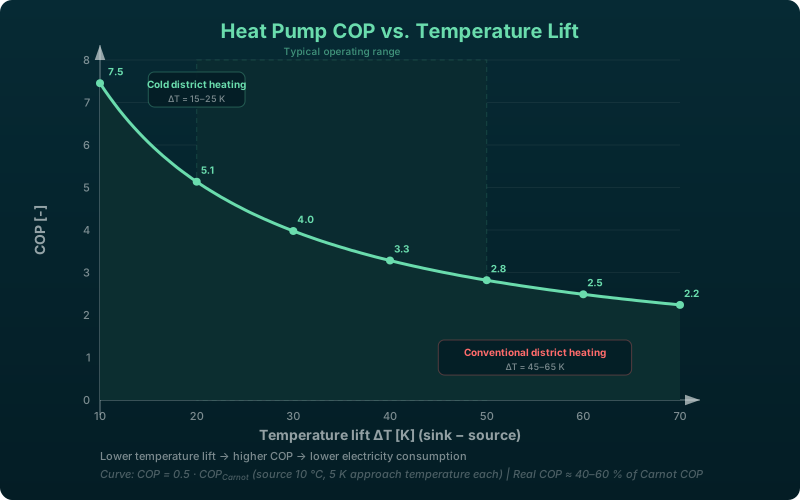
Heat pumps are assessed via the coefficient of performance (COP) and the seasonal coefficient of performance (SCOP):
The COP depends strongly on the operating temperatures. As a rule of thumb, the COP decreases by approximately 2.5% per Kelvin of temperature lift. For network applications, the following values are typical:
| Source / Supply | COP (design) |
|---|---|
| Lake water 8 °C / 50 °C supply | 4.0 — 4.5 |
| Groundwater 10 °C / 50 °C supply | 4.5 — 5.0 |
| Wastewater 15 °C / 65 °C supply | 3.5 — 4.0 |
| Air 2 °C / 50 °C supply | 3.0 — 3.5 |
COP calculation in VICUS Districts:
The heat pump simulation calculates the COP in every time step from the actual source and sink temperatures. The seasonal coefficient of performance (SCOP) follows automatically from the integration over the simulation period — considerably more accurate than a blanket standard value, because the real temperature conditions in the network are taken into account.
Which Metric to Use
The correct use and interpretation of efficiency ratings is fundamental to the assessment and comparison of heat generation technologies. For network planning, the net annual utilization rate is the decisive metric, as it encompasses all real operating conditions. CHP plants and heat pumps additionally require a weighted assessment to appropriately account for the different values of heat and electricity.
Further reading: Network Temperatures explains the influence of supply and return temperatures on COP and the efficiency of heat generators, Return Temperature Optimization shows how low return temperatures improve generator efficiency during operation, and Economic Assessment According to VDI 2067 describes the methodology for the economic evaluation of generation plants taking their efficiency ratings into account.
References and Standards
- VDI 2067 Part 1 — Economic Efficiency of Building Installations — Fundamentals and Cost Calculation
- DIN EN 15316 — Energy Performance of Buildings — Method for Calculation of System Energy Requirements and System Efficiencies
- AGFW FW 309 — Energy Performance Assessment of District Heating and District Cooling
Frequently Asked Questions
What is the difference between instantaneous efficiency and annual utilization rate?
What COP values do heat pumps achieve in district heating networks?
What is the overall efficiency of a CHP plant?
Related Articles
How is the heat load demand of a thermal network determined? Load curves, annual load duration curves and full-load hours
Overview of heat generation technologies: Wood boilers, heat pumps, solar thermal, geothermal, waste heat and CHP in comparison
Thermal energy storage for district heating networks: Sensible, latent and thermochemical storage technologies compared. Design and application areas.
Disclaimer: The content of this page is for general information purposes only and does not constitute legal, planning or engineering advice. All information is provided without guarantee. Despite careful research, VICUS Software GmbH assumes no liability for the accuracy, completeness or timeliness of the information provided. Third-party product names and trademarks are mentioned for informational purposes only and are the property of their respective owners.