Temperature Reduction in Existing Networks
Measures for reducing supply and return temperatures in existing thermal networks: Low-temperature compatibility and subnetworks
Table of Contents
Reducing supply temperatures in existing district heating networks from over 100 °C to 60 °C cuts heat distribution losses by 25 to 30%, improves the COP of heat pumps by 30 to 50% and enables the direct integration of renewable low-temperature heat sources such as solar thermal and geothermal energy. The transformation requires a coordinated approach, from smart heat meters and incentive tariffs through upgrading customer installations to subnetworks that are converted section by section to lower temperature levels.
Why Reduce Temperatures?
The motivation for reducing network temperatures arises from several factors that, taken together, offer significant economic and environmental benefits:
- Lower heat distribution losses: the heat losses of a buried pipeline are directly proportional to the temperature difference between the medium and the surrounding soil. A reduction of the mean network temperature by 20 K lowers distribution losses by approximately 25 to 30 %.
- Improved heat pump efficiency: the COP (Coefficient of Performance) of a heat pump increases as the temperature level of the heat sink decreases. Reducing the supply temperature from 80 °C to 60 °C can improve the COP by 30 to 50 %.
- Utilization of low-temperature heat sources: solar thermal, industrial waste heat and geothermal energy often deliver heat at a temperature level of 40 to 70 °C. Only at correspondingly low network temperatures can these sources be integrated directly and without additional temperature boosting.
- Higher condensing benefit: for gas and wood boilers, flue gas condensation can only be utilized at low return temperatures (below approx. 55 °C for gas, below approx. 50 °C for wood). This increases the condensing effect by 5 to 10 percentage points.
- Lower pipe stress: lower medium temperatures reduce the thermal expansion of pipelines and thus the mechanical stresses. This extends the service life and simplifies the pipe statics.
Measures for Temperature Reduction
Reducing network temperatures requires a bundle of coordinated measures. The following steps are based on the recommendations of the Planning Handbook for Thermal Networks and have proven effective in practice.
1. Assess Low-Temperature Compatibility
Before any reduction, a systematic assessment of the existing infrastructure is required. This evaluates which network sections and customer installations are already suitable for operation below 60 °C and where hydraulic or technical upgrades become necessary. This analysis covers the generation plants, the distribution network, the transfer stations and the building-side heating and hot water systems.
2. Create Incentives for Low Return Temperatures
The return temperature is largely determined by the behavior of customer installations. Return-temperature-dependent tariff models create economic incentives to operate installations optimally. Customers with low return temperatures pay less per kWh, customers with high return temperatures pay more. Dynamic tariffs — for example via transponders or digital billing systems — enable time-resolved evaluation.
3. Deploy Smart Heat Meters
Modern heat meters capture not only the transferred heat quantity but also the volume flow, the supply and return temperatures and temporal profiles. This data enables a differentiated evaluation of customer quality: Which installations cool the water optimally, which deliver excessively high return temperatures? Without this data basis, targeted optimization is virtually impossible.
4. Supply from the Return Line
Consumers with low temperature requirements — particularly underfloor heating systems with design temperatures of 35/28 °C — can be supplied via a three-pipe connection directly from the return line. This lowers the return temperature in the main network and productively utilizes the heat still present in the return. Three-pipe connections can be implemented on the primary side (before the heat exchanger) or on the secondary side (after the heat exchanger).
5. Improve the Building Envelope
Modernization of the building envelope — windows, facade insulation and roof insulation — reduces the specific heat demand of the connected buildings. A refurbished building with a heating demand of 50 kWh/(m²·a) instead of 150 kWh/(m²·a) can be supplied with a supply temperature of 55 °C instead of 80 °C. The energy refurbishment of buildings is therefore an essential prerequisite for network temperature reduction.
6. Review Heating Surfaces and Heating Operation
During building refurbishment, the conversion to low-temperature-compatible heating systems should be pursued. Underfloor heating and large-area radiators enable space heating with supply temperatures of 35 to 45 °C. Existing radiator heating systems are also frequently oversized and can — particularly after improvements to the building envelope — be operated at significantly lower temperatures. Hydraulic balancing ensures that all radiators are uniformly supplied with flow.
7. Temporary Increase of Supply Temperature
During transitional periods or cold snaps, a temporary increase of the supply temperature may be necessary to ensure security of supply. The use of heat pumps as temperature boosters makes it possible to run the base load at a low temperature level and only provide higher temperatures on demand for short periods. This approach combines the efficiency advantages of low temperatures with the flexibility of conventional supply.
Temperature reduction in VICUS Districts:
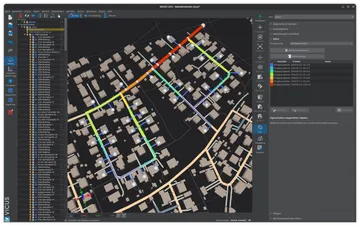
Different scenarios for a stepwise temperature reduction can be simulated: changing the heating curve, adapting the transfer stations, integrating low-temperature generators. For every scenario the simulation shows whether all consumers are still supplied adequately — and where bottlenecks may arise from undersized heating surfaces or unfavourable return temperatures.
Low-Temperature Compatibility
The conversion to low temperatures affects not only the distribution network but the entire supply system. An isolated consideration of individual components falls short — a holistic concept is required.
Heating Surfaces
The design of the heating surfaces determines the minimum required supply temperature. For a low-temperature network at 55/40 °C, the installed heating surfaces must be sufficiently large to cover the heating load at these temperatures. In practice, many existing buildings are equipped with oversized radiators and could therefore already be operated at lower temperatures today.
Domestic Hot Water Preparation
Domestic hot water preparation often poses the limiting requirement. According to DVGW Worksheet W 551, a minimum temperature of 60 °C at the outlet of the hot water heater is required to prevent the proliferation of Legionella. In small installations (residential buildings with less than 3 liters of pipe volume), this requirement may be waived. Decentralized instantaneous hot water stations using the flow-through principle offer a hygienically safe alternative at low supply temperatures, as no hot water is stored.
Control Technology
Hydraulic circuits and control valves must be suitable for variable temperatures and changed mass flow rates. When the supply temperature is reduced while the capacity requirement remains the same, the mass flow rate increases. Valves, pumps and heat exchangers must be reviewed for the new operating conditions and adjusted where necessary.
Subnetworks and Island Solutions
Where a full temperature reduction across the entire network is not feasible in the short term, subnetworks and island solutions offer a pragmatic transformation path.
Subnetworks
A subnetwork is a hydraulically separated section of the main network, connected via a heat exchanger at the feed-in point. The subnetwork has its own pressurization system and is operated at a lower temperature level than the main network. A typical configuration is a three-circuit arrangement: The main network feeds into the subnetwork via the heat exchanger, and the subnetwork supplies the connected buildings. The main network can continue to operate at a high temperature level (e.g. 90/60 °C), while the subnetwork operates at 60/35 °C.
Island Solutions
An island solution is a local network with its own heat source — such as a heat pump, a solar thermal system or a waste heat recovery installation. The island solution can be operated temporarily independent of the main network or serve as a permanent supplement. During the transition period, the main network serves as backup; in the long term, the island solution can completely replace the main network in that section.
Advantages of the Step-by-Step Approach
- Gradual transformation: the conversion is carried out section by section and can be aligned with the refurbishment cycle of the connected buildings
- Risk minimization: technical problems remain confined to individual subnetworks and do not jeopardize the overall supply
- Local optimization: each subnetwork can be individually optimized with respect to temperature level and generation technology
A Step-by-Step Transformation
Temperature reduction in existing heating networks is an iterative process that combines technical and organizational measures. There is no single lever that reduces the temperature level of an established network in one stroke. Instead, a coordinated approach is required: data acquisition through smart meters, incentives for low return temperatures, upgrading of customer installations, and the gradual introduction of subnetworks with lower temperatures. The effort is worthwhile, because lower network temperatures are the fundamental prerequisite for the economical integration of renewable heat sources and thus for the future viability of thermal networks. With VICUS Districts, various reduction scenarios can be simulated and the effects on heat losses, pump energy and generation costs evaluated across the overall system.
Further reading: Network Temperatures explains the fundamentals of temperature selection and its influence on network efficiency, Return Temperature Optimization describes the excess consumption method for systematic analysis of customer integration, and Network Operating Modes covers the various operating concepts and their influence on the temperature level.
References and Standards
- Lund, H. et al. (2014): 4th Generation District Heating (4GDH) — Integrating smart thermal grids into future sustainable energy systems. Energy, 68, pp. 1—11.
- Frederiksen, S.; Werner, S. (2013): District Heating and Cooling. Studentlitteratur, Lund.
Frequently Asked Questions
How much can heat distribution losses be reduced through temperature reduction?
What is a subnetwork in district heating temperature reduction?
What minimum temperature is required for domestic hot water in district heating?
Related Articles
Excess consumption method, influence on return temperature and incentive tariffs: Systematic optimization of customer integration
Operations monitoring, active load management and digital twin: Digital tools for the optimization of thermal networks
Efficiency measures, pump optimization and customer-side optimization: Practical approaches to improving the operation of thermal networks
Disclaimer: The content of this page is for general information purposes only and does not constitute legal, planning or engineering advice. All information is provided without guarantee. Despite careful research, VICUS Software GmbH assumes no liability for the accuracy, completeness or timeliness of the information provided. Third-party product names and trademarks are mentioned for informational purposes only and are the property of their respective owners.