Thermal Energy Storage
Thermal energy storage for district heating networks: Sensible, latent and thermochemical storage technologies compared. Design and application areas.
Table of Contents
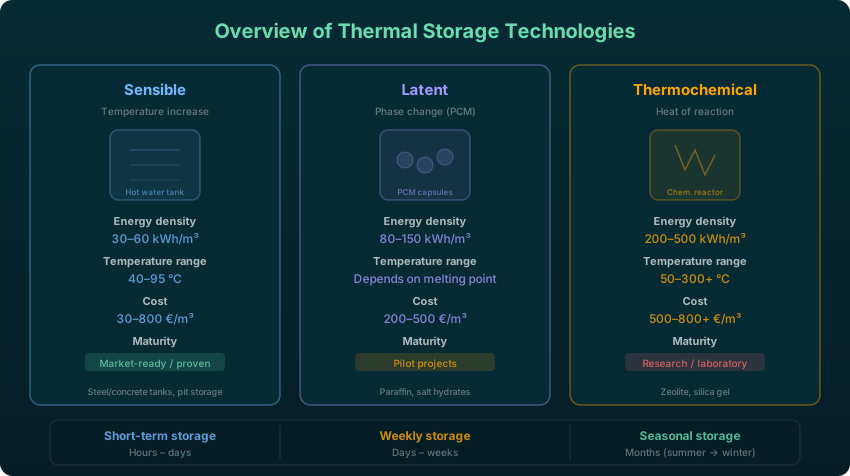
Thermal energy storage decouples heat generation from consumption over time and is therefore a key element of modern district heating networks. Short-term storage systems (steel tanks, 300—800 EUR/m³) balance peak loads over hours to days, while seasonal storage such as pit storage (30—80 EUR/m³) or aquifer systems store summer heat surpluses for winter use. The choice of storage technology, whether sensible, latent, or thermochemical, together with proper dimensioning determines the flexibility and economic viability of the entire network.
Overview of Storage Technologies
Sensible Heat Storage
In sensible storage, heat is stored by raising the temperature of a storage medium. The storable energy is calculated as:
where is the mass of the medium, is the specific heat capacity, and is the usable temperature difference. Water is the most commonly used medium due to its high heat capacity ( kJ/(kg·K)) and ease of handling.
Latent Heat Storage
Latent storage systems exploit the phase transition of a material (usually solid-liquid). The heat of fusion enables a significantly higher energy density than sensible storage at a nearly constant temperature. PCM (Phase Change Materials) such as paraffins or salt hydrates are typical storage media. The technology is still not widely adopted for network applications.
Thermochemical Heat Storage
Thermochemical storage systems use reversible chemical reactions. They offer the highest energy density and enable virtually loss-free long-term storage. However, the technology is largely still at the research stage.
Storage Types for Thermal Networks
Steel Tank (Unpressurized and Pressurized)
Unpressurized steel tanks are the standard storage type in thermal networks. They are equipped with stratification charging and discharging devices to ensure good temperature stratification. Sizes range from a few cubic meters to over 10,000 m³.
Unpressurized tanks operate at atmospheric pressure and temperatures up to 98 °C. They are cost-effective and easy to handle.
Pressurized tanks allow higher storage temperatures (> 100 °C) and thus higher energy density, but are more complex and expensive.
Concrete Tank
Concrete storage tanks are suitable for large volumes and can be partially buried in the ground. Construction costs per cubic meter decrease with increasing size.
Pit Storage
Pit storage systems are excavated, membrane-sealed and insulated pits filled with water. They are particularly suitable for large storage volumes (> 10,000 m³) for seasonal storage. Investment costs are significantly lower than those of a steel tank, although heat losses are higher.
Borehole Thermal Energy Storage
In borehole thermal energy storage (BTES), heat is stored in the subsurface via borehole heat exchangers and extracted again when needed. The surrounding soil serves as the storage medium. Advantages:
- No above-ground space requirement
- Scalable through the number of boreholes
- Well suited for combination with heat pumps
Storage temperatures are limited (typically 20 — 60 °C), which is why a heat pump is often required for heat recovery.
Aquifer Thermal Energy Storage
Aquifer thermal energy storage (ATES) uses natural water-bearing layers in the subsurface. Water is extracted via well pairs, heated, and injected into a second borehole. In winter, the process is reversed. The technology requires suitable geological conditions and water rights permits.
Dimensioning and Integration
Short-Term Storage (Hours to Days)
Short-term storage systems are typically designed for 2 to 8 hours of storage capacity at maximum generator output. They serve to:
- Balance peak loads (reduction of peak load generators)
- Decouple generation and consumption (e.g., overnight charging)
- Improve the part-load behavior of boilers (fewer starts)
Seasonal Storage (Months)
Seasonal storage systems bridge the summer heat surplus (e.g., from solar thermal) to the higher winter demand. They require large volumes and are particularly relevant when the solar fraction is high.
Hydraulic Integration
The integration of storage into the hydraulic system of the network can be achieved in various ways:
- Series: storage connected in the supply or return line
- Parallel: storage connected via three-way or four-way valve
- Charging and discharging via separate circuits: the most flexible option, but requires more control effort
The charging and discharging system must ensure good temperature stratification in the storage tank. A height-to-diameter ratio of at least 2:1 for steel tanks promotes stratification.
Costs and Economic Viability
Specific investment costs vary considerably depending on storage technology and size:
| Storage Type | Typical Costs |
|---|---|
| Steel tank (unpressurized) | 300 — 800 EUR/m³ |
| Concrete storage | 150 — 400 EUR/m³ |
| Pit storage | 30 — 80 EUR/m³ |
| Borehole thermal energy storage | 50 — 100 EUR/m (per borehole meter) |
Economic viability depends primarily on the number of full cycles per year and the avoided peak load share. In thermal networks, short-term storage systems typically have a significantly shorter payback period than seasonal storage systems.
Storage modelling in VICUS Districts:
The transfer station contains a simplified buffer storage tank that balances heat surpluses and deficits over time and is taken into account when the setpoint is formed. For more detailed storage models — stratified tanks or latent heat storage, for example — the software can be coupled with external simulation environments through the FMU interface.
Choosing and Sizing Storage
Thermal energy storage is a key element for the economical and environmentally sustainable operation of modern district heating networks. The optimal combination of storage technology, size, and hydraulic integration results from the interplay with the generation plants and the load profile of the network. Simulation tools such as VICUS Districts support the dimensioning and operational optimization of thermal storage within the context of the overall system.
Further reading: Network Operating Modes describes how storage increases the flexibility of network operating modes, Heat Load Demand and Load Profile explains the annual load duration curve as the basis for storage dimensioning, and Operational Optimization of Heat Substations shows how storage deployment can be optimized in conjunction with the generators.
References and Standards
- VDI 6002 Part 1 — Solar Domestic Hot Water Heating — General Principles, System Technology and Application
- Mangold, D.; Deschaintre, L. (2015): Seasonal Thermal Energy Storage — State of the Art and Application Examples. Solites, Stuttgart.
Frequently Asked Questions
What types of thermal energy storage exist for district heating?
How much does thermal energy storage for a district heating network cost?
How large does a thermal storage tank need to be for a district heating network?
Related Articles
How is the heat load demand of a thermal network determined? Load curves, annual load duration curves and full-load hours
Overview of heat generation technologies: Wood boilers, heat pumps, solar thermal, geothermal, waste heat and CHP in comparison
Definition and assessment of efficiency ratings in thermal networks: Instantaneous and annual utilization efficiency, weighted assessment of heat and electricity
Disclaimer: The content of this page is for general information purposes only and does not constitute legal, planning or engineering advice. All information is provided without guarantee. Despite careful research, VICUS Software GmbH assumes no liability for the accuracy, completeness or timeliness of the information provided. Third-party product names and trademarks are mentioned for informational purposes only and are the property of their respective owners.