Domestic Hot Water in District Heating
Instantaneous water heaters, storage water heaters and Legionella protection: variants of domestic hot water preparation in thermal networks
Table of Contents
Domestic hot water (DHW) preparation is the only year-round thermal load in district heating networks and it determines the entire heat demand during the summer months. Three systems are in common use. Freshwater stations achieve the lowest return temperatures (< 30 °C) with minimal Legionella risk, storage tanks with external heat exchangers reach < 35 °C, and storage tanks with internal heat exchangers stay at roughly 45 °C. Which system is chosen affects the required connection capacity and the return temperature, and with it the efficiency of the whole network.
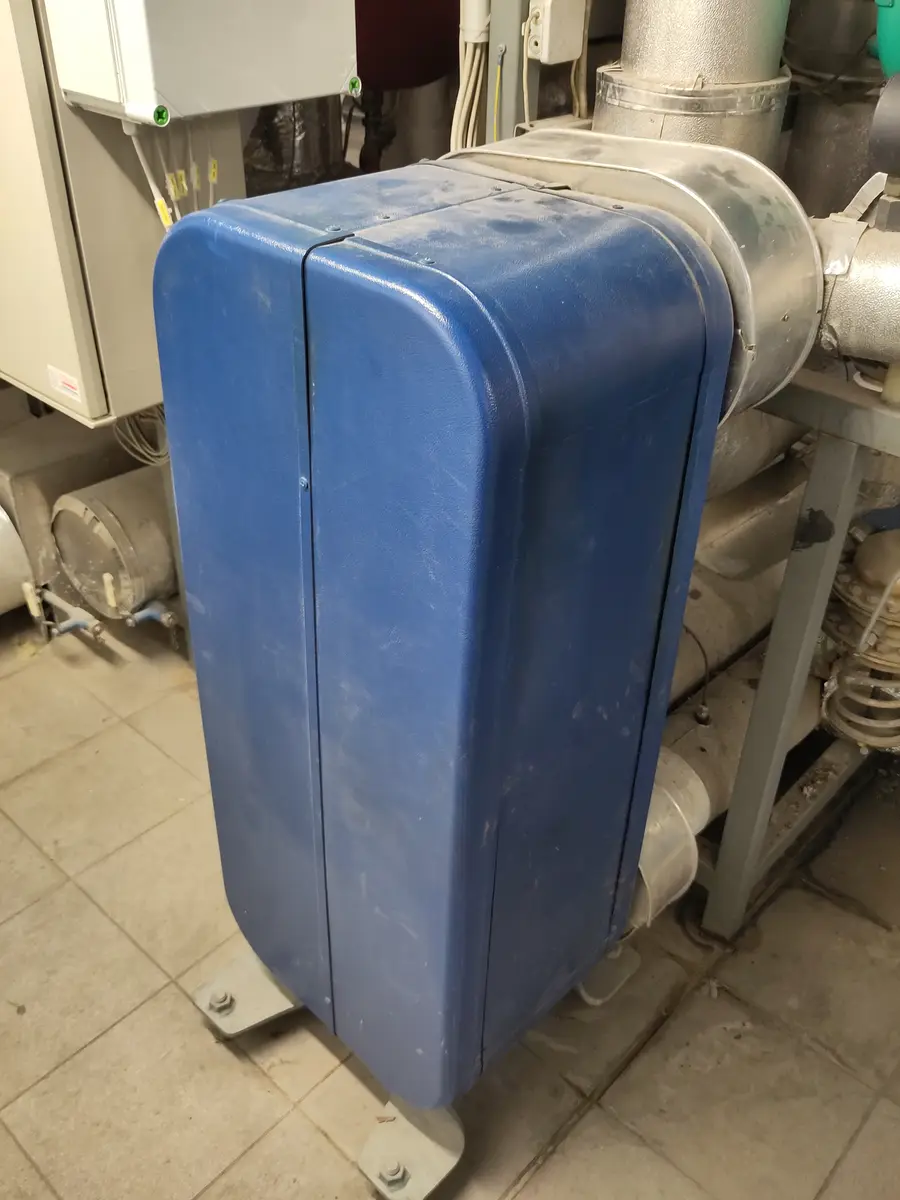
Photo: Pedalito · CC0 · via Wikimedia Commons
Variants of Domestic Hot Water Preparation
Instantaneous Water Heater (Freshwater Station)
In a freshwater station, the drinking water is heated on the instantaneous principle via a plate heat exchanger. No hot drinking water is stored; the hot water is produced directly at the time of demand.
The primary-side return temperature stays low (< 30 degrees C), because the cold water enters the heat exchanger at roughly 10 degrees C. No storage tank is needed, so the space requirement is small, and the absence of stagnant hot water reduces the Legionella risk.
The drawback is the high connection capacity, since the entire draw-off demand has to be met in real time. Limescale deposits and impurities in the drinking water can clog the heat exchanger. Stable hot water temperatures at varying draw-off rates require fast, accurate control of the primary side.
Storage Water Heater with Internal Heat Exchanger
In a storage water heater with internal heat exchanger, heating surfaces (coils or finned tube registers) sit directly inside the storage tank. The drinking water is heated and stored in the tank until drawn off.
Because the tank acts as a buffer, a high draw-off volume is available and the control requirements stay low; the system is sluggish and tolerant of fluctuations. During charging, though, the primary-side return temperature rises as the tank temperature climbs (typically up to approx. 45 degrees C). The tank also loses heat to its surroundings by radiation. This variant is not well suited to circulation, since the circulation return further raises the network return temperature.
Hot Water Storage with External Heat Exchanger
This variant combines the instantaneous and storage principle. An external plate heat exchanger heats the drinking water, and a charging pump on the secondary side delivers the heated water into the storage tank. The cold water is drawn from the lower section of the tank and heated through the exchanger in instantaneous flow mode.
The primary-side return temperature stays low (< 35 degrees C), because the exchanger operates in counterflow and the cold water enters from the cold storage zone. The tank buffers a high draw-off volume, and good stratification keeps the utilisation rate high. Against this stand the additional control and charging pump, the heat losses of the tank, and a higher installation effort than for the purely internal solution.
Comparison Table
| Criterion | Instantaneous water heater | Storage with internal HX | Storage with external HX |
|---|---|---|---|
| Return temperature | < 30 degrees C | approx. 45 degrees C | < 35 degrees C |
| Space requirement | low | medium | medium |
| Draw-off volume | limited | high | high |
| Control effort | high | low | medium |
| Legionella risk | low | present | present |
Priority of Domestic Hot Water Preparation
Priority switching determines how the available connection capacity is divided between DHW preparation and space heating, and it directly affects the required connection capacity of the transfer station.
No Priority (Parallel Operation)
DHW preparation and the heating circuit operate simultaneously and independently. The connection capacity equals the sum of both individual capacities:
This variant requires the largest connection capacity but offers maximum comfort, as there is no mutual interference.
Absolute Priority (Cylinder Priority Switching)
During DHW preparation, the heating circuit is shut down completely. The connection capacity corresponds to the higher of the two individual values:
This is the most common variant for single-family houses. Since the storage charging times are short (typically 20 to 40 minutes), the comfort loss for space heating remains minor, while the connection capacity and thus the transfer station itself come out noticeably smaller.
Reduced Heating Operation
Here the heating circuit is not shut down during DHW preparation but reduced to a setback temperature. DHW preparation keeps priority, and at least one control valve is needed to throttle the heating circuit. The result is a compromise between comfort and connection capacity.
Legionella Protection
Legionella are rod-shaped bacteria that multiply in stagnant water between 25 and 45 degrees C, with an optimum near 37 degrees C. In domestic hot water systems they pose a health risk, particularly when aerosols are inhaled during showering.
The standard SIA 385/1 sets three requirements. The discharge temperature at the draw-off point must reach at least 50 degrees C after 7 times the discharge volume. In circulation lines, the water must stay at 55 degrees C or above at all times. And water in the 25 to 45 degrees C range must not prevail permanently anywhere in the system.
Thermal disinfection is an additional measure: the entire hot water system is periodically heated to at least 60 degrees C. This assumes the district heating network can supply the corresponding network temperature, which is something to check during network planning.
Freshwater stations have a structural advantage here. Because they store no hot water, the risk of stagnant volumes in the critical temperature range does not arise.
Cold Water Preheating
An additional heat exchanger on the cold water side can preheat the incoming water using the primary-side return flow. Before the cold water reaches the actual water heater, it passes through a preheating exchanger that draws on the residual heat of the network return.
This lowers the primary return temperature further, since more heat is extracted from the return flow. The energy demand for the actual DHW preparation drops as well, because the cold water arrives already preheated. Cold water preheating works with all three DHW variants and is most effective when the heating-circuit return still sits well above the cold water temperature.
Domestic hot water preparation in VICUS Districts:
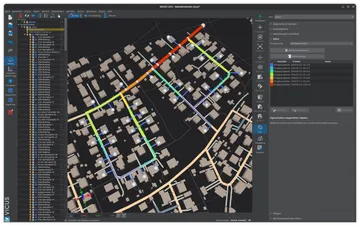
The domestic hot water demand is modelled separately from the space heating demand. For every building an annual DHW demand in kWh and a draw-off temperature can be specified. From these the software generates a demand profile that enters the network simulation as a separate load component. This allows the effects of hot water preparation on the return temperature and the network utilisation to be investigated specifically.
Choosing a DHW system
The choice of DHW preparation directly affects the return temperature and thus the efficiency of the district heating network. Freshwater stations achieve the lowest return temperatures (< 30 degrees C) and minimise the Legionella risk, at the cost of a higher connection capacity and precise control. Storage solutions with external heat exchangers offer a workable compromise between low return temperature and high draw-off capacity. Because priority switching sets the required connection capacity, it should be selected with care when dimensioning the transfer station. In VICUS Districts, the DHW preparation variants and their priority switching can be configured directly in the transfer station, and their effect on return temperature and network efficiency simulated.
Further reading: Transfer Stations describes the complete design and dimensioning of the heat transfer station, Network Temperatures explains the supply temperatures required for the various DHW preparation variants, and Hydraulic Circuit Types shows the hydraulic integration of DHW preparation into the secondary circuit.
References and Standards
- VDI 6003 — Domestic hot water heating systems — Comfort criteria and design fundamentals
- DVGW W 551 — Technical measures for reducing Legionella growth in drinking water installations
- DIN 1988-200 — Technical rules for drinking water installations — Planning, components, apparatus, materials
Frequently Asked Questions
What types of domestic hot water preparation exist in district heating networks?
What is priority switching in DHW preparation?
What temperature requirements apply for Legionella protection?
Related Articles
How to size house transfer stations: domestic hot water priority, space heating loads and diversity factors — with sizing guidance for district heating connections.
Central vs. decentralised pump concepts: sizing, index-point control and energy demand
What is a heating curve and how does it affect the design of district heating networks and heat pumps?
Pump switching and control in district heating networks: parallel and series configurations, redundancy concepts and differential-pressure control.
Disclaimer: The content of this page is for general information purposes only and does not constitute legal, planning or engineering advice. All information is provided without guarantee. Despite careful research, VICUS Software GmbH assumes no liability for the accuracy, completeness or timeliness of the information provided. Third-party product names and trademarks are mentioned for informational purposes only and are the property of their respective owners.