Digital Twin and Monitoring
Operations monitoring, active load management and digital twin: Digital tools for the optimization of thermal networks
Table of Contents
Monitoring, active load management and digital twins enable data-driven operations optimization of thermal networks that goes far beyond mere surveillance. Practical examples demonstrate natural gas savings of up to 50%, peak load reductions of 33% and return temperature decreases of up to 8 °C through predictive control. These digital tools are indispensable when decentralized generators, volatile renewable energies and flexible consumers must be coordinated across complex networks with multiple heat plants.
Monitoring and Data Acquisition
Systematic monitoring forms the foundation of any operations optimization. Without reliable operational data, neither weak points can be identified nor optimization measures evaluated.
Measurement and Control Technology
The quality management guidelines for wood-fired heating plants (QM Holzheizwerke) have become an established basis for the instrumentation of thermal networks. The sensor and data acquisition requirements defined therein can generally be transferred to all heat generators and network types. Key measured variables include:
- Temperatures: supply and return temperatures at generators, storage tanks and transfer stations
- Volume flows: mass flow rates in network sections and at feed-in points
- Energy quantities: heat meters at generators and consumers
- Pressures: differential pressures at critical network points, pump pressure
Target-Actual Comparison and Data Analysis
A key element of monitoring is the continuous target-actual comparison. Deviations from defined setpoints — such as an excessively high return temperature or unexpectedly high pump energy consumption — are automatically detected and reported. Data acquisition should be established as a continuous process, with monthly or quarterly evaluation of operational data.
Data Visualization
For meaningful presentation, it is advisable to combine several parameters in a single diagram — but no more than six parameters simultaneously to maintain clarity. Daily and weekly profiles are particularly well suited for analyzing typical operating states. At least two operating states should be examined in detail: low load in summer and full load during cold winter periods.
Active Load Management
Active load management refers to the temporal shifting of heat generation and/or heat consumption. It is an effective instrument for improving the economic viability and efficiency of thermal networks.
Objectives and Strategies
The central objectives of load management are:
- Smoothing peak loads: reducing the use of expensive peak-load generators (e.g. gas boilers)
- Optimizing the merit order: prioritizing the use of cost-effective and renewable generators
- Integrating renewable energies: temporally adapting consumption to supply (e.g. solar thermal)
Storage as Buffer
Thermal storage tanks are the classic instrument for load shifting. They can be installed centrally at the energy plant or decentrally at the customer. Central storage offers the advantage of simpler management and monitoring, while decentralized storage reduces the network load directly at the point of consumption. In both cases, they enable the temporal decoupling of generation and consumption and can effectively absorb peak loads.
Buildings as Thermal Storage
The thermal mass of buildings offers considerable potential for load management. A heating interruption of just 15 to 20 minutes can be sufficient to significantly reduce peak loads in the network — without any noticeable drop in room temperature. For process heat in industry and commerce, a reduction of connection capacity by 15 to 20 % is achievable through targeted load shifting.
Predictive Control
Modern approaches go beyond reactive control. Predictive controls use building models, weather forecasts and AI algorithms to predict future heat demand and proactively adjust generation. Forecast horizons are typically 6 to 24 hours, with shorter horizons providing higher accuracy. This can further increase the economic viability of the overall system.
The Digital Twin
A digital twin is a dynamic, digital model of the entire thermal network — including energy plant(s), pumps, pipelines, storage tanks and customer installations. Unlike static documentation, it is a model that is fed with real operational data, continuously learns and adapts to actual conditions.
Application Areas
The digital twin delivers its benefits across several phases:
- Planning instrument: planned measures (e.g. network extensions, new generators) can be simulated in advance. Network bottlenecks are identified, variants quantitatively compared.
- Operational support: malfunctions such as a faulty valve or a suboptimal control strategy can be detected from the deviation between model and reality. Adjustments can be tested on the model before implementation.
- Production planning: the merit order of heat generators is optimized, CO2 emissions are minimized, and load and temperature requirements are forecast 6 to 24 hours ahead.
Role of Numerical Simulation
Numerical simulations are an indispensable tool for the digital twin. They mathematically represent the physical relationships — hydraulics, heat transport, storage behavior — and enable quantitative statements about system behavior under various boundary conditions.
Nevertheless, they do not replace interpretation by experts: Evaluating results, placing them in the operational context and deriving concrete measures still require experience and expertise.
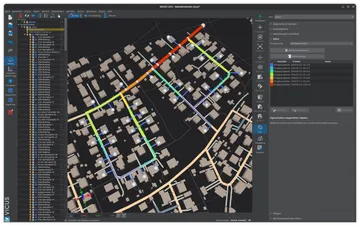
Digital twin with VICUS Districts:
The software can be used as the digital twin of a heat network. All temperatures, pressures, mass flow rates, heat outputs and pump energies are output with a time resolution. Through the FMU interface the simulation model can be coupled to external control systems or monitoring platforms, in order to run target-actual comparisons and identify optimisation potential during operation.
Practical Examples
AEW Energie AG, Maegenwil
In the Maegenwil district heating network, AEW Energie AG operates a wood-fired boiler in combination with gas-fired boilers and a thermal storage tank. Through the use of AI-based storage management, the power demand is forecast 6 to 12 hours ahead. The predictive control optimizes the use of the wood-fired boiler, maximizes its operating hours and minimizes the gas demand for peak-load coverage.
Result: Approximately 200,000 kWh/a of natural gas saved — equivalent to around 50 % of annual natural gas consumption.
St. Gallen Municipal Utilities (ZOB)
The St. Gallen Municipal Utilities employ a combination of neural networks and digital twin technology in the ZOB (Centrally Optimized Operations) project. The system achieves genuine sector coupling of heat, electricity and mobility.
Over 150 data points are continuously captured and three software systems are linked to optimize overall operations in terms of energy and economics. The project demonstrates how the coupling of different sectors opens up additional optimization potential.
District Heating Network Zurich (Yuon/Hoval)
In a district heating network in Zurich with two gas boilers (450 kW each), predictive control was implemented by Yuon and Hoval. The system uses weather forecasts and building models to proactively control heat generation. The results impressively demonstrate the potential of digital tools:
- Peak loads reduced by 33 %
- Connection capacity reduced by 26 %
- Energy consumption reduced by 39,400 kWh/a
- Return temperature reduced by up to 8 °C
From Data to Decisions
Digital tools are increasingly indispensable for the efficient operation of modern thermal networks. They span systematic data acquisition, active load management and the digital twin, and together enable proactive, data-driven operations management that improves both economic viability and environmental performance.
The practical examples show that significant savings are already being achieved today, both in energy costs and CO2 emissions. Simulation software such as VICUS Districts provides the foundation for a digital twin and supports planners and operators in exploiting the full optimization potential of their networks.
Further reading: Thermo-Hydraulic Simulation describes the numerical fundamentals of coupled pressure and temperature calculation, Network Control explains the control strategies for optimal management of thermal networks, and Operations Optimization of Heat Substations covers concrete efficiency measures on the generation and consumer side.
References and Standards
- VDI/VDE 3695 Part 1 — Engineering of Installations — Fundamentals and Planning
- Tao, F. et al. (2018): Digital Twin in Industry: State-of-the-Art. IEEE Transactions on Industrial Informatics, 15(4), pp. 2405—2415.
- AGFW FW 440 — Hydraulic Calculation of Hot Water District Heating Networks
Frequently Asked Questions
What is a digital twin in a district heating network?
How much energy can predictive control save in district heating?
What parameters are monitored in thermal network operations?
Related Articles
Excess consumption method, influence on return temperature and incentive tariffs: Systematic optimization of customer integration
Measures for reducing supply and return temperatures in existing thermal networks: Low-temperature compatibility and subnetworks
Efficiency measures, pump optimization and customer-side optimization: Practical approaches to improving the operation of thermal networks
Disclaimer: The content of this page is for general information purposes only and does not constitute legal, planning or engineering advice. All information is provided without guarantee. Despite careful research, VICUS Software GmbH assumes no liability for the accuracy, completeness or timeliness of the information provided. Third-party product names and trademarks are mentioned for informational purposes only and are the property of their respective owners.