Planning Phases of Thermal Networks
Planning phases of thermal networks: From the supply area through design to operation. The six steps of district heating network planning at a glance.
Table of Contents
Planning a thermal network follows six phases, from the preliminary study through design, tendering and construction to operational optimization and permanent operation, and typically takes two to five years. The QM Planning Handbook for Thermal Networks provides the industry-wide recognized basis for this structured workflow, in which cost accuracy improves from +/-25% in the preliminary study to +/-10% after bids are received. Careful execution of each phase avoids costly misjudgments and creates the conditions for long-term economically viable operation.
Phase 1: Preliminary Study
Objective: Clarify the feasibility of the project and identify opportunities and risks at an early stage.
In the preliminary study, the supply area is defined and an initial estimate of the heat demand is carried out. The key tasks include:
- Delineate the supply area: capture the geographic extent, settlement structure, and existing infrastructure. The situation assessment covers building inventories, existing heating systems, and potential customers.
- Identify and survey key customers: major customers such as industrial facilities, commercial enterprises, public institutions, or larger residential developers are specifically approached. Their willingness to connect is critical for the economic viability of the network.
- Develop load profile and annual duration curve: determining the temporal profile of heat demand forms the basis for sizing the generation plants and the network. The annual duration curve shows how many hours per year each power level is required.
- Assess available energy sources: available heat sources such as waste heat, biomass, solar thermal, geothermal, or heat pumps are inventoried and evaluated in terms of capacity, availability, and cost.
- Preliminary planning of route alignment and heat plant location: an initial route alignment is sketched based on the existing infrastructure and the location of customers.
- Initial economic assessment: the cost estimate at this stage has an accuracy of approximately +/- 25%. It serves as the decision-making basis for whether the project will be pursued further.
The preliminary study is frequently supported by public funding instruments, as it provides the foundation for investment decisions with comparatively low effort.
Outcome: Decision on whether to proceed with the project into the conceptual design phase.
Phase 2: Conceptual Design
Objective: Develop and evaluate one or more economically viable variants.
The conceptual design deepens the results of the preliminary study and specifies the technical and economic parameters:
- Specify key customers: detailed questionnaires covering power demand, temperature levels, connection timing, and contractual framework conditions are evaluated. Additionally, smaller customers are systematically recorded.
- Define the supply area: based on customer feedback, the final supply area is defined and divided into development stages.
- Evaluate pipe systems: various pipe systems (pre-insulated bonded pipes, flexible composite pipes, steel pipes) are compared in terms of suitability, cost, and service life.
- Second economic assessment: a detailed projected balance sheet and projected income statement are prepared. Cost accuracy is approximately +/- 15%. Sensitivity analyses show the effects of varying connection rates and energy prices.
- Prepare heat supply contracts and start customer acquisition: the coverage ratio of annual energy turnover should be secured by at least 70% through letters of intent or preliminary contracts before the implementation decision is made.
What is important in this phase is the close coordination between technical planning and commercial evaluation: a technically elegant solution that is not economically viable is rejected just as readily as a purely cost-optimized variant with technical risks.
Outcome: Decision on the implementation of the project.
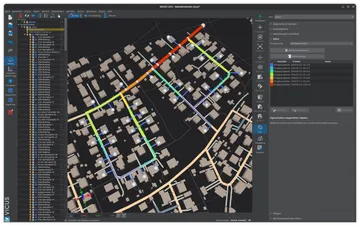
Planning export from VICUS Districts:
The network layout can be exported as a DXF file for CAD integration. In addition, a bill-of-materials function produces a list of all pipes by diameter, length and material — useful for cost estimates in the early planning phases.
Phase 3: Detailed Design, Tendering, and Award
Objective: Prepare execution so that a smooth construction and installation process is ensured.
In this phase, all technical details are worked out:
- Design of the thermal network: the pipe system is finalized, pipe diameters are dimensioned, and installation methods are determined. Valves, expansion joints, and branch connections are specified.
- Specification of transfer stations: capacity, control systems, measurement technology, and hydraulic integration of each transfer station are defined.
- Pipe stress analysis: thermal expansions, anchor point loads, and compensation measures are calculated and verified.
- Prepare drawings: site plans, longitudinal profiles, and trench cross-sections form the basis for approval procedures and tendering.
- Building permit process: depending on the municipality and the scope of the project, the approval process can take up to six months. Early submission is therefore critical.
- Tendering, bid evaluation, and award: the works are put out to tender, bids are obtained, and contracts are awarded based on defined criteria.
- Third economic assessment: based on the received bids, the economic viability is reviewed with an accuracy of approximately +/- 10%.
- Finalize TAV and heat supply contracts: technical connection requirements (TAV) and heat supply contracts are brought into their final form.
The coordination between civil engineering, pipeline construction, and building services is particularly demanding in this phase and requires clear scheduling and interface planning.
Phase 4: Construction and Acceptance
In the construction phase, the planned network is realized. Close coordination between the engineering office, contractors, and the client is essential in this phase.
The key tasks include:
- Prepare construction drawings: shop drawings and detail drawings are prepared by the contractor based on the tender documents and approved by the engineer.
- Construction supervision: proper execution is ensured through regular site inspections and documentation. Particular attention is paid to weld seam testing, correct pipe installation, and compliance with minimum cover depths.
- Commissioning: commissioning is carried out in several steps: functional testing of all components, cold commissioning (pressure testing, flushing), followed by hot commissioning with gradual temperature increase. Any defects identified are documented and rectified.
- Documentation: two types of documentation are required. The testing and verification documentation includes test reports, welding records, and pressure test certificates. The operational documentation contains operating instructions, maintenance schedules, and as-built drawings.
- Acceptance: formal acceptance is carried out against the specification document. An acceptance protocol documents the condition of the installation and any outstanding defects. The warranty period begins with acceptance.
The construction phase should take seasonal constraints into account: civil engineering work during winter months is more complex and costly, while commissioning ideally takes place at the beginning of the heating season so that regular operation can be tested under real load conditions.
Phase 5: Initial Operational Optimization
Objective: Adjust the system to optimal operation and realize savings potential.
The initial operational optimization typically takes place during the first one to two heating seasons after commissioning:
- Data acquisition: a measurement concept is developed that covers all relevant operating parameters: temperatures, flow rates, pressures, energy quantities, and electricity consumption. Reference values are recorded for subsequent target-actual comparisons.
- Analysis: the recorded data is systematically evaluated. Target-actual comparisons and graphical presentations (e.g., annual duration curves, temperature profiles) make deviations from the planning targets visible and identify optimization potential.
- Optimization: based on the analysis, specific measures are implemented: hydraulic balancing of transfer stations, adjustment of setpoints and controller parameters, optimization of time schedules for night and weekend setback, and correction of faulty settings.
Experience shows that the initial operational optimization can achieve savings of 10 to 20% in auxiliary energy demand (pump electricity) and a significant reduction in return temperatures. The investment in a thorough optimization phase therefore typically pays for itself within a few months.
Phase 6: Operation and Management
The long-term operation of a thermal network requires a structured organization:
- Operating concept: a documented operating concept governs responsibilities, operating procedures, incident management, and on-call service. It also defines the interfaces between network operator, generation plant operator, and customer service.
- Maintenance: regular servicing, inspection, and repair ensure the service life and operational reliability of the installation. A maintenance contract with defined intervals and scope of services forms the basis.
- Insurance: construction, fire, and public liability insurance cover the key risks. The insured sums are based on the replacement value of the installation.
- Customer support and acquisition: ongoing support of existing customers and the acquisition of additional heat customers secure the economic operation and improve the utilization of the network.
- Monitoring and reporting: continuous operational data collection enables the detection of gradual deterioration, such as rising return temperatures, increasing pressure losses, or declining generation efficiencies, and forms the basis for targeted countermeasures.
Quality Assurance Across All Phases
Systematic quality assurance accompanies the entire project workflow. For each of the six phases, checklists are available (e.g., Tables 6.10 to 6.15 in the planning handbook) that list all quality-relevant tasks and checkpoints. The checklists cover the following areas:
- Planning: completeness of documentation, compliance with standards and guidelines, plausibility of calculations
- Construction and installation: proper execution, material testing, documentation of installation work
- Commissioning: functional testing, documentation, defect rectification
- Operation: regular operational evaluations, maintenance records, customer satisfaction
The overarching foundation is SN EN ISO 9001, which defines requirements for a systematic quality management system. Furthermore, it is advisable to carry out external quality reviews by independent specialists at defined milestones, particularly at the transitions between phases. These peer reviews identify planning errors early and reduce the risk of costly corrections during construction.
Why the sequence matters
The structured project workflow in six phases forms the foundation for economically and technically successful operation of thermal networks. Each phase builds on the results of the preceding one and provides the decision-making basis for the next step. Early engagement of key customers, a realistic economic assessment, and consistent quality assurance are the key success factors. Planning software such as VICUS Districts supports in particular phases 1 to 3, from the initial demand estimation through hydraulic network calculation to detailed design and economic analysis.
Further reading: Supply Area and Heat Demand Density describes the criteria for delineating the supply area and identifying key customers, Economic Analysis According to VDI 2067 explains the methodology of economic evaluation in the individual planning phases, and Thermo-Hydraulic Simulation covers the calculation methods for network design in phases 2 and 3.
References and Standards
- HOAI (2021) — Fee Schedule for Architects and Engineers, Service Phases 1-9
- Nussbaumer, T.; Thalmann, S.; Zaugg, D.; Cueni, M. (2025): Planning Handbook for Thermal Networks. Version 2.0, EnergieSchweiz / Swiss Federal Office of Energy SFOE.
Frequently Asked Questions
How long does it take to plan a district heating network?
What cost accuracy do the economic assessments have across the planning phases?
What is achieved during the initial operational optimization of a district heating network?
Related Articles
Heat demand density, connection density, and key customers: Criteria for delineating the supply area of thermal networks
Software for municipal heat planning and district energy concepts: tool categories from heat cadastre to network simulation, with data, results and phases.
Disclaimer: The content of this page is for general information purposes only and does not constitute legal, planning or engineering advice. All information is provided without guarantee. Despite careful research, VICUS Software GmbH assumes no liability for the accuracy, completeness or timeliness of the information provided. Third-party product names and trademarks are mentioned for informational purposes only and are the property of their respective owners.