Network Operating Modes
Network operating modes in district heating networks: sliding, constant, and sliding-constant operation. Operating principles, advantages and disadvantages compared.
Table of Contents
The network operating mode determines whether the supply temperature of a district heating network is adjusted continuously with outdoor temperature (sliding), held constant, or operated as a combination of both (sliding-constant). Sliding-constant operation is the standard for most thermal networks because it simultaneously serves weather-dependent consumers (space heating) and weather-independent consumers (domestic hot water at a minimum of 60-65 degC). The choice of operating mode directly affects heat losses, generation efficiency, and security of supply, and is specified in the Technical Connection Regulations (TAV) of each network operator.
Sliding Operation
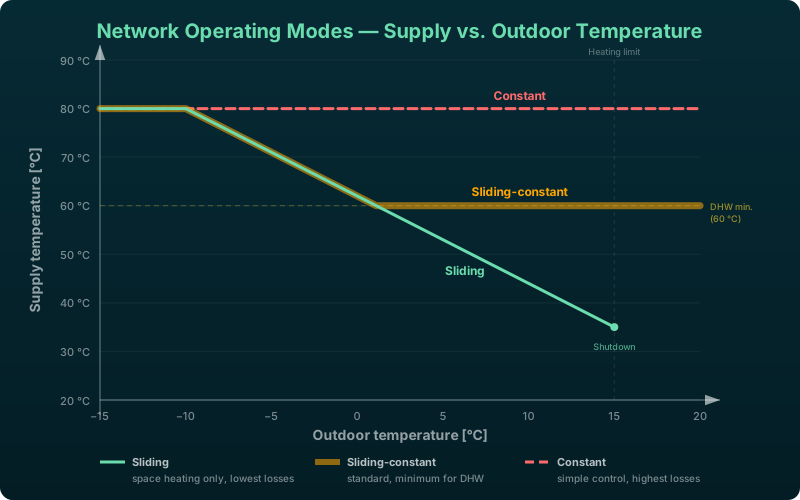
In sliding operation, the supply temperature is continuously adjusted along the heating curve as a function of outdoor temperature:
- As outdoor temperature drops, the supply temperature rises gradually to the maximum value
- As outdoor temperature rises, the supply temperature decreases gradually until the heating limit is reached and heat supply is discontinued
Advantages:
- Minimum heat losses, as the supply temperature is always matched to the current demand
- High efficiency for heat pumps and condensing boilers due to low return temperatures (see return temperature optimization)
Purely sliding operation is only suitable for space heating and other weather-dependent consumers. It is unsuitable for domestic hot water preparation or process heat that requires a constant minimum temperature level.
Sliding-Constant Operation
Sliding-constant operation is the most common operating mode for thermal networks, as it enables simultaneous supply of different consumer types:
- As outdoor temperature drops, the supply temperature rises gradually to the maximum value
- As outdoor temperature rises, the supply temperature decreases gradually, but only to a minimum value that is not undercut
The minimum value is determined by the requirements of weather-independent consumers, typically domestic hot water preparation (at least 60 — 65 °C supply temperature) or process heat.
Advantages:
- Good compromise between efficiency and security of supply
- Weather-dependent and weather-independent consumers can be supplied simultaneously
Constant Operation
In constant operation, the supply temperature is kept constant regardless of outdoor temperature:
- The supply temperature corresponds to the maximum required by all consumers
- Flow control is achieved via the volume flow rates at the transfer stations
Advantages:
- Simple control
- All consumers can be supplied with the full supply temperature at any time
Disadvantages:
- Higher heat losses, as the supply temperature remains at the maximum value even at low demand
- Unfavorable for heat pumps and condensing boilers
Constant operation is primarily used for process heat or in networks with predominantly weather-independent consumers.
Control Variable: Supply Temperature
The supply temperature of the network is typically controlled based on an outdoor temperature averaged over 12 to 25 hours. This prevents:
- Excessively rapid temperature changes in the network due to short-term weather fluctuations
- Excessive supply temperatures during brief cold spells
- Unnecessary control activity of the generation plants
The currently measured outdoor temperature should under no circumstances be used directly as a control variable, as this leads to unstable network operation.
Influence on Heat Losses and Efficiency
The network operating mode has a direct influence on the efficiency of the overall system:
| Operating mode | Heat losses | Heat pump efficiency | Boiler efficiency |
|---|---|---|---|
| Sliding | Low | High | High (condensing) |
| Sliding-constant | Medium | Medium | Medium — High |
| Constant | High | Low | Medium |
The heat losses of a thermal network depend linearly on the difference between network temperature and ambient temperature. A temperature reduction of the average network temperature by 10 K typically reduces heat losses by 10 — 15%.
Network operating modes in VICUS Districts:
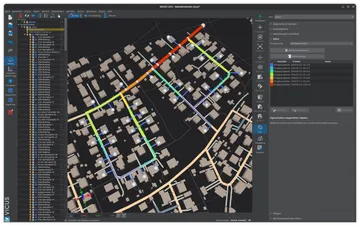
Operating modes arise from the combination of heating curve and pump control: a sliding mode results from an outdoor-temperature-controlled heating curve with a controlled pump, a constant mode from a fixed supply temperature with a constant-pressure pump. Time-dependent setpoint profiles allow a seasonal changeover to be represented as well. The steady-state analysis can evaluate several operating points: maximum heating power (annual or monthly), at specific hours of the year, at part load (as a percentage) and at connection load — so the network behaviour can be checked both under design conditions and in the critical summer minimum-load case.
Seasonal Operating Adjustments
Many networks use seasonal adjustments to their operating mode:
- Winter operation: sliding-constant operation with maximum temperature
- Summer operation: reduced constant supply temperature, only for hot water and minimum heat losses
Summer operation typically requires only 15 — 25% of the winter volume flow rate. Some networks use a separate, smaller summer pump for this purpose, which achieves better efficiency for this load range.
Choosing the right operating mode
The choice of network operating mode is a fundamental planning decision that affects heat losses, generation efficiency, and customer satisfaction. Sliding-constant operation has proven to be the standard solution for most thermal networks. For low-temperature networks with heat pumps, sliding operation offers the highest efficiency. The effects of different operating modes on the overall system can be studied in detail with simulation software such as VICUS Districts.
Further reading: Network Temperatures — the temperature level of the network determines the selectable operating mode, Pump Switching and Control — the pump control must be adapted to the chosen operating mode, Network Control — control strategies for implementing the operating mode during operation.
References and Standards
- AGFW FW 440 — Hydraulic Calculation of Hot Water District Heating Networks
- Lund, H. et al. (2014): 4th Generation District Heating (4GDH). Energy, 68, pp. 1—11.
Frequently Asked Questions
What are the operating modes of a district heating network?
Which operating mode is most energy-efficient for district heating?
How much do heat losses decrease with lower network temperatures?
Related Articles
What operating pressure, rest pressure, MOP, MIP and the nominal pressure rating mean, why gauge pressure is the working convention, and how the minimum pressure follows from the saturation pressure plus 1.5 bar
Pressurization systems in thermal networks: open and closed systems, pre-charge pressure from the static height, expansion volume and make-up water
The pressure diagram of a heat network: static pressure, rest pressure and pressure loss, the index point and the minimum differential pressure of 0.5 to 1.0 bar required there
Control concepts for thermal networks: differential pressure control, index point and control with multiple feed-in points
Disclaimer: The content of this page is for general information purposes only and does not constitute legal, planning or engineering advice. All information is provided without guarantee. Despite careful research, VICUS Software GmbH assumes no liability for the accuracy, completeness or timeliness of the information provided. Third-party product names and trademarks are mentioned for informational purposes only and are the property of their respective owners.