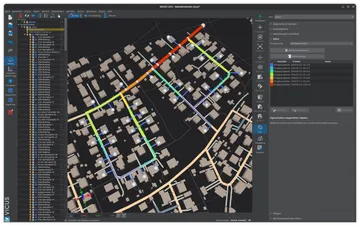
Validation Standards for Building Simulation
ASHRAE 140, EN 15255/15265, EN ISO 13791, IEA SHC Task 34, CIBSE TM 33 — overview of validation procedures for thermal building simulation.
Table of Contents
Validation standards such as ASHRAE Standard 140, EN 15255/15265 (now superseded by EN ISO 52016-1), EN ISO 13791 and CIBSE TM 33 verify the correct implementation of physical algorithms in building simulation software using defined test cases with reference results. For summer thermal protection in Germany, DIN 4108-2 is the decisive standard; it references EN ISO 13791 as the validation framework for the simulation tool used. Internationally, ASHRAE 140 is the minimum requirement. A program’s published validation documentation is a key selection criterion for engineers and designers.
Why validation?
A dynamic building simulation program solves complex physical equations: heat conduction, radiation, convection, ventilation, HVAC control. Errors in the implementation lead to erroneous results that are hard to detect in practice. Validation standards provide an objective basis for checking the correct implementation of the physical algorithms. They do not replace the user’s plausibility check, but they do give the assurance that the computational core is working correctly.
ASHRAE Standard 140
Background
ASHRAE Standard 140 (Standard Method of Test for the Evaluation of Building Energy Analysis Computer Programs) is the most widely used validation standard internationally. It was first published in 2001 and is updated regularly. The standard originates from the BESTEST procedure (Building Energy Simulation Test), developed in the 1990s within the framework of the IEA (International Energy Agency).
Test cases
The standard comprises several test series:
- Building Thermal Envelope: test cases with a simple single-zone building under various boundary conditions, from opaque components, glazings and solar shading to internal loads, night ventilation and ground coupling. The results (heating and cooling energy demand, peak loads) are compared with reference results from several validated programs.
- HVAC systems: test cases for mechanical cooling and heating, including capacity control and part-load behaviour.
- Ground-coupled heat transfer: test cases for heat transfer through ground-coupled components were introduced via Addendum a to ASHRAE 140-2011 (published 2015) and have been part of the base standard since ASHRAE 140-2017.
Evaluation
There is no rigid pass-or-fail criterion. The results of a program are compared with the spread of the reference programs. If a result falls outside this spread, an investigation is required: there may be an error in the program, but there may also be a legitimate modelling approach that differs from the reference programs.
Software with ASHRAE 140 validation
EnergyPlus, IDA ICE, TRNSYS, ESP-r, VICUS Buildings (via NANDRAD/SimQuality) and many other programs have run through ASHRAE 140 test cases and publish the results.
Validation of VICUS Buildings
The simulation core is validated with an extensive test suite covering single zones, windows, solar radiation, shading, long-wave radiation, infiltration, surface heating systems and network models. Reference results are available for each test case, enabling verification against international validation standards such as ASHRAE 140 and the European test-case sets of EN 15255/15265.
EN 15255 and EN 15265
Background
The European standards EN 15255 and EN 15265 are part of the EPBD set of standards (Energy Performance of Buildings Directive) and define validation test cases for simulation programs used in the context of European energy-saving legislation.
- EN 15255 (Energy performance of buildings — Sensible room cooling load calculation — General criteria and validation procedures): defines test cases for calculating the sensible cooling load of a room. The test cases check the correct representation of solar radiation, internal loads and thermal mass.
- EN 15265 (Energy performance of buildings — Calculation of energy needs for space heating and cooling using dynamic methods — General criteria and validation procedures): defines test cases for calculating the heating and cooling energy demand using dynamic methods. The standard comprises 12 test cases (4 introductory + 8 main validation tests) with a single-zone building under systematically varied boundary conditions (orientation, glazing, shading, internal loads, ventilation, control).
Status
EN 15255:2007 and EN 15265:2007 have been withdrawn and replaced by EN ISO 52016-1:2017 (with EN ISO 52017-1:2018 covering the load reference method). The original test-case sets remain in use as benchmarks in vendor validation reports and in the literature.
Significance
EN 15255 and EN 15265 formed the basis for the recognition of dynamic simulation methods within the framework of national energy-saving regulations and continue to do so via EN ISO 52016-1. In Germany, dynamic simulation is permitted as a verification method for summer thermal protection in accordance with DIN 4108-2.
Software with EN 15255/15265 validation
IDA ICE has published a validation report against EN 15265 and is thus one of the few programs that cover both ASHRAE 140 and the European test-case sets in documented form. No public EN 15255/15265 validation reports are available for EnergyPlus and TRNSYS.
EN ISO 13791
Background
EN ISO 13791 (Thermal performance of buildings — Calculation of internal temperatures of a room in summer without mechanical cooling — General criteria and validation procedures) defines test cases for calculating summer room temperatures without active cooling. The standard is particularly relevant for the validation of simulation tools used for verification of summer thermal protection.
Test cases
The standard comprises four validation test cases, each isolating a specific physical mechanism:
- Test case 1, heat conduction through opaque components: tests the correct representation of transient heat conduction and thermal mass.
- Test case 2, long-wave radiation balance indoors: tests the radiative exchange between interior surfaces.
- Test case 3, short-wave radiation and shading: tests the distribution of solar radiation in the room and shading calculation.
- Test case 4, composite multi-room test: tests the correct coupling of the sub-models in a multi-zone configuration with heat transfer between rooms.
Status
EN ISO 13791 was withdrawn on 9 April 2025; its calculation methodology has been migrated into EN ISO 52016-1 and EN ISO 52017-1. In Germany, DIN 4108-2 still references EN ISO 13791 as the validation framework for the simulation tool used, so the test cases remain in practical use.
IEA SHC Task 34 / EBC Annex 43
Background
IEA SHC Task 34 (Testing and Validation of Building Energy Simulation Tools) was an international research project of the International Energy Agency (Solar Heating and Cooling Programme) that ran from 2003 to 2007; the final reports were published through 2009. It was carried out jointly with EBC Annex 43 (Testing and Validation of Building Energy Simulation Tools) of the Energy in Buildings and Communities Programme.
Contents
The project went beyond the existing BESTEST test cases and developed additional validation procedures:
- Multi-zone models: test cases for buildings with several thermally coupled zones, including heat transfer through interior walls.
- Ground coupling: extended test cases for ground-coupled components, which were later incorporated into ASHRAE 140.
- Mechanical systems: test cases for HVAC components and their control.
- Empirical validation: comparison of simulation results with measurement data from real buildings and test cells.
Significance
IEA SHC Task 34 significantly advanced the validation methodology for building simulation. Many of the developed test cases have been incorporated into subsequent revisions of the standards. The empirical validation, the comparison with real measurement data such as those generated for a digital twin, complements the analytical validation of the other standards and significantly increases their expressiveness.
Participating software
Software participating in the project included EnergyPlus, ESP-r, IDA ICE, TRNSYS and VA114, among others. IDA ICE published extensive validation results within the framework of Task 34, especially for multi-zone models and empirical test cases.
CIBSE TM 33
Background
CIBSE TM 33 (Tests for Software Accreditation and Verification, 2006) was developed by the Chartered Institution of Building Services Engineers (CIBSE) in the United Kingdom. It defines a series of test cases that vendors can use to demonstrate the correct implementation of their simulation software. CIBSE has since archived the document.
Test cases
TM 33 comprises test cases that focus on calculations relevant in British practice:
- Heating and cooling energy calculation
- Daylight calculation
- Overheating risk (summer thermal protection)
- CO₂ emissions calculation
Significance and distinction from Part L accreditation
TM 33 is frequently published by software vendors as a self-verification report and serves users as a confidence signal. It is not the formal accreditation route for the British Building Regulations: Part L compliance is administered through the National Calculation Methodology (NCM), via SAP for dwellings and via SBEM or approved Dynamic Simulation Models for non-dwellings (administered by BRE/MHCLG).
Software with TM 33 validation reports
EQUA has published a CIBSE TM 33 validation report for IDA ICE (December 2007). TAS (EDSL) and DesignBuilder (via EnergyPlus) likewise publish TM 33 validation results. For Part L verifications, these programs are listed individually on the NCM list of approved software.
Comparison table: validation standards by software
| Standard | EnergyPlus | IDA ICE | TRNSYS | VICUS Buildings |
|---|---|---|---|---|
| ASHRAE 140 | Yes | Yes | Yes | Yes (SimQuality) |
| EN 15255 | — | Yes | — | In preparation |
| EN 15265 | — | Yes | — | In preparation |
| EN ISO 13791 | — | Yes | — | In preparation |
| IEA SHC Task 34 | Yes | Yes | Yes | — |
| CIBSE TM 33 (report) | Via DesignBuilder | Yes | — | — |
| SimQuality | — | — | — | Yes |
| DIN 4108-2 verification | — | Yes | — | Yes |
As of April 2026. ”–” means: not published or not carried out. EN 15255, EN 15265 and EN ISO 13791 have been withdrawn as CEN standards; the test-case sets remain in use as validation benchmarks.
IDA ICE in detail
IDA ICE (Indoor Climate and Energy) from EQUA Simulation AB has one of the most extensive validation histories on the market. The software has completed and published the following validations:
- ASHRAE 140: complete test series for the building envelope (Section 5.2) and HVAC equipment tests (Sections 5.3–5.5); reports published against ASHRAE 140-2004 and 140-2023.
- EN 15265: all 12 test cases passed, predominantly in accuracy classes A and B (heating: 9× A, 3× B; cooling: 6× A, 5× B, 1× C).
- EN 15255: cooling load calculation validated.
- EN ISO 13791: validation report published for all four test cases.
- IEA SHC Task 34 / Annex 43: active participation in the research project with results for multi-zone models and empirical validation.
- CIBSE TM 33: validation report (December 2007) published.
This broad validation base makes IDA ICE one of the best-validated commercial simulation programs. For projects that require formal validation in accordance with European standards, this is a relevant advantage.
VICUS Buildings and SimQuality
VICUS Buildings uses the simulation engine NANDRAD, which was validated within the framework of the SimQuality project. SimQuality is a research project funded by the German Federal Ministry of Economic Affairs (BMWi/BMWK) and led by TU Dresden (Institute of Building Climatology) together with RWTH Aachen (Chair of Energy Efficient Building) that has developed an independent set of validation test cases. The test cases draw on ASHRAE 140 BESTEST and EN ISO 13791 and add further tests targeting individual physical models, plant coupling and boundary conditions. NANDRAD’s results, alongside those of IDA ICE, TRNSYS, TAS, AixLib (Modelica), THERAKLES and ETU-Simulation, are published on the SimQuality results platform. Beyond this, NANDRAD is validated against ASHRAE 140 test cases.
Validation against the historical test-case sets of EN 15255, EN 15265 and EN ISO 13791 is in preparation. For the verification of summer thermal protection in accordance with DIN 4108-2, VICUS Buildings can already be used.
Which standard for which purpose?
| Use case | Recommended validation |
|---|---|
| International comparison | ASHRAE 140 |
| Energy performance certificate / EPBD | EN ISO 52016-1 (formerly EN 15265) |
| Summer thermal protection (DE) | DIN 4108-2 with EN ISO 13791 as the validation framework |
| Cooling load calculation | EN ISO 52016-1 / 52017-1 (formerly EN 15255) |
| British Building Regulations | NCM listing (SAP/SBEM/DSM); CIBSE TM 33 as a complementary report |
| Research / multi-zone | IEA SHC Task 34 |
What validation tells you
Validation is not a one-off seal of quality, but an ongoing process. Every new program version should be tested against the relevant standards. For users, the published validation documentation is an important selection criterion for the software comparison: it shows not only that a program calculates correctly, but also that the vendor provides transparency about the capabilities of its software.
When selecting a simulation software, the validation should be evaluated in the context of the use case: for summer thermal protection in Germany, DIN 4108-2 is decisive, with EN ISO 13791 as the validation framework for the tool used. For international projects, ASHRAE 140 is the standard. For the British market, the listing as an approved DSM under the NCM is what counts; CIBSE TM 33 serves as a complementary validation report. As validated building simulation software, VICUS Buildings covers the core validation through SimQuality and ASHRAE 140 and is progressively extending this with the historical CEN test-case sets.
Further reading: Dynamic Building Simulation — what gets validated: the simulation method itself, Building Simulation Software Comparison — the tools being tested and their validation coverage, Summer Thermal Protection in Accordance with DIN 4108-2 — a practical application where validated software is essential.
References and Standards
- ASHRAE Standard 140 — Standard Method of Test for the Evaluation of Building Energy Analysis Computer Programs
- EN ISO 52016-1:2017 — Energy performance of buildings — Energy needs for heating and cooling, internal temperatures and sensible and latent heat loads — Calculation procedures (successor to EN 15255 and EN 15265)
- EN ISO 13791 — Thermal performance of buildings — Calculation of internal temperatures of a room in summer without mechanical cooling — General criteria and validation procedures (withdrawn 2025)
- DIN 4108-2 — Thermal protection and energy economy in buildings — Minimum requirements for thermal insulation
- VDI 6020 — Requirements on methods of calculation to thermal and energy simulation of buildings and plants
- CIBSE TM 33:2006 — Tests for Software Accreditation and Verification (archived)
- IEA SHC Task 34 / EBC Annex 43 — Final reports (2008–2009)
- SimQuality project — final report and test-case results: simquality.org
- Judkoff, R.; Neymark, J. (1995): International Energy Agency Building Energy Simulation Test (BESTEST) and Diagnostic Method. NREL/TP-472-6231.
Frequently Asked Questions
What validation standards exist for building simulation software?
Which building simulation software is most comprehensively validated?
Is VICUS Buildings validated for summer thermal protection under DIN 4108-2?
Related Articles
Building simulation explained: dynamic vs. steady-state calculation, fields of application, result quantities and software for thermal building simulation.
Verification per DIN 4108-2: solar heat gain coefficient vs. dynamic building simulation — methods, overheating degree hours and the 1200 Kh limit.
From BIM model to simulation: how IFC files improve the workflow between CAD and building simulation
Comparison of steady-state energy demand calculation and dynamic simulation: methods, accuracy and fields of application
Disclaimer: The content of this page is for general information purposes only and does not constitute legal, planning or engineering advice. All information is provided without guarantee. Despite careful research, VICUS Software GmbH assumes no liability for the accuracy, completeness or timeliness of the information provided. Third-party product names and trademarks are mentioned for informational purposes only and are the property of their respective owners.