Pressure Profile and Pressure Diagram
The pressure diagram of a heat network: static pressure, rest pressure and pressure loss, the index point and the minimum differential pressure of 0.5 to 1.0 bar required there
Table of Contents
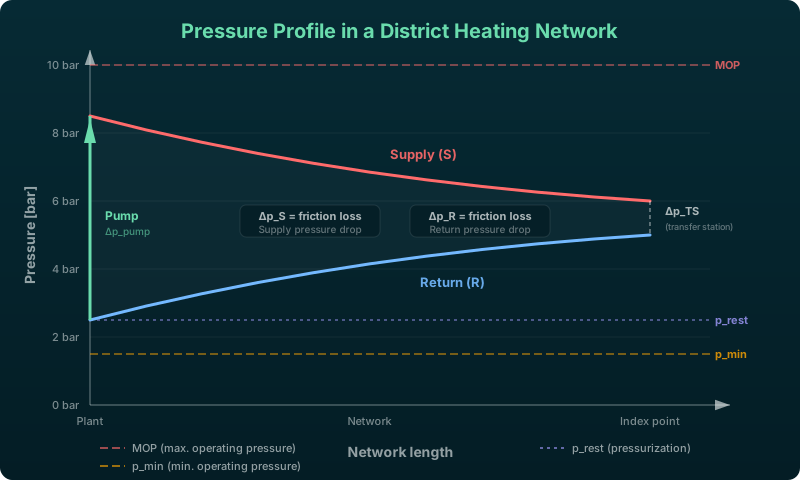
The pressure diagram plots the pressure along the network length from the feed-in point to the index point and superimposes static pressure, rest pressure, and dynamic pressure loss. It shows whether all pressure limits are met and whether the required minimum differential pressure is still available for the transfer stations at the index point, the location with the lowest differential pressure — typically 0.5 to 1.0 bar, with 0.8 to 1.0 bar as the planning value; the technical connection requirements (TAB) of the network operator are binding. It is the central planning tool for the pressure conditions in thermal networks.
What Limits the Diagram Checks
The pressure diagram is the presentation; the limits themselves come from elsewhere. Upwards, the maximum permissible operating pressure MOP of the weakest component on the path has to be met; downwards, the minimum operating pressure from the saturation pressure at the hottest point of the supply line plus a safety margin of roughly 1.5 bar. Added to these are the briefly permissible incident pressure MIP and the test pressure of the leak tightness test.
What these terms mean, which nominal pressure ratings the pipe systems permit, why gauge pressure is the working convention and how the margin of 1.5 bar is derived is covered by Meeting Operating Pressure Limits in Heat Networks. Nothing is repeated here, it is applied: the diagram makes visible whether the limits hold at every point and in every load case.
Structure of the Pressure Diagram
The pressure diagram shows the pressure profile as a function of network length from the feed-in point to the index point. It is composed of several components:
Static Pressure
The static pressure at a network point follows from its elevation difference to the reference point of the pressurization system — not from its position relative to the lowest point in the network:
where:
- : static pressure component at network point relative to the reference point [Pa]
- : density of the network water [kg/m³]
- : acceleration due to gravity, 9.81 [m/s²]
- : elevation of the reference point of the pressurization system [m]
- : elevation of the network point considered [m]
Points below the reference point therefore gain a contribution, points above it lose one. The difference between the highest and the lowest point in the network does not set the pressure level itself, only the spread between the smallest and the largest static pressure in the network. As an order of magnitude: 10 m of elevation difference correspond to roughly 1 bar, so 1 m to roughly 0.1 bar.
The static component is independent of the operating state and is determined by the geodesy alone. What counts is the elevation of the pipe axis, that is the terrain elevation minus the burial depth; how reliable the underlying elevation values are and which terrain model is suitable for the purpose is covered in Terrain Elevation and Topography in Network Planning.
Rest Pressure (pressurization)
The rest pressure is the pressure in the network with the pump switched off. It is determined by the pressurization system and must ensure the minimum operating pressure at every point of the network. How it is formed from the static height and the fill pressure margins, and which pressurization system is suitable, is covered by Pressurization and Expansion.
Network Pressure Loss
The dynamic pressure component arises from friction and local resistance losses during flow through the network (see pressure loss calculation). It is generated by the pump and changes with the volume flow rate:
- Supply pressure profile: pressure decreases from the feed-in point to the index point
- Return pressure profile: pressure continues to decrease in the direction of flow, from the index point back to the feed-in point, where it reaches the value set by pressure maintenance on the pump suction side
- Transfer station differential pressure: difference between supply and return pressure at the customer connection
The Superposition
Formally, the supply pressure at a point is composed of the level of the pressurization system, the geodetic component, the pump head and the friction losses accumulated up to that point:
For the return line the calculation runs the other way — the pressure lies above the level at the connection point of the pressurization system by the friction losses of the return path:
where:
- : pressure at the point of pressurization [bar]
- , : geodetic elevation of the pipe axis at the reference point and at point [m]
- : pump head as a pressure difference [bar]
- : friction and local resistances of the respective section [bar]
The difference of the two equations shows an important effect directly: in the available differential pressure the geodetic term drops out, in the two individual pressure levels it does not. Geodesy therefore loads the pressure limits, not the differential pressure.
The Governing Load Cases
The upper and the lower limit become governing in different operating states. A diagram that shows only the design case regularly misses the lower limit:
| Load case | What governs |
|---|---|
| Design case — maximum load, maximum volume flow, maximum supply temperature | Upper limit: highest pressure at the pump outlet and at the geodetic low point. At the same time the differential pressure at the index point is smallest here. |
| Pump at a standstill — rest pressure case | Lower limit at the high point: without pump head the supply line drops to the rest pressure level. This case is missed most often because it does not appear in a steady-state design calculation — yet it occurs for real after a pump failure, that is while the network water is still hot. |
| Part load | The friction losses fall quadratically and the diagram flattens. What matters is whether the control system still holds the differential pressure at the shifting index point. |
| Summer minimum load | The lower limit again: the volume flows approach zero while the saturation pressure stays high, because the supply temperature is held for domestic hot water. |
Total Pressure
The maximum network pressure (superposition of static and dynamic components) occurs at maximum load at the design point and at maximum network temperature. This value must not exceed the MOP at any point.
The Index Point
The index point (also referred to as the network’s weakest point) is the location in the network with the lowest differential pressure between supply and return. Supply shortages are most likely to occur at this point.
Characteristics:
- The index point shifts depending on the current heat demand in the network
- It is typically the most remote customer
- The minimum differential pressure at the transfer station is typically 0.5 to 1.0 bar there, with 0.8 to 1.0 bar established as the planning value; the technical connection requirements (TAB) of the network operator are always binding
The network pump must be sized (see pump sizing) so that the required differential pressure at the index point is guaranteed even under the most unfavorable operating conditions.
Where the Figure Comes From
The required minimum differential pressure is not an unexplained rule of thumb but the sum of the pressure losses a transfer station has to cover on the primary side:
- service line from the route into the building, there and back,
- primary-side pressure loss of the heat exchanger at design output,
- strainer, isolating valves and heat meter,
- control valve with sufficient valve authority — for the control to work stably, a substantial share of the available differential pressure has to drop across the valve rather than across the fixed resistances.
The last point dominates the sum: a control valve left with too little differential pressure loses its authority, works only in the upper part of its travel and tends to oscillate. From this sum follows the usual range of 0.5 to 1.0 bar; 0.8 to 1.0 bar have become established as the planning value. The lower end of the range presupposes short service lines and a heat exchanger with low pressure loss, and carries no reserve.
The technical connection requirements of the network operator are binding in every case. They set the figure that is planned and commissioned against, and they can differ per pressure zone.
Practical Values from a Real Set of Connection Requirements
The following values come from the technical connection requirements of a network operator with three separate pressure zones (as of 10/2024). They show the spread that can occur between the zones of a single supplier:
| Quantity | Network A | Network B | Network C |
|---|---|---|---|
| max. gauge pressure in the network | 16.0 bar | 9.5 bar | 9.1 bar |
| rest gauge pressure | 4.0 bar | 5.5 bar | 3.5 bar |
| max. differential pressure | 8.0 bar | 3.2 bar | 5.0 bar |
| min. differential pressure | 1.0 bar | 0.8 bar | 0.8 bar |
The second limit is notable: alongside the minimum differential pressure there is a maximum one. Transfer stations close to the feed-in receive considerably more differential pressure than the index point, and their control valves have to hold that pressure tight when closed. A network that supplies the index point purely by raising the pump head will at some point exceed this upper limit at the nearest stations.
Available and Required
The two quantities have to be kept apart cleanly. The available differential pressure is a network quantity: it arises from pump head and pipe network losses and is, at the transfer point, the result of the hydraulic calculation. The required differential pressure is a plant quantity: it follows from the design of the station and its rated output. The check is that the available reaches the required at every transfer point — in the least favourable operating case, not on average. Too little means the station cannot draw its output; too much means noise, valve wear and a hydraulic balancing exercise that has to destroy the surplus.
Pressure Boosting and Network Separation
Booster Station
In larger and more extensive networks, it can be economically advantageous to install a booster station at the periphery of the network rather than generating the entire pressure loss centrally through the main pump.
Advantages:
- Reduced operating pressure in the central network
- Lower nominal pressure rating possible
- Smaller central network pumps
Network Separation
Network separation refers to the hydraulic decoupling of two otherwise connected circuits. Possible reasons:
- Protection against excessive pressures (geodetic elevation differences)
- Separation when using different media (e.g., steam-water)
- Different network parameters (pressure, temperature, water quality)
- Secondary networks with their own pressurization
Network separation is achieved via heat exchangers, where the exergy loss should be minimized through the lowest possible temperature approach in the heat exchanger.
Practical Guidelines
The following points should be considered when creating a pressure diagram:
- Survey the elevation profile of the pipe axis (see Terrain Elevation and Topography in Network Planning) and calculate the static pressure relative to the reference point of the pressurization system
- Pressure losses of individual pipe sections at design load
- Pressurization selected so that the minimum operating pressure is maintained at the highest point
- MOP is not exceeded at any point in the network (also check at part load)
- Differential pressure at the index point is sufficient for the transfer stations
The pressure diagram should be created for the design case (maximum load) and the part-load case, as the pressure conditions change with the volume flow rate. The results can be validated using thermo-hydraulic simulation.
Pressure calculation in VICUS Districts:
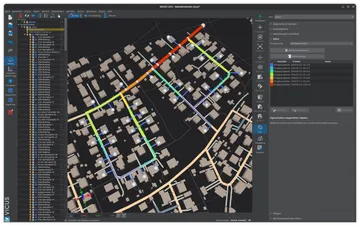
The location of the pressurization and the rest pressure can be set freely. With a controlled pump the index point is determined automatically, so the required minimum differential pressure is always available at the least favourable consumer. The complete pressure profile of the network is available as a simulation result.
The pressure diagram as a planning basis
The pressure diagram is an indispensable planning tool that ensures compliance with all pressure limits and enables the correct sizing of pumps, pressurization systems, and, where applicable, booster stations. It should be updated during every planning phase and forms the basis for safe network operation.
Further reading: Meeting Operating Pressure Limits in Heat Networks — where the limits checked in the pressure diagram are derived, Terrain Elevation and Topography in Network Planning — the data basis of the static pressure component, Pressure Loss Calculation — the pressure losses in individual pipe sections form the basis of the pressure diagram, Pump Sizing — the pump generates the pressure profile in the network, Pressurization and Expansion — the static pressure superposition from the pressurization system.
References and Standards
- Planungshandbuch Fernwärme. Version 1.3, QM Fernwärme / Verenum — section 3.7 on the pressure profile in the district heating network, p. 58
- AGFW FW 440 — Hydraulic Calculation of Hot Water District Heating Networks
- DIN 4747-1 — District Heating Systems — Safety Requirements
- Nussbaumer, T.; Thalmann, S.; Zaugg, D.; Cueni, M. (2025): Planning Handbook for Thermal Networks. Version 2.0, EnergieSchweiz / Swiss Federal Office of Energy.
Frequently Asked Questions
What is a pressure diagram in district heating?
What is the index point in a district heating network?
What differential pressure is needed at the index point?
Related Articles
What operating pressure, rest pressure, MOP, MIP and the nominal pressure rating mean, why gauge pressure is the working convention, and how the minimum pressure follows from the saturation pressure plus 1.5 bar
Network operating modes in district heating networks: sliding, constant, and sliding-constant operation. Operating principles, advantages and disadvantages compared.
Pressurization systems in thermal networks: open and closed systems, pre-charge pressure from the static height, expansion volume and make-up water
Control concepts for thermal networks: differential pressure control, index point and control with multiple feed-in points
Disclaimer: The content of this page is for general information purposes only and does not constitute legal, planning or engineering advice. All information is provided without guarantee. Despite careful research, VICUS Software GmbH assumes no liability for the accuracy, completeness or timeliness of the information provided. Third-party product names and trademarks are mentioned for informational purposes only and are the property of their respective owners.