Pump Switching and Control
Pump switching and control in district heating networks: parallel and series configurations, redundancy concepts and differential-pressure control.
Table of Contents
The switching configuration and control strategy of network pumps determine the supply reliability and energy efficiency of a thermal network. Parallel configurations suit networks with high flow rates and flat characteristic curves, while series configurations are advantageous for high delivery heads at low flow rates. Placing the differential pressure control at the worst point in the network, rather than at the pump itself, minimises pump electricity consumption and ensures that the required minimum differential pressure of typically 0.4—1.0 bar reaches every transfer station.
Pump Configurations
Parallel Configuration
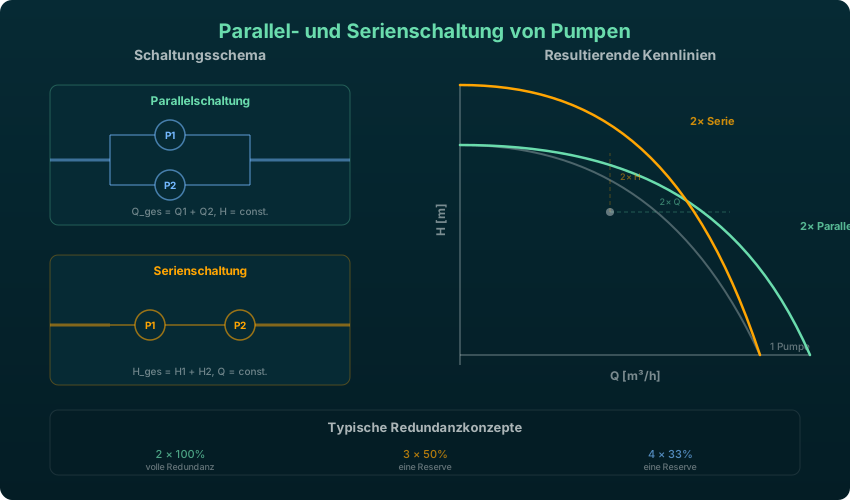
A parallel configuration is advantageous in thermal networks with high volume flow rates and relatively low delivery head, that is, a flat network characteristic curve. The pumps arranged in parallel should be of the same type. Control is load-dependent: at low load a single pump runs alone, at higher load both run at synchronous speed, and one pump serves as standby for redundancy. In this arrangement the delivery head stays constant while the volume flow rates add up.
Series Configuration
A series configuration is advantageous in thermal networks with high delivery head and relatively low volume flow rate, that is, a steep network characteristic curve. A bypass with an automatic shut-off damper is arranged in parallel to each pump. At low load one pump operates alone, at higher load both operate together; the volume flow rates stay the same while the delivery heads add up. A booster pump in the periphery of the network also runs in series with the main pump.
Redundancy and Expansion
Because the pumps are central to the operation of a thermal network, redundancy is recommended. Common arrangements are 2 x 100% as the simplest but cost-intensive solution for large networks, 3 x 50% as a good compromise between availability and cost, and 4 x 33% for large networks, where the investment cost of smaller pumps falls disproportionately. During the first operating years of a network still under development, only a fraction of the planned pumping capacity is usually needed, so it makes sense to install smaller pumps at first and replace them with larger ones as demand grows.
Low-Load and Summer Pump
The minimum speed of circulation pumps is around 25% of maximum speed. Where a thermal network shows a large gap between maximum and minimum volume flow rate, a separate summer pump can be worthwhile. It is designed for low-load operation below 20% of winter demand, runs at higher efficiency in that range, and its characteristic curve must overlap with that of the main pumps.
Pump Control
Constant Pressure Control
With constant pressure control, the differential pressure across the pump is held constant as the volume flow rate varies. The operating point follows the constant pump control curve horizontally in the part-load range. The control is simple but less efficient at part load, which suits smaller networks and systems with constant hydraulic resistance.
Proportional Pressure Control
With proportional pressure control, the differential pressure falls as the volume flow rate falls. The operating point follows a declining pump control curve. Less energy is consumed at part load, making this the better fit for most thermal networks.
Differential Pressure Control in the Network
For the best control, the differential pressure is measured not at the pump itself but at one or more reference points in the network, typically at the network critical point where the differential pressure is lowest. The pumps are then controlled so that the minimum required differential pressure, typically 0.4 to 1.0 bar between supply and return, reaches every transfer station. This supplies all customers reliably, holds the pump energy demand to a minimum and prevents both over- and under-supply.
Control with Multiple Feed-In Points
In thermal networks with multiple heat substations at different locations, the pump groups must be coordinated. One feed-in point acts as master and takes over pressure control. The other feed-in points act as slaves, delivering a defined heat output or following a characteristic map. The coordinating algorithm has to ensure that no flow stagnation arises between the feed-in points.
Pump Energy Demand
The annual energy demand of the pumps is determined from the mean values of the resulting flow rates and delivery pressures derived from the annual duration curve of the network. As a rough approximation:
where is the nominal pump power and is the full-load hours of the customers.
Experience shows that with optimal design the annual pump energy demand runs between 0.5% and 1.0% of the distributed heat energy. Values well above this point to oversizing or suboptimal control.
Configuration and control in practice
The right combination of pump configuration and control strategy decides the economic viability and reliability of a thermal network. Modern variable-speed pumps with network-based differential pressure control offer the largest savings. Whether parallel or series configuration is chosen depends on the network characteristic curve, and the redundancy strategy secures the supply.
Further reading: Pump Sizing describes the dimensioning of volume flow rate and delivery head as the basis for pump selection, Network Control covers the overarching control strategies in interaction with pump control, and Network Operating Modes explains how sliding and constant operating modes affect the requirements for pump control.
References and Standards
- DIN EN 16297 — Pumps — Variable speed pumps — Specific requirements and tests
- VDI 2073 Part 1 — Hydraulics of water-based systems — Fundamentals
- AGFW FW 515 — Control and regulation in district heating networks
Frequently Asked Questions
When is a parallel vs. series pump configuration used?
What redundancy concepts exist for network pumps?
How much energy do network pumps consume annually?
Related Articles
How to size house transfer stations: domestic hot water priority, space heating loads and diversity factors — with sizing guidance for district heating connections.
Central vs. decentralised pump concepts: sizing, worst-point control and energy demand
What is a heating curve and how does it affect the design of district heating networks and heat pumps?
Mixing, injection and throttle circuits: hydraulic circuit types for connections to thermal networks
Disclaimer: The content of this page is for general information purposes only and does not constitute legal, planning or engineering advice. All information is provided without guarantee. Despite careful research, VICUS Software GmbH assumes no liability for the accuracy, completeness or timeliness of the information provided. Third-party product names and trademarks are mentioned for informational purposes only and are the property of their respective owners.