Pressure Loss Calculation in District Heating
Fundamentals of hydraulic calculation: pipe friction, local resistances and pressure distribution in district heating networks
Table of Contents
Pressure loss in district heating networks comprises pipe friction (Darcy-Weisbach equation) and local resistances from fittings and valves, and determines the pump energy demand as well as supply reliability for all consumers. Typical design values are 100—200 Pa/m specific pressure loss, and typically 0.5 to 1.0 bar of differential pressure has to remain available at the hydraulically worst-case consumer (index point); 0.8 to 1.0 bar has become established as the planning value, and the technical connection requirements (TAB) of the network operator are binding. Where this value comes from and which further limits have to be met at the same time is covered by Meeting Operating Pressure Limits in Heat Networks.
Pipe Friction Losses: The Darcy-Weisbach Equation
The pressure loss due to friction in a straight pipe is calculated using the Darcy-Weisbach equation:
Here, is the dimensionless Darcy friction factor, the pipe length, the inner diameter, the fluid density and the mean flow velocity. The specific pressure loss per metre of pipe is often denoted as :
Determining the Friction Factor
The friction factor depends on the flow regime and the pipe wall roughness. The decisive quantity is the Reynolds number:
where is the kinematic viscosity of the fluid. Different correlations apply in the different flow regimes:
Laminar flow ():
Turbulent flow (): Here the implicit Colebrook-White equation is used:
with the pipe wall roughness . Typical roughness values:
| Pipe material | Roughness (mm) |
|---|---|
| Steel pipe (new) | 0.05 |
| Steel pipe (aged) | 0.1 — 0.5 |
| Plastic pipe (PE, PEX) | 0.007 — 0.01 |
| Copper pipe | 0.002 |
Since the Colebrook-White equation is implicit, it has to be solved iteratively. In practice, explicit approximation formulas or tabulated data (e.g. the Moody diagram) are often used.
Temperature Dependence
The kinematic viscosity of water is strongly temperature-dependent. At 20 °C it is approximately m/s, at 80 °C only about m/s. The Reynolds number therefore increases with temperature and the friction factor decreases. In the supply line of a high-temperature network the pressure loss is thus lower than in the cooler return line — an effect that should be taken into account in accurate calculations.
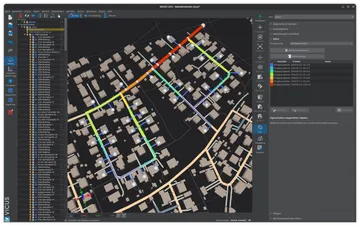
Pressure loss calculation in VICUS Districts:
The hydraulic equations are solved as a non-linear algebraic system with the Newton-Raphson method. Pipe friction uses the Darcy-Weisbach equation with the Colebrook-White friction factor (explicit Serghides approximation). In the laminar range (Re < 2300) the calculation is analytical, in the transition range (2300 < Re < 4000) it is linearly interpolated. The temperature dependence of the viscosity is fully accounted for — the solver evaluates the fluid properties at the local temperature of every pipe segment.
Local Resistances: Fittings, Valves and Installations
In addition to pipe friction, changes in direction, cross-section changes and installed components cause further pressure losses. These so-called local resistances are described by loss coefficients :
Typical loss coefficients in district heating networks:
| Component | -value |
|---|---|
| 90° bend (smooth) | 0.3 — 0.5 |
| Tee (straight through) | 0.3 — 0.5 |
| Tee (branch) | 1.0 — 1.5 |
| Gate valve (open) | 0.1 — 0.3 |
| Check valve | 2.0 — 4.0 |
| Plate heat exchanger | 10 — 30 (depending on design) |
Simplified Treatment via Allowance Factors
In early planning phases, local resistances are often accounted for as a lump-sum allowance on the pipe length. The allowance factor typically amounts to 30 to 50 %, so that the effective pipe length becomes:
For accurate calculations, however, the local resistances should be recorded individually.
Fitting calculation in VICUS Districts:
Pipe fittings (bends, tees, reducers) are assigned automatically from the network geometry. Their pressure losses are calculated individually via ζ values — blanket allowances on the pipe length are not needed.
The Pressure Distribution in the Network
Pressure Gradient Diagram
The pressure gradient diagram is a graphical representation of the pressure profile along a network path. It is the most important tool for the hydraulic evaluation of a district heating network. The distance from the heat source is plotted on the horizontal axis, the pressure on the vertical axis.
The pump generates a pressure difference , which is dissipated along the supply line by friction and local resistances. At the consumer, the remaining pressure difference is available (differential pressure at the transfer station). In the return line the pressure continues to drop back to the pump.
Geodetic Pressure Differences
In hilly terrain, the geodetic pressure difference must additionally be considered:
with the gravitational acceleration m/s and the height difference . A height difference of 10 m corresponds to a pressure difference of approximately 1 bar. In a closed circuit, the geodetic pressures in the supply and return lines cancel out, provided the lines run in parallel. That cancellation, however, relieves the pump head alone — it does not shift the absolute pressure levels in the network. The absolute pressure limits therefore have to be checked point by point: the highest absolute pressure occurs at the geodetic low point, the lowest at the high point, where the static pressure of the pressurization is smallest at the same time. How reliable the elevation values behind this are, and which terrain model provides the right data basis, is covered by terrain elevation in network planning.
Minimum Pressure Requirements
The lower pressure limit in a network is not a chosen number but a physical condition: the absolute pressure must remain above the saturation pressure of the network water at the temperature prevailing at that location. Below it the water evaporates, cavitation occurs at pumps and valves, and in the extreme case the water column separates at a high point. The governing location is the hottest point of the supply line:
where:
- : required lowest absolute pressure in the network [bar]
- : saturation pressure at the highest supply temperature that occurs [bar]
- bar: margin against evaporation and cavitation — broad professional consensus
- bar: margin for the control tolerance of the pressure maintenance and for transients — a planning recommendation, not a standard
A worked example: at a supply temperature of 90 °C the saturation pressure is 0.70 bar absolute. Together with the combined margin of 1.5 bar this yields a required minimum absolute pressure of 2.20 bar, corresponding to roughly 1.2 bar gauge against the atmosphere.
The widespread rules of thumb for the minimum overpressure — of the order of 1.5 bar in high-temperature networks and 0.5 bar in low-temperature networks — are guide values derived from this condition, not a requirement of their own. They are not to be confused with the equally sized margin of 1.5 bar: the margin is added on top of the saturation pressure, whereas the rules of thumb name the resulting gauge pressure itself. They merely reflect how steeply the saturation pressure rises with temperature. What is checked is not the rule of thumb but the vapour-pressure condition at the maximum temperature that actually occurs. The full derivation, the saturation pressure table from 70 to 150 °C and the remaining pressure limits are set out in Meeting Operating Pressure Limits in Heat Networks.
At the consumer a second, independent condition applies: every transfer station needs a minimum differential pressure between supply and return — typically 0.5 to 1.0 bar, with 0.8 to 1.0 bar as the planning value. Here too, the technical connection requirements (TAB) of the network operator are binding.
The Worst-Case Consumer
The hydraulically worst-case consumer (also known as the index point) is the one with the lowest available differential pressure. It is usually located at the end of the longest or most resistive network path.
The pump must be sized so that the required minimum differential pressure is still available even at the worst-case consumer — typically 0.5 to 1.0 bar, with 0.8 to 1.0 bar as the planning value; the technical connection requirements (TAB) of the network operator are binding. The total pump head therefore results from:
where the sums are taken over the entire critical path (supply and return lines).
Steady-state network analysis in VICUS Districts:
The steady-state analysis calculates, for every pipe: mass flow rate, pressure difference, specific pressure loss (Pa/m) and the fitting losses at the inlet and outlet nodes. The results can be shown colour-coded on the network map, so the worst-case consumer is immediately apparent.
Meshed Networks
In meshed networks (network topology), the volume flows are distributed over parallel paths. A simple branch-by-branch calculation is not sufficient here. The calculation requires the simultaneous solution of the mass and momentum conservation equations for all nodes and branches of the network. This is usually done iteratively using the Hardy-Cross method or the Newton-Raphson method.
In VICUS Districts, the entire network is modelled as a graph. The hydraulic equations are formulated as a non-linear system of equations and solved using the Newton-Raphson method. This makes it possible to reliably calculate even complex, meshed networks with multiple feed-in points.
Pressure Loss in Part-Load Operation
In real operation, district heating networks rarely run at full load. Since the pressure loss increases quadratically with velocity (), it decreases considerably at part load. At 50 % volume flow the pressure loss is only 25 % of the full-load value. Variable-speed pumps can exploit this effect and significantly reduce pump power consumption in part-load operation.
From equation to network planning
Pressure loss calculation links pipe-flow physics with the practical planning of networks. The Darcy-Weisbach equation and the calculation of local resistances form the basis. Only the analysis of the entire pressure profile, from the heat source via the worst-case consumer back to the pump, provides a complete picture. Geodetic conditions, minimum pressure requirements and the part-load behaviour must be considered just as carefully as the correct recording of all resistances in the network. For more complex networks, software-based calculation with VICUS Districts is indispensable.
Further reading: Pipe Dimensioning in District Heating Networks — sizing methodology that builds on pressure loss results, Meeting Operating Pressure Limits in Heat Networks — the derivation of the pressure limits against which the calculated pressure profiles have to be checked, Thermo-Hydraulic Simulation — dynamic analysis coupling hydraulics and thermal behaviour, Pump Sizing in District Heating Networks — determining pump head requirements from pressure loss calculations, Linear Heat Density — how network economics relate to hydraulic design.
References and Standards
- AGFW FW 524 — Hydraulic Calculation of Hot Water District Heating Networks
- Planungshandbuch Fernwärme. Version 1.3, QM Fernwärme / Verenum — section 3.7 on the pressure profile in the district heating network, p. 58; published in English as Handbook on Planning of District Heating Networks, Version 1.0a
- Moody, L. F. (1944): Friction Factors for Pipe Flow. Transactions of the ASME, 66(8), pp. 671–684.
- DIN 4747 — District Heating Systems — Safety Requirements for Hot Water Building Installations
- DIN EN 13941 — District heating pipes — Design and installation of pre-insulated bonded pipe systems
Frequently Asked Questions
How is pressure loss calculated in a district heating network?
What is the specific pressure loss R in district heating?
What is the worst-case consumer (index point) in a district heating network?
Related Articles
District heating pipe sizing from flow velocity (0.5–2.5 m/s) and pressure gradient (100–200 Pa/m): DN reference values per line type, plus an online calculator.
Calculating heat losses in buried district heating pipes: methods, influencing factors and typical values
What is linear heat density and why is it the central metric for the economic viability of district heating networks?
Supply and return temperatures in district heating networks: calculation, influencing factors and optimisation
Disclaimer: The content of this page is for general information purposes only and does not constitute legal, planning or engineering advice. All information is provided without guarantee. Despite careful research, VICUS Software GmbH assumes no liability for the accuracy, completeness or timeliness of the information provided. Third-party product names and trademarks are mentioned for informational purposes only and are the property of their respective owners.