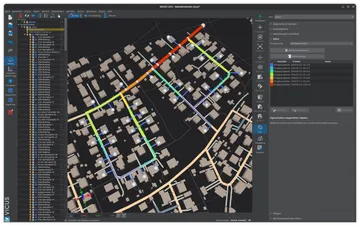
Heat Generation in Thermal Networks
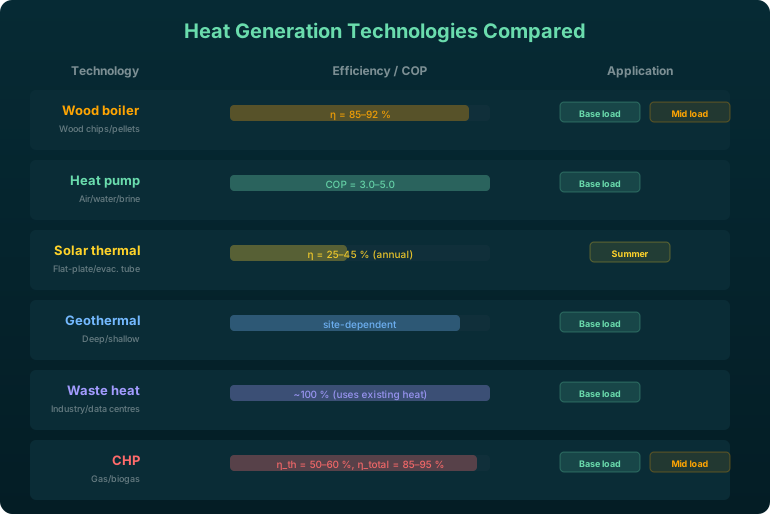
Overview of heat generation technologies: Wood boilers, heat pumps, solar thermal, geothermal, waste heat and CHP in comparison
Table of Contents
Modern district heating networks rely on a combination of generation technologies. The base load generator, such as a wood boiler or heat pump, is designed for 30 to 60% of peak output and covers 70 to 90% of the annual heat demand, while peak load generators handle the few hundred hours of highest demand. The choice of technology determines not only the investment and operating costs but also the achievable CO2 reduction, the required network temperatures, and the overall system flexibility.
Base Load and Peak Load Concepts
The temporal distribution of heat demand over the year makes the use of multiple heat generators practical. The starting point is the annual load duration curve:
- Base load generators cover the heat demand that occurs consistently over long periods. They run with high full-load hours (4,000 — 6,000 h/a) and should therefore have low fuel or energy costs.
- Peak load generators cover the few hundred hours with high power demand. They require low investment costs and rapid load-following capability.
Typical split: The base load generator is designed for 30 — 60% of the maximum thermal output and covers 70 — 90% of the annual energy demand. Optionally, a separate generator is added for summer operation (low load) when the base load generator has poor efficiency at part load.
Heat Generators at a Glance
Wood Boilers and Wood Boiler Cascades
Wood chip and pellet boilers are the most commonly used renewable heat generators for thermal networks in Switzerland and Central Europe. Advantages:
- CO2-neutral, regional energy source
- Proven and well-established technology
- Well suited as base load generators
For plants with three or more boilers of similar capacity, the term wood boiler cascade is used. These allow modular operation with good part-load capability. The use of a thermal storage tank can further optimize operation and reduce the number of boiler starts.
Heat Pumps
Heat pumps use ambient heat (air, water, ground) or waste heat at a low temperature level and raise it to the required supply temperature. Their efficiency is described by the coefficient of performance (COP):
Efficiency increases with decreasing supply temperature and increasing source temperature. Typical COP values for network applications range from 3 to 5. Heat pumps are particularly suitable for:
- Low-temperature networks (< 60 °C supply)
- Combination with seasonal storage
- Use of waste heat from wastewater, lake water, or groundwater
Heat pumps in VICUS Districts:
Heat pumps are represented with a detailed model in which the COP is calculated in every time step from the current source and sink temperatures — either via a polynomial or via the Carnot efficiency. The energy balance is fully resolved: condenser output (useful heat), evaporator output (source extraction) and electrical drive power are available as separate result quantities.
Solar Thermal
Solar thermal systems can be integrated into thermal networks, although the strongly seasonal yield poses a challenge. In combination with seasonal storage (borehole thermal energy storage, aquifer), solar fractions of 20 to 50% can be achieved.
Geothermal Energy
Geothermal sources provide a constant, weather-independent heat source. A distinction is made between:
- Shallow geothermal (up to approx. 400 m): in combination with heat pumps, typical for cold district heating
- Medium-depth geothermal (400 — 3,000 m): direct use at sufficiently high temperatures
- Deep geothermal (> 3,000 m): higher temperatures, but significantly higher investment costs and geological risks
Waste Heat
The direct use of waste heat from industrial processes, waste incineration plants (WIP) or data centers is a particularly efficient form of heat supply. In Switzerland, around 45% of district heating comes from WIP waste heat. Key aspects:
- Clarify availability and temperature level of the waste heat source
- Long-term safeguarding through contracts
- A heat pump may be required for temperature boosting
Combined Heat and Power (CHP)
CHP plants generate heat and electricity simultaneously (cogeneration). They are particularly cost-effective when:
- There is a high simultaneous demand for electricity and heat
- High full-load hours can be achieved (> 5,000 h/a)
- The generated electricity can be marketed favorably
Typical fuels are natural gas, biogas, or wood gas. The overall efficiency is 85 — 95% (based on the net calorific value), with approximately 30 — 40% as electricity and 50 — 60% as heat.
Heat generators in VICUS Districts:
For heat generators such as boilers, CHP units or solar thermal plants, ideal heat sources with a configurable power limit and maximum temperature are available. The heat source can also be coupled to a time-dependent temperature, in order to represent the seasonal variation of a geothermal or solar thermal plant, for example.
Fossil-Free Heat Generation
The path to fossil-free heat generation can be achieved step by step. Typical approaches include:
- Replace peak boilers: wood pellets instead of fossil peak boilers
- Wood boiler cascades: modular expansion with renewable base load
- Add heat pumps: combination with wood heat for bivalent operation
- Solar thermal and storage: seasonal thermal energy storage
- Integrate waste heat: use of local waste heat sources
Bivalent Operation: Heat Pump and Wood Boiler
A promising combination is bivalent operation with a heat pump as the base load and a wood boiler as the peak load. The heat pump handles heat generation down to a certain outdoor temperature (e.g., °C), while the wood boiler covers the coldest periods. In this way, heat pumps can cover around 74% of the annual heat demand, while the wood boiler only operates for about 10 weeks in winter.
Choosing the Generation Technology
The selection follows a planning priority sequence:
- Site-bound high-grade waste heat (WIP, industry, CHP)
- Site-bound low-grade ambient heat (wastewater, lake, groundwater)
- Regionally available renewable energy sources (biomass)
- Non-site-bound ambient heat (solar thermal, air)
- Regionally available renewable energy sources with limited availability (energy wood)
The combination of different generators, optimal storage dimensioning, and the integration of renewable energies can be investigated and optimized in detail using simulation tools such as VICUS Districts.
Further reading: Network Temperatures explains how the choice of generation technology determines the network supply temperature, Cold District Heating: Fundamentals describes the concept of 5GDHC networks with decentralized heat pumps as an alternative to conventional generation, and Planning Phases of Thermal Networks places the generator selection within the overall planning process.
References and Standards
- AGFW Main Report — District Heating in Germany, annually updated industry statistics by AGFW
- BMWK (2024): Renewable Energies in Figures — National and International Development. Federal Ministry for Economic Affairs and Climate Action.
- Nussbaumer, T.; Thalmann, S.; Zaugg, D.; Cueni, M. (2025): Planning Handbook for Thermal Networks. Version 2.0, EnergieSchweiz / Swiss Federal Office of Energy SFOE.
Frequently Asked Questions
Which heat generation technologies are suitable for district heating networks?
How are base load and peak load generators sized in a district heating network?
What is bivalent operation in district heating networks?
Related Articles
How is the heat load demand of a thermal network determined? Load curves, annual load duration curves and full-load hours
Thermal energy storage for district heating networks: Sensible, latent and thermochemical storage technologies compared. Design and application areas.
Definition and assessment of efficiency ratings in thermal networks: Instantaneous and annual utilization efficiency, weighted assessment of heat and electricity
Disclaimer: The content of this page is for general information purposes only and does not constitute legal, planning or engineering advice. All information is provided without guarantee. Despite careful research, VICUS Software GmbH assumes no liability for the accuracy, completeness or timeliness of the information provided. Third-party product names and trademarks are mentioned for informational purposes only and are the property of their respective owners.