Cold District Heating Projects in Germany: Overview
Realised cold district heating networks in Germany and Switzerland: size, heat sources, commissioning and key features — every data point with a source.
Table of Contents
In Germany, cold district heating networks have mainly been built in new residential developments, usually operated by municipal utilities (Stadtwerke) and in some cases by cooperatives. The documented projects range from about 20 buildings to around 1,200 residential and commercial units; the predominant sources are horizontal ground collectors and borehole fields, in individual cases supplemented by wastewater heat, agrothermal fields or ice storage. The overview below contains only projects whose key data can be verified through operators, municipalities, trade press or research reports.
The technical basics of cold district heating — network hydraulics, decentralised heat pumps and ground coupling — are covered in the main article. This page is intended as a reference collection for planners who want to point to comparable projects in feasibility studies or council submissions.
Selection criteria and data status
Included are networks that meet the characteristics of the fifth generation: network temperature close to ground level, uninsulated pipes, decentralised heat pumps in the buildings. Warm low-temperature networks with central heat pumps are not included, nor are projects that are only at the planning stage. All data come from the linked sources, as of October 2026. Where sources diverge, this is noted; values that could not be verified are marked “n/a”. For projects with several construction phases, figures may have changed since the source was published.
Realised networks in Germany
| Project / location | In operation since | Size | Heat sources | Key feature | Source |
|---|---|---|---|---|---|
| Bad Nauheim-Süd (Hesse) | 2019 | 400 dwellings in 140 buildings, network approx. 6 km | Ground collector 22,000 m² in two layers (11,000 m² each at 1.5 and 3 m depth) | Monitoring in the research projects KNW-Opt and KNW-Opt II | ZfK |
| Hüttengelände, Neustadt am Rübenberge (Lower Saxony) | 2020 (phase 1) | Phase 1: 145 dwellings, 588 planned; network in the area approx. 1.5 km | Ground collector, 15,400 m² at full build-out in three sections | Climate-neutral quarter on a former ironworks site | Ideenstadtwerke |
| Neuer Soester Norden, Soest (North Rhine-Westphalia) | Phase 1 in operation, development from 2021 | approx. 600 dwellings at full build-out; phase 2 approx. 130 dwellings with approx. 3 km of pipes | Horizontal collectors: 9,300 m² double-layer (phase 1) and 23,000 m² (phase 2) | Large new development with collectors at 1.5–3 m depth | Solarserver, Stadtwerke Soest |
| Lagarde-Campus, Bamberg (Bavaria) | 2024 | approx. 1,200 residential and commercial units | Collectors 32,000 m² beneath buildings and roads, 74 boreholes up to 120 m, 225 m wastewater heat exchanger | Inner-city conversion site combining three sources | Stadtwerke Bamberg |
| Vordere Viehweide, Wüstenrot (Baden-Württemberg) | 2012 | 23 houses | Agrothermal: approx. 1.5 ha collector beneath cultivated farmland | Research project EnVisaGe, plus-energy settlement | MGT 5/2017 (PDF) |
| Hochvogelstraße, Biberach an der Riß (Baden-Württemberg) | 2016 | 42 dwellings (detached, terraced, multi-family) | 35 boreholes up to 200 m, approx. 6,960 m in total | Operated by e.wa riss | KEA-BW |
| Wichelkoppeln, Schleswig (Schleswig-Holstein) | Network completed 2021 | approx. 60 plots and a fire station | Ground collectors, two ground-ice storage units, PVT collectors | Accompanying research ErdEis II and III | TGA-Praxis, Stadtwerke SH |
| Lehmkuhle, Werther (Thuringia) | 2023 | 33 houses | Ground collector 8,000 m² | First cold network in Thuringia, citizens’ energy cooperative | stadt+werk |
| Niestadtweg, Mettingen (North Rhine-Westphalia) | 2024 | more than 90 connections planned, network over 4,400 m | 38 boreholes up to 150 m | Built in three phases | SWTE Netz |
| Uferquartier, Hörstel (North Rhine-Westphalia) | 2025 | 43 connections incl. town hall, school, fire station; network approx. 1,850 m | 70 boreholes of approx. 80 m | Supplies municipal buildings in the town centre | SWTE Netz, stadt+werk |
| Spechort, Schermbeck (North Rhine-Westphalia) | 2025/2026 | 49 plots, up to 80 dwellings; network approx. 600 m | Borehole field, approx. 26–30 boreholes of approx. 175 m (sources differ) | Mandatory connection in the development | Gelsenwasser |
| Erkings Hof, Hilter a. T. W. (Lower Saxony) | n/a (network built) | 39 detached, 6 semi-detached, 3 multi-family houses | 32 boreholes of 140 m | Cooperative operator | TEN eG |
Networks under construction
| Project / location | Status | Size | Heat sources | Source |
|---|---|---|---|---|
| Schlutuper Straße, Lübeck (Schleswig-Holstein) | under construction since 2024, commissioning planned for 2026 | approx. 400 dwellings, network approx. 3 km | 135 boreholes of approx. 170 m in nine fields, approx. 1.8 MW | ingenieur.de |
| Albachten-Ost, Münster (North Rhine-Westphalia) | under construction | approx. 500 dwellings planned | up to 102 boreholes of approx. 250 m in five fields | Stadtwerke Münster |
| Grundwegsiedlung, Crailsheim (Baden-Württemberg) | network 2025, collector from 2027 | 300 dwellings in 48 buildings | Ground collector 15,000 m² at 1.5 m depth | Stadtwerke Crailsheim |
Reference from Switzerland: ETH Hönggerberg anergy network
The best-known anergy network in the German-speaking countries has supplied the Hönggerberg campus of ETH Zurich since 2013. It couples buildings with heating and cooling demand via a ring main and stores summer waste heat in several borehole fields. In 2019, 14 buildings were connected; 431 boreholes, each 200 m deep and about 82 borehole kilometres in total, formed the seasonal storage. In 2018 the system covered 81 % of the heating and 78 % of the cooling demand of the connected buildings (energeiaplus, Swiss Federal Office of Energy; IEA HPT Annex 47). Unlike the German residential developments, the heating and cooling balance here is largely even thanks to the high cooling demand of laboratory and computing buildings. How such a balance affects storage design is explained in Seasonal Storage in Cold District Heating Networks.
What the projects have in common
Several patterns relevant to new feasibility studies emerge from the overview:
- New builds dominate: almost all networks supply new developments with underfloor heating. Existing buildings are so far the exception; in Hörstel, existing municipal buildings in the town centre are connected. The specific requirements are discussed in Cold District Heating in Existing Neighbourhoods.
- Source choice follows land availability: large areas with green or traffic spaces rely on collectors (Bad Nauheim, Soest, Neustadt, Crailsheim). Smaller or denser areas use borehole fields (Biberach, Mettingen, Hörstel, Lübeck, Münster).
- Multiple sources in inner-city locations: Lagarde-Campus combines collectors beneath buildings, boreholes and wastewater heat because no single source is sufficient.
- Municipal utilities as operators: most networks are operated by Stadtwerke or municipal companies, often with mandatory connection or high connection rates in the development. Cooperatives appear in smaller projects (Werther, Hilter).
- Accompanying research: several projects are scientifically monitored (Bad Nauheim, Wüstenrot, Schleswig). The monitoring results are a valuable data basis for designing new networks. In Bad Nauheim, for instance, the lower collector layer at 3 m depth supplied 57 % of the extraction and 78 % of the cooling capacity (ZfK).
Comparing variants in VICUS Districts
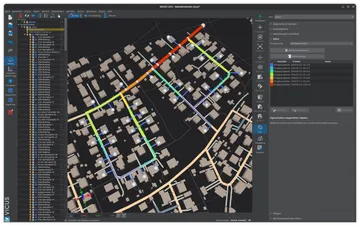
Reference projects provide orders of magnitude but do not replace design for your own site. In VICUS Districts, collector and borehole variants can be compared within the same network model: borehole heat exchangers and horizontal ground collectors are integrated as components and simulated with a coupled ground model over several operating years.
Assessment
Cold district heating in Germany has moved beyond the pilot phase. The number of networks is growing and new projects are getting larger: while early networks such as Wüstenrot (2012) and Biberach (2016) supply 23 houses and 42 dwellings respectively, current projects reach 400 to 600 dwellings with borehole fields of more than 100 boreholes. For planning, this means that experience from small networks is only partly transferable. Hydraulics, pumping energy and the long-term behaviour of the sources have to be verified separately for larger networks, as described in Dimensioning 5GDHC Networks.
The table will be extended as new verifiable projects become known. We welcome pointers to further realised networks with publicly available sources via our contact page.
Further reading: Low-Temperature District Heating: Fundamentals — operating principle and components, Dimensioning 5GDHC Networks — hydraulic design in detail, Seasonal Storage in Cold District Heating Networks — sources and regeneration over the service life, Cold District Heating in Existing Neighbourhoods — requirements outside new developments.
References and Standards
- ZfK (2025): Vom Pilot zur Anleitung: Bad Nauheim baut den Plan für andere Stadtwerke. Zeitung für kommunale Wirtschaft.
- Ideenstadtwerke Neustadt a. Rbge. (2023): Ministerpräsident Weil besucht kaltes Nahwärmenetz.
- Solarserver (2023): Kaltes Nahwärmenetz für 600 Wohnungen in Soest.
- Stadtwerke Bamberg (2024): Auf dem Lagarde-Campus ist eines der ökologischsten Wärmenetze Deutschlands in Betrieb gegangen.
- Moderne Gebäudetechnik 5/2017: Agrothermie speist Kaltwärmenetz.
- KEA-BW: Best Practice Wärmenetze: Biberach.
- TGA-Praxis: Wohnquartier mit Sandwichkollektoren und kalter Nahwärme.
- stadt+werk: Erstes kalte Nahwärmenetz (Werther) and Kalte-Nahwärme-Netz in Betrieb gegangen (Hörstel).
- SWTE Netz: Kalte Nahwärme (Mettingen, Hörstel).
- Gelsenwasser Energienetze: Nahwärme (Schermbeck).
- Teutoburger Energie Netzwerk eG: Kalte Nahwärme Erkings Hof in Hilter a. T. W..
- ingenieur.de (2026): 135 Sonden, 23.000 Bohrmeter: So baut Lübeck kalte Nahwärme auf.
- Stadtwerke Münster (2026): Albachten-Ost: Stadtwerke legen Erdsondenfelder für klimaneutrale Wärme an.
- Stadtwerke Crailsheim: Kalte Nahwärme Grundwegsiedlung.
- energeiaplus / Swiss Federal Office of Energy (2021): Wie die ETH Zürich sich selbst mit Energie versorgt.
- Buffa, S. et al. (2019): 5th generation district heating and cooling systems: A review of existing cases in Europe. Renewable and Sustainable Energy Reviews, 104, pp. 504–522.
Frequently Asked Questions
Where are cold district heating networks in Germany?
Which heat sources do realised cold district heating networks use?
How large are cold district heating networks in Germany?
Related Articles
Cold district heating (5GDHC) explained: operating principle, heat sources, decentralized heat pumps and network hydraulics of 5th-generation networks.
5GDHC simulation and dimensioning of cold district heating networks: passive vs. active networks, pressure-loss criteria and ground coupling.
How do prosumer concepts work in district heating networks? Heat feed-in, bidirectional networks and operating models
Advantages and disadvantages of cold district heating (5GDHC): under 3 % heat losses and free cooling versus decentralized heat pumps and more complex planning.
Disclaimer: The content of this page is for general information purposes only and does not constitute legal, planning or engineering advice. All information is provided without guarantee. Despite careful research, VICUS Software GmbH assumes no liability for the accuracy, completeness or timeliness of the information provided. Third-party product names and trademarks are mentioned for informational purposes only and are the property of their respective owners.