Linear Heat Density in District Heating
What is linear heat density and why is it the central metric for the economic viability of district heating networks?
Table of Contents
Linear heat density expresses how much heat is delivered per metre of route length per year (in MWh/(ma)) and is the single most important metric for assessing district heating network economics. Networks above approximately 1.5 MWh/(ma) are generally considered viable, while below 0.5 MWh/(m*a) specific network costs exceed 50 EUR/MWh, making alternatives such as low-temperature district heating or decentralized solutions worth investigating.
Definition and Calculation
The linear heat density indicates how much heat is delivered per year and per metre of route length:
Here, is the amount of heat delivered annually via the network to the consumers (in MWh/a), and is the total length of the route (in m). The route length refers to the length of the trench, not the sum of the supply and return lines — for a twin-pipe installation in one trench the length is therefore counted only once.
The unit is typically MWh/(ma) or, equivalently, kWh/(ma).
Distinction: Linear Heat Density vs. Connection Density
Linear heat density should not be confused with connection density. Connection density (in kW/m) refers to the installed connected load, not the actual annual energy consumption. Since connection density gives no information about full-load hours, it is less meaningful as a sole basis for evaluation.
Typical Values and Benchmarks
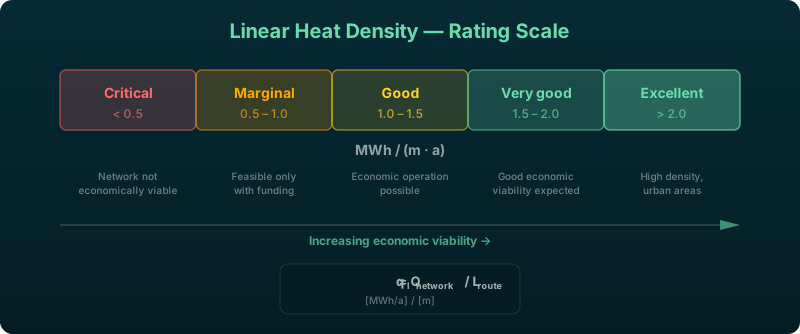
The following table provides reference values for assessing the linear heat density:
| Assessment | Linear heat density |
|---|---|
| Very good | > 1.5 MWh/(ma) |
| Good | 1.0 — 1.5 MWh/(ma) |
| Sufficient | 0.5 — 1.0 MWh/(ma) |
| Critical | < 0.5 MWh/(ma) |
Large inner-city district heating networks reach values of 3 to 5 MWh/(ma) and above. Local district heating networks in newly developed areas with well-insulated buildings (KfW-55 or better) are often only at 0.3 to 0.8 MWh/(ma) — a range in which the economic viability of conventional district heating networks comes under scrutiny.
Influence of the Building Stock
The specific heat demand of the connected buildings has a dominant influence on the linear heat density. An old-building district with 150 kWh/(ma) produces three to five times higher linear heat density than a new-build area with 30 kWh/(ma) for the same route length. Energy-efficient building refurbishment improves energy efficiency but at the same time lowers linear heat density — a dilemma that must be considered in long-term network planning.
Relationship to Heat Losses
The linear heat density is directly related to the network’s relative loss share. The heat losses of a buried pipe are largely independent of the amount of heat transported — they occur even at zero load. The relative loss share is approximately:
with the specific annual heat loss (in MWh/(ma)). A typical local district heating network with standard insulation loses approximately 0.10 to 0.15 MWh/(ma). At a linear heat density of 1.5 MWh/(ma), the loss share is therefore approximately 7 to 9 %. At only 0.5 MWh/(ma), it rises to 17 to 23 %.
Economic Significance
The investment costs for the pipe network are spread over the amount of heat transported across the service life. The higher the linear heat density, the lower the specific network costs per MWh. A rough estimate of the network-specific investment costs:
With average investment costs of approximately 800 EUR/m of route (including civil works, materials and installation) and a depreciation period of 30 years, the following values result:
- At MWh/(ma): approximately 13 EUR/MWh network costs
- At MWh/(ma): approximately 27 EUR/MWh network costs
- At MWh/(ma): approximately 53 EUR/MWh network costs
These figures show that below around 0.5 MWh/(ma), the network costs alone become so high that economic operation is hardly possible without subsidies, and tariff design becomes particularly challenging.
Linear Heat Density and Funding Programmes
The German federal funding programme for efficient district heating networks (BEW) uses linear heat density as one of the evaluation criteria for eligibility. A high linear heat density signals an efficient network with low specific losses and acceptable network costs.
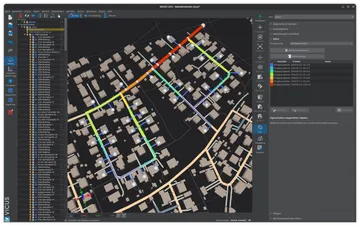
In feasibility studies (planning phases) and transformation plans, too, linear heat density is one of the first key figures to be calculated and reported. It serves as an early indicator: if it is significantly below 0.5 MWh/(ma), it should be examined whether decentralised solutions (e.g. individual heat pumps) would be more economical. In VICUS Districts, the linear heat density is automatically determined from the simulation results and can be used to evaluate individual network sections.
Measures to Improve Linear Heat Density
If the calculated linear heat density is too low, several approaches are available:
Increasing Heat Sales
- Connecting additional consumers: additional buildings, commercial businesses or public facilities along the existing route increase the numerator of the equation without significantly extending the route length.
- Integration of process heat: commercial or industrial heat consumers often have higher full-load hours than residential buildings and disproportionately improve linear heat density.
Shortening the Route Length
- Optimising the route: direct routes instead of detours, avoiding unnecessary dead-end branches.
- Densifying the supply area: concentrating on areas with high building density and refraining from peripheral areas with few connections.
- Phased network expansion: initially only developing the economically attractive core areas and extending the network in stages.
Special Case: Cold District Heating
For cold district heating, linear heat density according to the classical definition is less meaningful, as heat losses are negligible or even negative. Economic assessment shifts towards other metrics such as specific investment costs per connection and pump energy demand.
Reading the metric in practice
Linear heat density is the most important rapid-assessment metric for district heating networks. It combines heat sales and route length into a single figure that allows immediate conclusions about loss shares, specific network costs and economic viability. Values above 1.0 MWh/(ma) generally indicate an economically operable network, while particular care is required below 0.5 MWh/(ma). Linear heat density should therefore be calculated and critically evaluated as the very first key figure in every feasibility study.
Further reading: Heat Loss Calculation According to DIN EN 13941 — quantifying the losses that erode low heat line densities, Network Temperatures in District Heating Networks — temperature optimisation to improve network economics, Economic Analysis According to VDI 2067 — the economic evaluation method that uses heat line density, BEW Funding — funding thresholds linked to network viability metrics.
References and Standards
- AGFW Main Report — District Heating in Germany, annually updated industry statistics by AGFW
- AGFW FW 309 — Energy Evaluation of District Heating and Cooling
- Nussbaumer, T.; Thalmann, S. (2016): Planungshandbuch Fernwärme. EnergieSchweiz / Swiss Federal Office of Energy.
Frequently Asked Questions
What is linear heat density in district heating?
What linear heat density is needed for an economically viable district heating network?
How is linear heat density calculated?
Related Articles
District heating pipe sizing from flow velocity (0.5–2.5 m/s) and pressure gradient (100–200 Pa/m): DN reference values per line type, plus an online calculator.
Fundamentals of hydraulic calculation: pipe friction, local resistances and pressure distribution in district heating networks
Calculating heat losses in buried district heating pipes: methods, influencing factors and typical values
Supply and return temperatures in district heating networks: calculation, influencing factors and optimisation
Disclaimer: The content of this page is for general information purposes only and does not constitute legal, planning or engineering advice. All information is provided without guarantee. Despite careful research, VICUS Software GmbH assumes no liability for the accuracy, completeness or timeliness of the information provided. Third-party product names and trademarks are mentioned for informational purposes only and are the property of their respective owners.