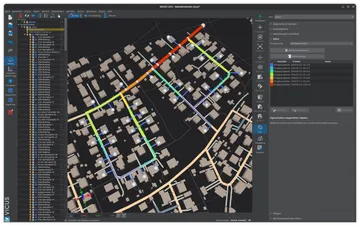
Dynamic Building Simulation: Fundamentals
Building simulation explained: dynamic vs. steady-state calculation, fields of application, result quantities and software for thermal building simulation.
Table of Contents
Dynamic building simulation calculates the thermal behaviour of a building in hourly or finer time steps over an entire year, delivering room temperatures, heating and cooling load profiles, and comfort metrics for every zone. Unlike the steady-state energy balance in accordance with DIN V 18599, it physically models thermal mass effects, variable weather data and changing occupancy profiles, making it indispensable for summer thermal protection verification (DIN 4108-2), comfort analysis and HVAC sizing.
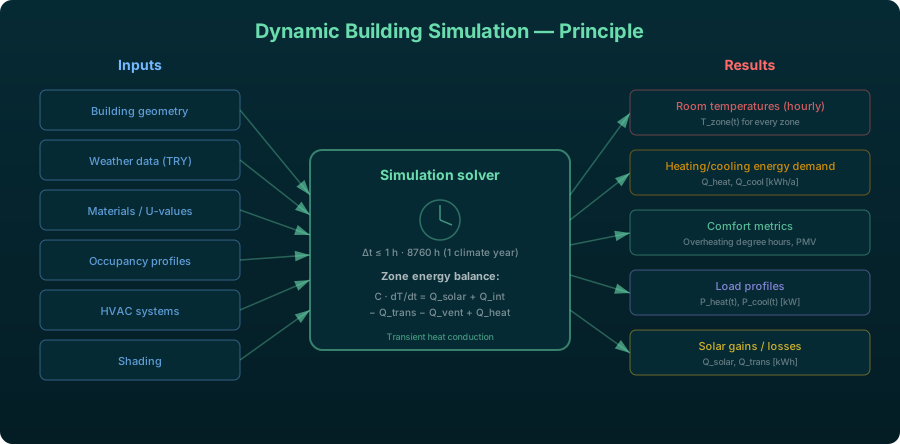
Principle of dynamic simulation
Time resolution
The core feature of dynamic simulation is the calculation at discrete time steps. Common time step sizes are one hour or less. Many simulation programs work with time steps of 15 minutes, 5 minutes or even 1 minute when fast control processes need to be represented. At each time step, the energy balance of all zones, building components and HVAC components is solved anew.
In simplified form, the energy balance of a thermal zone reads:
Here is the effective thermal capacity of the zone (in J/K), is the zone air temperature and the terms are the respective heat flows. The thermal capacity ensures that the building does not react instantaneously to changes in boundary conditions, but rather with a time delay, an effect that steady-state methods capture only approximately.
Heat conduction in building components
Heat conduction through walls, ceilings and roofs is not treated as steady-state heat transfer but as a transient process. The one-dimensional heat conduction equation
is solved numerically for each building component, typically by discretization into several layers (finite-difference methods or transfer functions). This correctly represents effects such as the thermal inertia of heavy components (concrete, masonry). A 30 cm thick concrete wall can store solar heat gains for several hours and release them again with a time delay, an effect that is decisive for summer thermal protection.
Solar radiation
Solar radiation is calculated for every hour and every façade orientation from climate data. Direct and diffuse radiation are distinguished, the angle-of-incidence dependence of the glazing is taken into account, and shading by neighbouring buildings, overhangs or solar protection devices is determined geometrically. The solar radiation entering through windows is distributed across the room’s enclosing surfaces and absorbed or reflected there.
Dynamic simulation in VICUS Buildings:
The transient energy balance of every thermal zone is solved in full: heat conduction through walls and slabs (finite-volume discretisation on a non-equidistant grid), solar radiation through windows, ventilation and infiltration, internal loads from occupants, lighting and equipment, and the output of the heating and cooling plant. An adaptive time-step integrator chooses the step size automatically — fine during fast control processes, coarse in stable states.
Required input data
A dynamic building simulation requires significantly more input data than a steady-state calculation. The most important categories are:
Building geometry
The three-dimensional geometry of the building must be captured: dimensions and orientation of all exterior and interior walls, ceilings, floors and windows. The geometric accuracy largely determines the quality of the shading calculation and the solar gains. Modern simulation programs allow BIM models to be imported (IFC format), which considerably reduces the effort required for geometry input.
Building component assemblies and materials
For each component layer, the thermal conductivity , density and specific heat capacity are required. For glazing, the g-value (total solar energy transmittance) and the U-value are also needed. The thermal properties of the inner component layers are particularly important for dynamic simulation, as they determine the storage capacity.
Climate data
The simulation requires hourly climate data for the location: outdoor air temperature, direct and diffuse solar radiation, wind speed and direction, relative humidity and air pressure. In Germany, test reference years (TRY) from the German Weather Service are frequently used, representing typical meteorological conditions. For summer thermal protection in accordance with DIN 4108-2, special hot reference years are used.
Usage profiles and internal loads
Occupancy schedules, lighting, electrical equipment and their heat emissions must be defined as time profiles. An office room, for example, has an occupancy of approximately 10 m² per person during weekdays from 8 a.m. to 6 p.m., with an internal load of 7 to 10 W/m² from people and equipment. In the evenings and at weekends the zone is unoccupied. These profiles affect both the heating and cooling demand and the indoor temperatures.
HVAC systems
Heating systems, cooling systems, ventilation units and their control strategies are modelled. The simulation calculates the power that the system has to provide at each time step to maintain the setpoint temperature — or which room temperature results when the system reaches its power limit.
Typical fields of application
Comfort analysis and summer thermal protection
Dynamic building simulation is the established approach for evaluating thermal comfort. It delivers hourly room temperatures and enables the calculation of over-temperature degree hours in accordance with DIN 4108-2. Particularly for buildings with a high glazing proportion, unusual geometry or special uses, the simplified method (solar heat gain coefficient approach) is not sufficient.
HVAC sizing
Heating and cooling load calculations based on dynamic simulation are more accurate than methods according to DIN EN 12831, which are based on steady-state extreme conditions. The simulation shows which peak loads actually occur and how long they last. This enables demand-oriented sizing that avoids both over-sizing and under-supply.
Variant comparison and optimisation
One essential advantage of dynamic building simulation lies in the rapid comparison of design variants across planning phases. Different façade constructions, glazing types, solar protection strategies or ventilation concepts can be evaluated quantitatively. Typical questions are: Is night-time ventilation sufficient to forego active cooling? How does triple glazing compared with double glazing affect the heating energy demand and the summer temperatures?
Sustainability certification
Certification systems such as DGNB, BREEAM and LEED partly require proof of thermal comfort or energy efficiency on the basis of dynamic simulations. The simulation provides the required metrics such as operative room temperatures, energy demand values and CO₂ emissions. The software used must comply with recognised validation standards.
Simulation results
Dynamic building simulation provides extensive result data. The most important output quantities are:
- Room temperatures (air and operative temperature) as hourly values for each zone
- Heating and cooling energy demand (annually, monthly, hourly) in kWh
- Heating and cooling power as a time series, including peak load in kW
- Solar gains through windows per orientation and zone
- Heat flows through individual building components (transmission, ventilation, internal gains)
- Over-temperature degree hours for the verification in accordance with DIN 4108-2
From this data, energy balances can be prepared that show where the energy flows and which measures would have the greatest effect.
Advantages over steady-state methods
The steady-state energy balance in accordance with DIN V 18599 works with monthly mean values and lumped approaches for solar gains and thermal storage. It is sufficient for the verification in accordance with GEG (German Building Energy Act) and quickly provides an overview of the energy demand. For many questions, however, it is not sufficient:
| Criterion | Steady-state (DIN V 18599) | Dynamic |
|---|---|---|
| Time resolution | Month | Hour or finer |
| Thermal storage | Lumped (utilisation factor) | Physically calculated |
| Solar gains | Simplified | Hourly, angle-dependent |
| Room temperatures | Not calculated | Hourly per zone |
| Comfort evaluation | Not possible | Detailed analysis possible |
| HVAC control | Simplified | Time-resolved |
Where it earns its keep
Dynamic building simulation represents the temporal dimension of building behaviour. It is required whenever steady-state methods reach their limits: for comfort evaluation, summer thermal protection, HVAC optimisation and variant comparison. The higher effort for data input is justified by the greater expressiveness and accuracy of the results. As BIM models spread and building simulation software such as VICUS Buildings becomes faster, the modelling effort keeps falling, so dynamic building simulation is becoming economical even for standard projects.
Further reading: Steady-state vs. Dynamic Calculation — method comparison and when each approach is appropriate, Validation Standards for Building Simulation Software — how simulation quality is assured, Summer Thermal Protection in Accordance with DIN 4108-2 — a key application of dynamic simulation, IFC Import for Building Simulation — how BIM models streamline the simulation workflow.
References and Standards
- ISO 52016-1 — Energy performance of buildings — Energy needs for heating and cooling — Part 1: Calculation procedures
- ASHRAE Standard 140 — Standard Method of Test for the Evaluation of Building Energy Analysis Computer Programs
- DIN V 18599 — Energy efficiency of buildings — Calculation of the net, final and primary energy demand
Frequently Asked Questions
What is dynamic building simulation?
When is dynamic building simulation needed?
What software is used for dynamic building simulation?
Related Articles
Verification per DIN 4108-2: solar heat gain coefficient vs. dynamic building simulation — methods, overheating degree hours and the 1200 Kh limit.
From BIM model to simulation: how IFC files improve the workflow between CAD and building simulation
Comparison of steady-state energy demand calculation and dynamic simulation: methods, accuracy and fields of application
EnergyPlus, IDA ICE, TRNSYS and VICUS Buildings: overview and comparison of the leading simulation programs
Disclaimer: The content of this page is for general information purposes only and does not constitute legal, planning or engineering advice. All information is provided without guarantee. Despite careful research, VICUS Software GmbH assumes no liability for the accuracy, completeness or timeliness of the information provided. Third-party product names and trademarks are mentioned for informational purposes only and are the property of their respective owners.