District Heating Pipe Sizing: Methods & Criteria
District heating pipe sizing from flow velocity (0.5–2.5 m/s) and pressure gradient (100–200 Pa/m): DN reference values per line type, plus an online calculator.
Table of Contents
Pipe diameter in district heating networks is determined from the required mass flow, the allowable flow velocity (0.5—2.5 m/s) and the maximum specific pressure loss (typically 100—200 Pa/m). Since the pipe network accounts for 40 to 60 % of total investment costs, correct dimensioning is decisive for both economic viability and energy efficiency of the entire system.
Online Calculator: Determining the Pipe Diameter
This calculator is also available as a standalone page: district heating pipe sizing calculator.
Enter the connection capacity and the temperature spread, choose a typical pressure gradient — the tool derives mass and volume flow and selects the smallest nominal size that satisfies both the pressure-gradient and the velocity criterion. Cold district heating (5GDHC) is also available — with water or a water-glycol mixture as the medium. How the two criteria work and which guide values apply is explained in the article below.
Preliminary sizing of a single pipe — the tool selects the smallest nominal size that satisfies both the pressure-gradient and the velocity criterion.
- Mass flow
- –
- Volume flow
- –
- Velocity
- –
- Pressure gradient
- –
| DN | dᵢ (mm) | v (m/s) | R (Pa/m) | Criteria |
|---|---|---|---|---|
Assumptions: fluid properties at mean temperature — heating water at 70 °C (ρ = 978 kg/m³, cₚ = 4.19 kJ/(kg·K), ν = 0.41·10⁻⁶ m²/s); cold network at 10 °C: water (ρ = 1000 kg/m³, cₚ = 4.19 kJ/(kg·K), ν = 1.31·10⁻⁶ m²/s) or water-glycol 30 vol% (ρ = 1040 kg/m³, cₚ = 3.7 kJ/(kg·K), ν = 3.0·10⁻⁶ m²/s) · roughness k = 0.05 mm, inner diameters per EN 253 (steel service pipe) — an approximation for cold networks, where PE pipes are common · friction factor per Colebrook-White · velocity limits: house connection 1.0 m/s, distribution and cold networks 1.5 m/s, transmission 2.5 m/s. The tool provides a preliminary sizing and does not replace a hydraulic network calculation. Last updated: July 2026. VICUS Software accepts no liability for the correctness of the results.
Why Pipe Dimensioning Is So Important
The pipe network typically accounts for 40 to 60 % of the total investment costs of a district heating network. The diameters determine not only material costs but also influence civil engineering costs (larger trenches), pump energy demand and the level of heat losses over the entire operating life. Careful dimensioning is therefore key to an economically and energetically optimal network.
The Central Equation: Mass Flow and Capacity
The starting point for any sizing is the heat flow to be transported. From the required thermal output the necessary mass flow follows as:
Here, is the specific heat capacity of the medium (approximately 4.18 kJ/(kgK) for water) and is the temperature spread between supply and return. The volume flow follows from the mass flow and the density :
Together with the chosen flow velocity , the volume flow determines the required inner pipe diameter :
This equation already shows that the temperature spread has a direct influence on the pipe diameter. Doubling the spread halves the volume flow and reduces the required diameter by approximately 30 %.
Pipe Dimensioning Methods
In practice, two methods have become established and are often applied in combination.
Method 1: Velocity-Based Dimensioning
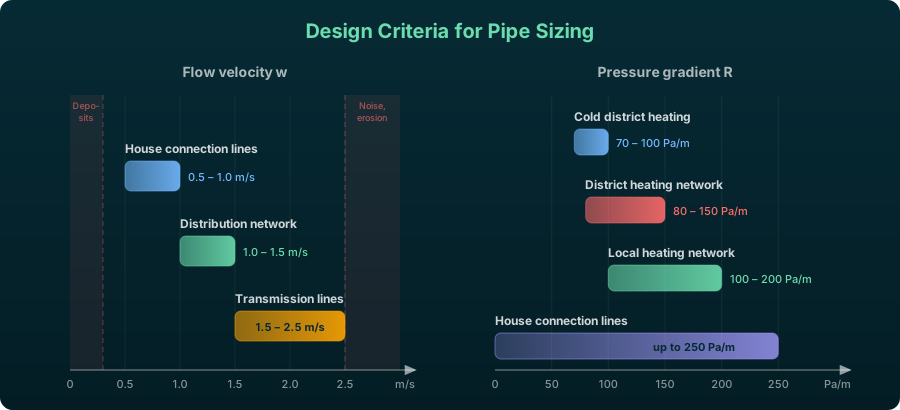
With this method, a maximum flow velocity is specified. The pipe diameter is chosen such that the velocity at full load does not exceed this value. Typical limits:
| Network section | Recommended velocity |
|---|---|
| House connection lines | 0.5 — 1.0 m/s |
| Distribution network | 1.0 — 1.5 m/s |
| Transmission lines | 1.5 — 2.5 m/s |
Velocities above 2.5 m/s should be avoided, as they can lead to noise problems, increased wear and erosion corrosion. Below 0.3 m/s there is a risk of deposits forming in steel pipes.
Method 2: Pressure-Gradient-Based Dimensioning
The second method limits the specific pressure loss per metre of pipe, the so-called pressure gradient (in Pa/m). The pipe diameter is chosen such that does not exceed a specified maximum value:
where is the Darcy-Weisbach friction factor. Typical guide values for the maximum pressure gradient:
| Network type | Recommended pressure gradient |
|---|---|
| District heating network | 80 — 150 Pa/m |
| Local district heating network | 100 — 200 Pa/m |
| Cold district heating | 50 — 100 Pa/m |
| House connection lines | up to 250 Pa/m |
Combined Application
In practice, both criteria are checked simultaneously. The chosen diameter must comply with both the velocity limits and the maximum pressure gradient. In transmission lines, velocity is often the governing criterion, while in distribution networks it is the pressure gradient.
Influence of Network Temperatures
The operating temperatures (network temperatures) of the network significantly influence dimensioning. A conventional district heating network with a spread of 50 K (e.g. 90/40 °C) requires significantly lower volume flows at the same output than a low-temperature network with only a 20 K spread (e.g. 60/40 °C). Specifically:
- At K and MW: kg/s
- At K and MW: kg/s
The 2.5 times higher mass flow in the low-temperature network requires approximately 60 % larger pipe diameters. This is one of the reasons why lowering network temperatures must be carefully weighed against the resulting additional costs.
Discrete Nominal Sizes and Practical Implementation
In reality, not every diameter is available. Pipes are manufactured in standardised nominal sizes (DN). The common nominal sizes in district heating networks range from DN 20 for small house connections up to DN 500 or more for large transmission lines. The calculated ideal diameter almost never corresponds exactly to a nominal size, so a decision must be made between the next smaller and the next larger step.
An economic evaluation is worthwhile here: the smaller nominal size saves investment costs but causes higher pressure losses and therefore higher operating costs over the entire service life. A typical service life of 30 to 50 years makes clear that operating costs play a substantial role.
Stepwise Dimensioning Across the Network
A district heating network typically consists of a main trunk with distribution and connection lines branching off from it. The main trunk must transport the entire volume flow, while side branches carry only partial flows. The pipe diameter therefore decreases in steps from the heat source towards the consumers. For meshed networks (network topology), dimensioning becomes more complex because the volume flows are distributed over several paths.
Dimensioning modes in VICUS Districts:
Two modes determine the consumer capacity used for pipe dimensioning: “Connection load” uses the installed capacity, “Maximum heating power” uses the actual demand profiles of the buildings — for heat pump consumers taking the COP into account. The second mode yields more realistic pipe diameters.
Simultaneity and Load Profiles
In practice, not all consumers ever demand their maximum output simultaneously. The simultaneity factor (typically 0.5 to 0.8 for residential buildings, see heat load demand) reduces the design-relevant volume flow in the main trunk:
The more consumers connected to a branch, the lower the simultaneity factor generally is. This must be taken into account during dimensioning to avoid oversizing.
Simultaneity in VICUS Districts:
For simultaneity VICUS Districts follows its own approach: an optimisation procedure shifts the load profiles of the consumers realistically against each other in time (maximum time shift adjustable, 3 h by default) and thus determines the achievable simultaneity factor for every network pipe. Pipes with at least 5 downstream consumers are evaluated. The results feed directly into the pipe dimensioning — so pipe diameters are determined from the actual load profiles rather than from generic table values.
Software-Supported Dimensioning
For networks with more than a few branches, manual dimensioning quickly becomes unmanageable. Modern planning software such as VICUS Districts enables automatic pipe dimensioning based on hydraulic calculation. All branches are considered simultaneously, simultaneity factors are taken into account and the optimal nominal sizes are determined under the defined boundary conditions (maximum velocity, maximum pressure gradient).
Automatic pipe dimensioning in VICUS Districts:
The automatic pipe dimensioning selects the optimum diameter for every pipe from the pipe database — based on the maximum permissible specific pressure loss (Pa/m). Optionally, maximum flow velocities can be specified per nominal size as an additional criterion. The software takes the complete network topology into account, the flow distribution according to the shortest-path method and — if enabled — the simultaneity factors from the diversity optimisation.
From formula to network design
Pipe dimensioning is far more than simply inserting values into a formula. It requires balancing investment against operating costs, considering network temperatures and simultaneity factors, and knowing the standardised nominal sizes. The velocity- and pressure-gradient-based methods form the foundation upon which an economically and technically optimal network design is built. For more complex networks, simulation software such as VICUS Districts is recommended to reliably capture all interactions.
Further reading: Pressure Loss Calculation in District Heating Networks — the hydraulic constraints that govern pipe sizing, Linear Heat Density — economic sizing considerations based on heat sales per metre, Network Temperatures in District Heating Networks — how temperature levels influence required pipe diameters, Pump Sizing in District Heating Networks — how pump selection interacts with pipe dimensioning.
References and Standards
- AGFW FW 401 — Installation and Structural Analysis of Pre-insulated Bonded Pipes for District Heating Networks
- DIN EN 13941 — District heating pipes — Design and installation of pre-insulated bonded pipe systems
- AGFW FW 524 — Hydraulic Calculation of Hot Water District Heating Networks
Frequently Asked Questions
What flow velocity is recommended in district heating networks?
What specific pressure loss is typical for district heating pipes?
How is pipe diameter calculated in a district heating network?
Related Articles
Fundamentals of hydraulic calculation: pipe friction, local resistances and pressure distribution in district heating networks
Calculating heat losses in buried district heating pipes: methods, influencing factors and typical values
What is linear heat density and why is it the central metric for the economic viability of district heating networks?
Supply and return temperatures in district heating networks: calculation, influencing factors and optimisation
Disclaimer: The content of this page is for general information purposes only and does not constitute legal, planning or engineering advice. All information is provided without guarantee. Despite careful research, VICUS Software GmbH assumes no liability for the accuracy, completeness or timeliness of the information provided. Third-party product names and trademarks are mentioned for informational purposes only and are the property of their respective owners.