Pump Sizing in District Heating Networks
Central vs. decentralised pump concepts: sizing, worst-point control and energy demand
What you will learn in this article:
- Central vs. decentralised pump concepts
- Flow rate, pump head and control strategies
- Energy demand and annual energy calculation
Table of Contents
Pump sizing determines whether a district heating network can be operated efficiently and economically. The flow rate is derived from the network heat output and the temperature spread, while the pump head results from the pressure losses along the most critical supply path. In well-designed networks, pump electricity consumption amounts to 1—2 % of the transported heat — with unfavourable dimensioning, especially in low-temperature networks with small temperature spreads, it can rise to 5—10 % and jeopardise the economics of the entire project.
Central vs. decentralised pump concepts
Central pump concept
In the central concept, one or more main circulation pumps are located in the heating plant. They generate the required differential pressure for the entire network. At the transfer stations, differential pressure controllers or control valves regulate the flow rate to each individual consumer.
Advantages:
- Centralised maintenance and monitoring
- High efficiency thanks to large, optimised pumps
- Simple hydraulic structure
Disadvantages:
- High differential pressure at consumers close to the plant requires throttling (energy loss)
- All pressure losses in the network must be overcome by the central pump
Decentralised pump concept
Here, circulation pumps are installed at every heat transfer station and each one only overcomes the local pressure loss and its share of the network pressure loss. The network itself has little or no centrally generated differential pressure. This concept is typical for passive cold district heating networks, in which the brine circulation pumps integrated into the heat pumps provide the circulation.
Advantages:
- No energy losses due to throttling
- Each pump works only against the pressure loss actually required
- Suitable for networks with widely varying distances to the plant
Disadvantages:
- Many individual pumps, each with lower efficiency
- Higher maintenance effort
- Check valves are necessary to prevent backflow
Hybrid concepts
In practice, hybrid approaches are often chosen: a central pump generates a base differential pressure that covers most of the network losses. At distant consumers, additional booster pumps support the supply. This can improve the overall energy efficiency compared to a purely central concept.
Dimensioning: flow rate and pump head
Flow rate
The nominal flow rate of the network pump results from the total heat load demand and the temperature spread between supply and return:
For a conventional network with 2 MW output and a spread of 30 K, this yields:
By comparison, a cold district heating network with the same output and only a 3 K spread requires a flow rate that is ten times higher, about 160 l/s. This illustrates why pressure loss optimisation is particularly important in low-temperature networks.
Pump head
The required pump head is composed of:
Here, is the pressure loss of the most critical supply path (worst point), i.e. the hydraulically most unfavourable consumer — typically the one that is furthest away or the one with the largest pressure losses along its route.
For the pipe pressure losses, an approximate relationship is:
with the specific pressure loss in Pa/m and the pipe length in m. Common design values for are:
| Network type | Specific pressure loss |
|---|---|
| Conventional district heating | 100 - 200 Pa/m |
| Low-temperature network | 80 - 150 Pa/m |
| Cold district heating | 70 - 100 Pa/m |
Worst-point control and differential pressure control
Worst-point control
Worst-point control (also: differential pressure setpoint control at the worst point) is the most efficient control strategy for network pumps. A differential pressure sensor is installed at the hydraulically most unfavourable consumer. The pump speed is controlled so that a minimum differential pressure (e.g. 0.3 to 0.5 bar) is always maintained at this point, which is required for proper operation of the heat transfer station.
This method dynamically adapts the pump output to the actual demand and avoids the over-supply of consumers close to the plant.
Constant pressure control
Alternatively, the differential pressure can be kept constant at the pump outlet (or at another central point). This method is simpler to implement but leads to higher energy consumption, since the setpoint must be designed for the maximum case (all consumers at full load). At part load, excess pressure is destroyed at the control valves.
Variable speed control and energy savings
Modern network pumps are without exception operated with variable-speed drives that allow stepless speed adjustment. The relationship between speed and power consumption follows the affinity laws:
Reducing the speed to 80 % of nominal speed lowers the power consumption to , i.e. about 51 % of nominal power. In practice, network pumps run at part load for most of the year, which enables considerable energy savings compared to unregulated pumps.
Energy demand of network pumps
Typical characteristic values
The pump electricity consumption of a well-designed district heating network is typically 1 to 2 % of the annually transported heat. In poorly dimensioned networks — especially in low-temperature networks with small temperature spreads — this share can rise to 5 to 10 % or more.
The electrical pump power is calculated as:
with the total efficiency , which is the product of hydraulic efficiency, motor efficiency and drive efficiency. Typical total efficiencies lie between 0.60 and 0.75 for large network pumps.
Full-load hours approach
To estimate the annual pump electricity consumption, the full-load hours approach is often used:
The part-load factor accounts for the fact that the pump does not run at nominal power on an annual average. Typical values:
| Network type | Operating hours | Part-load factor |
|---|---|---|
| Heating only | 4500 - 5500 h/a | 0.35 - 0.50 |
| Heating + DHW | 6000 - 8000 h/a | 0.30 - 0.45 |
| Cold district heating (year-round) | 7500 - 8760 h/a | 0.25 - 0.40 |
The equivalent full-load hours result from the product and typically lie between 1500 and 3000 h/a.
Practical recommendations
- Minimise pressure losses: Generous pipe dimensioning (low specific pressure loss) saves more in pump electricity costs over the service life than the higher investment costs of the larger pipes.
- Use worst-point control: The energy saving compared to constant pressure control is 20 to 40 %, depending on the network.
- Provide redundancy: At least two pumps (one in operation, one in standby) secure the supply in case of failure or maintenance.
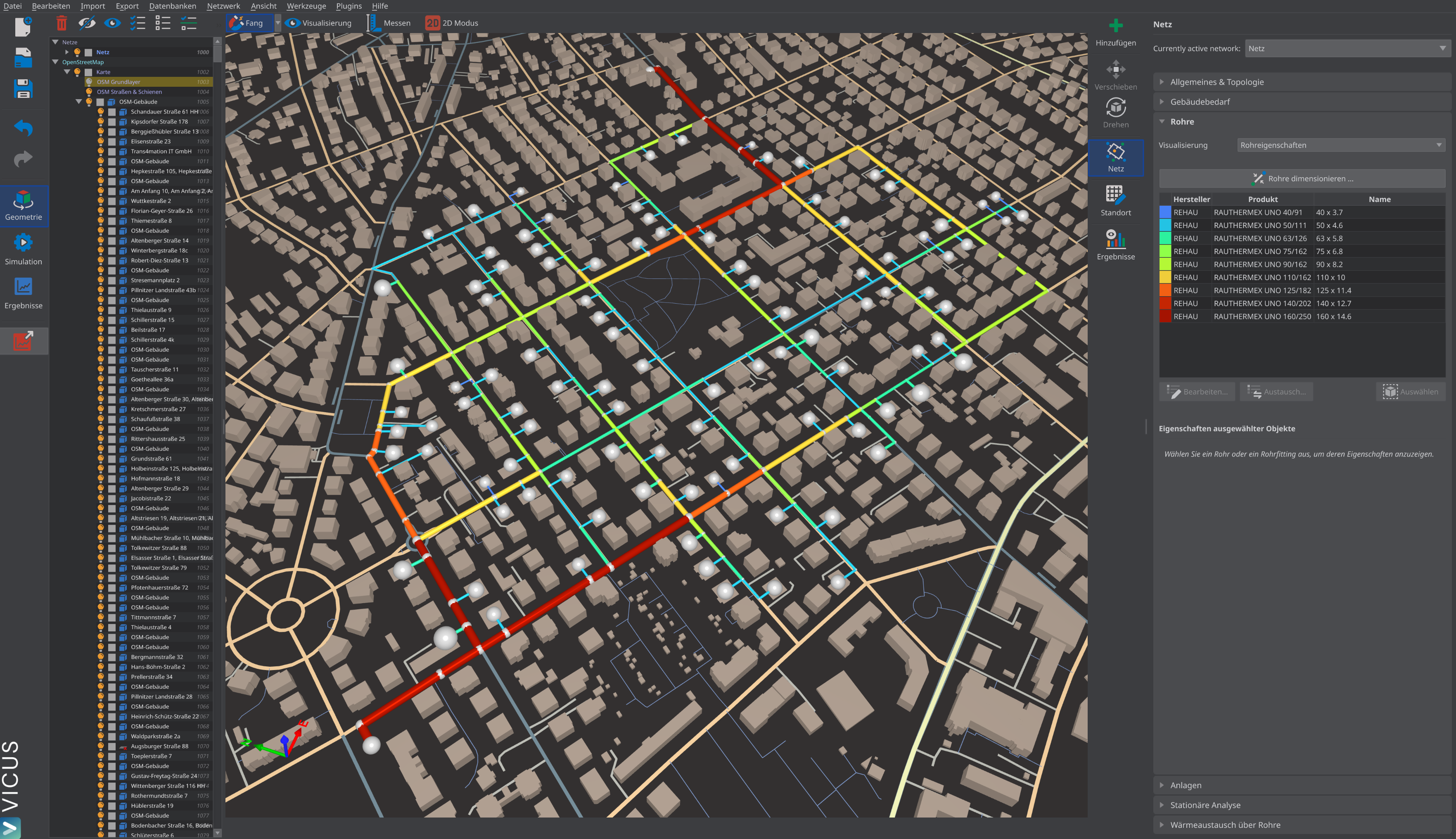
- Use simulation: Dynamic network simulations with software such as VICUS Districts allow the precise calculation of pressure losses and pump operating points over the entire year.
Conclusion
Pump sizing is a central building block in district heating network planning that is often underestimated. In conventional networks with a large temperature spread, the effects are moderate — in low-temperature networks and especially in cold district heating, an oversized pump system or an unfavourable control strategy can jeopardise the economic viability of the entire project. Choosing the right pump concept, a careful hydraulic design and the use of variable-speed pumps with worst-point control are the keys to efficient network operation with minimum pump electricity consumption. Tools such as VICUS Districts calculate the pump operating points dynamically and report the annual pump electricity consumption as part of the overall balance.
Further reading: Pressure Loss Calculation in District Heating Networks — determining head loss that the pump must overcome, Thermo-Hydraulic Simulation — dynamic analysis of pump operating points over the year, Sizing of Heat Transfer Stations — system integration at the consumer side, Economic Analysis According to VDI 2067 — accounting for pump lifecycle costs in the economic assessment.
References and Standards
- DIN EN 16297 — Pumps — Rotodynamic pumps — Glandless circulators — Requirements and tests
- AGFW FW 524 — Hydraulic Calculation of Hot Water District Heating Networks
- Europump & Hydraulic Institute (2004): Variable Speed Pumping — A Guide to Successful Applications. Elsevier.
Frequently Asked Questions
How is a district heating network pump sized?
What is worst-point control for network pumps?
What is the typical pump electricity consumption of a district heating network?
Related Articles
Dimensioning of house transfer stations: domestic hot water, space heating and diversity factors
What is a heating curve and how does it affect the design of district heating networks and heat pumps?
Pump switching and control in district heating networks: parallel and series configurations, redundancy concepts and differential pressure control. Practice and design.
Mixing, injection and throttle circuits: hydraulic circuit types for connections to thermal networks
Disclaimer: The content of this page is for general information purposes only and does not constitute legal, planning or engineering advice. All information is provided without guarantee. Despite careful research, VICUS Software GmbH assumes no liability for the accuracy, completeness or timeliness of the information provided. Third-party product names and trademarks are mentioned for informational purposes only and are the property of their respective owners.