Low-Temperature District Heating: Fundamentals, Planning and Benefits
What is cold district heating? Operating principles, planning and benefits of 5GDHC networks
Table of Contents
Low-temperature district heating (5GDHC) uses uninsulated pipe networks operating at natural ground temperatures of -5 to 25 °C, with decentralized heat pumps raising the temperature to usable heating levels in each building. This eliminates distribution losses almost entirely and enables simultaneous heating and cooling within the same network, achieving seasonal performance factors of 4.5 to 5.0.
What is Low-Temperature District Heating?
Unlike conventional district heating networks that operate at temperatures of 70-120°C, low-temperature networks use natural ground temperatures of approximately -5°C to 25°C. The actual heat generation occurs decentrally through heat pumps at individual consumers.
Operating Principle
- Heat Sources: Ground heat collectors, borehole heat exchangers, wastewater heat, or other low-temperature sources feed the network.
- Distribution: An uninsulated or minimally insulated pipe network transports the medium at low temperature levels.
- Decentralized Heat Pumps: Each consumer has their own heat pump that raises the low temperature level to usable temperatures.
Advantages of Low-Temperature District Heating
High Efficiency
Typical seasonal performance factors of 4.5 to 5.0 for heat pumps mean: 1 kWh of electricity produces 4.5-5 kWh of heat.
Bidirectional Operation
The same network can be used for cooling in summer – the extracted heat is returned to the ground and is available again in winter.
Low Network Losses
Due to the low temperatures, heat losses in the network are minimal – often only 2-5% instead of 10-20% in conventional networks.
Simple Installation
Uninsulated or simply insulated plastic pipes significantly reduce investment costs.
Renewable Energy
Low-temperature district heating is ideal for integrating geothermal energy, solar thermal, wastewater heat, and other renewable sources.
Planning with VICUS Districts
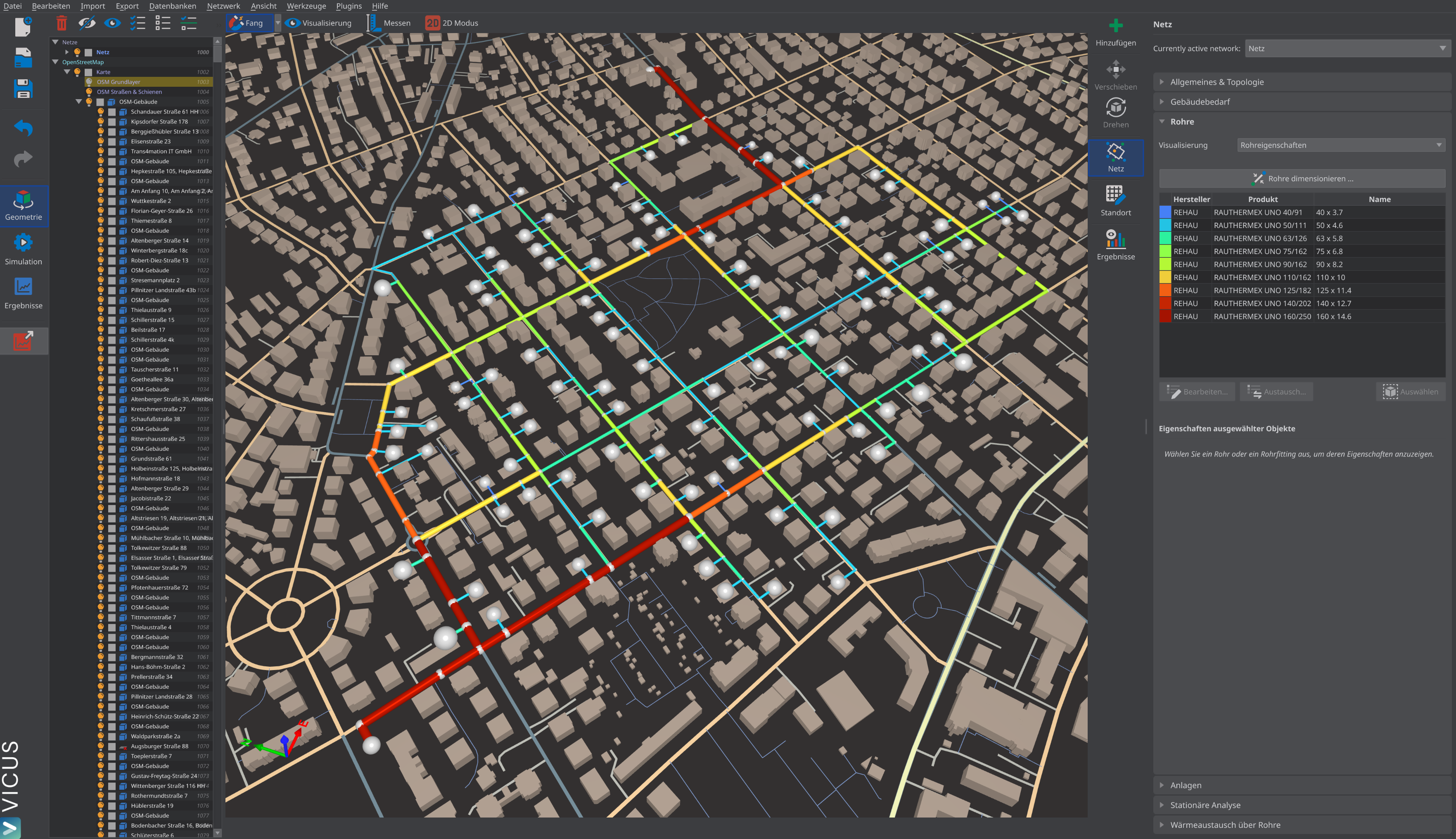
VICUS Districts offers specialized features for planning low-temperature district heating networks:
- Size ground heat collectors: Calculate required collector areas based on load profiles
- Annual simulation: Complete thermo-hydraulic simulation over the entire year
- Network heat gains: Calculate heat absorption from the surrounding ground
- Hydraulic verification: Design and verification of passive or active network operation
Typical Values
| Parameter | Typical Value |
|---|---|
| Network temperature | 0-25°C |
| Annual heat pump efficiency | 4.5-5.0 |
| Network losses | 2-5% |
| Collector area | 1.5-2.5 m²/kW |
Further reading: Advantages and Disadvantages of Low-Temperature District Heating — an honest assessment of pros and cons, Dimensioning Low-Temperature District Heating Networks — how 5GDHC systems are designed in practice, Network Temperatures in District Heating Networks — temperature levels across different network generations, BEW Funding — funding options for climate-neutral district heating networks.
References and Standards
- Buffa, S. et al. (2019): 5th generation district heating and cooling systems: A review of existing cases in Europe. Renewable and Sustainable Energy Reviews, 104, pp. 504–522.
- Lund, H. et al. (2014): 4th Generation District Heating (4GDH). Energy, 68, pp. 1–11.
- Nussbaumer, T.; Thalmann, S. (2016): Planungshandbuch Fernwärme. EnergieSchweiz / Swiss Federal Office of Energy.
Frequently Asked Questions
What is low-temperature district heating (5GDHC)?
How much does a low-temperature district heating network cost?
Can a low-temperature district heating network also provide cooling?
Related Articles
Special considerations for designing low-temperature district heating networks: passive vs. active networks, pressure loss criteria and ground coupling
How do prosumer concepts work in district heating networks? Heat feed-in, bidirectional networks and operating models
An honest comparison of the advantages and disadvantages of low-temperature district heating networks (5GDHC) for planners and decision-makers
Disclaimer: The content of this page is for general information purposes only and does not constitute legal, planning or engineering advice. All information is provided without guarantee. Despite careful research, VICUS Software GmbH assumes no liability for the accuracy, completeness or timeliness of the information provided. Third-party product names and trademarks are mentioned for informational purposes only and are the property of their respective owners.