Dimensioning Low-Temperature District Heating Networks (5GDHC)
Special considerations for designing low-temperature district heating networks: passive vs. active networks, pressure loss criteria and ground coupling
Table of Contents
Low-temperature district heating networks (5GDHC) require 7 to 13 times the volume flow of conventional systems for the same thermal output, because the temperature spread is only 3 to 6 K instead of 40 K. Dimensioning therefore differs fundamentally: pressure loss limits (50—100 Pa/m), the choice between passive and active networks and ground coupling as a heat source define the design process.
What makes dimensioning a 5GDHC network special?
In a conventional district heating network operating at, for example, 80/40 °C (a 40 K spread), comparatively low volume flows are transported. A low-temperature district heating network, by contrast, operates at temperatures close to the ground temperature, typically 0 to 20 °C, and with a spread of only 3 to 6 K. The direct consequence: for the same thermal output, a cold network must transport 7 to 13 times the volume flow.
Starting from the mass flow equation:
an example calculation for 100 kW yields:
- Conventional ( K): kg/s
- Low-temperature district heating ( K): kg/s
These high volume flows dictate the entire design process and make careful hydraulic dimensioning indispensable.
Passive vs. active networks
The hydraulic concept is the first and most consequential design decision for a low-temperature district heating network.
Passive networks
In passive networks, the brine circulation pumps integrated into the decentralized heat pumps handle circulation. There is no central pump. Each heat pump draws its own brine flow through the network and the heat source. This concept is suitable for smaller districts with up to approximately 40 buildings.
The available head of the circulation pumps built into the heat pumps is limited. Typically, about 0.6 to 0.7 bar of free pressure is available — this is the portion of head remaining after the internal pressure loss across the heat pump’s heat exchanger has been subtracted, which is then available for the external network.
The dimensioning criterion for passive networks is therefore: the pressure loss in the network (supply and return) plus the pressure loss in the heat source must not exceed the free pressure of the most unfavorable heat pump:
Since several heat pumps can be in operation simultaneously, the dimensioning must account for the coincidence case. In addition, check valves are required at every heat pump to prevent unwanted backflow through idle units.
Active networks
Beyond a certain network size, or in the case of unfavorable network geometries, the free pressure of the decentralized pumps is no longer sufficient. In such cases, a central circulation pump is installed in an energy center. The pumps in the heat pumps are then no longer needed; instead, motorized shut-off valves are used, opening whenever the respective heat pump starts to operate.
Active networks additionally require balancing valves or flow limiters to ensure uniform supply to all consumers. Typical heads of central circulation pumps lie in the range of 0.8 to 1.2 bar.
Comparison of the two concepts
| Criterion | Passive network | Active network |
|---|---|---|
| Network size | Up to approx. 40 buildings | Also larger networks |
| Central pump | No | Yes |
| Control | Decentralized (self-regulating) | Central + decentralized valves |
| Check valves | Required | Not required |
| Max. pressure gradient (guide value) | 50 — 70 Pa/m | 80 — 100 Pa/m |
| Investment cost energy center | Low | Higher (pump, pressure maintenance) |
| Pump electricity | Distributed across heat pumps | Centralized (easier to optimize) |
Pipe dimensioning: pressure gradient as the guiding parameter
Because of the high volume flows and the limited pump heads, the specific pressure gradient (in Pa/m) is the central dimensioning criterion in low-temperature district heating networks. Recommended reference values are:
- Passive networks: 50 to 70 Pa/m
- Active networks: 80 to 100 Pa/m
- Building service connections: up to 150 Pa/m
The flow velocities follow from the pressure gradient and typically lie between 0.5 and 1.5 m/s. Because of the large diameters relative to the thermal output transported, velocity limits play only a minor role.
Pipe material
In low-temperature district heating networks, plastic pipes made of PE100-RC or PE-Xa are used almost exclusively. Their advantages over steel pipes are low cost, easy installation, corrosion resistance and very low wall roughness ( mm), which results in lower pressure losses.
Ground coupling: the network as a heat source
A distinctive feature of low-temperature district heating networks is that the pipes themselves act as a heat source. Because the brine temperature lies below the ground temperature, heat flows from the ground into the pipes. This heat gain can be substantial and typically amounts to:
per trench meter (supply and return combined). The heat gain depends on the ground temperature, the brine temperature, the burial depth and the thermal conductivity of the soil.
Ground temperature and seasonal behavior
In Central Europe, the undisturbed ground temperature at a depth of 1 to 2 m varies seasonally between approximately 3 and 17 °C. During heating operation (winter), the ground surrounding the pipes cools down as heat is extracted. In summer, it regenerates through solar radiation and — if cooling is delivered via the network — through the rejection of heat from buildings.
The long-term balance of the ground must be neutral. A sustained net extraction leads to progressive cooling of the soil and, in extreme cases, to freezing. Ground simulation over several operating years is therefore an important part of the dimensioning process.
Balance of heating and cooling demand
A key advantage of 5GDHC networks is the ability to handle both heating and cooling within the same network. During cooling operation, heat is transferred from the buildings into the network and from there into the ground. This heat becomes available again in winter as heating energy.
For sizing the heat sources, the net balance is decisive:
In districts with a balanced heating and cooling demand (e.g. mixed-use areas combining offices and housing), the required source capacity can be significantly lower than the pure heating demand. In the ideal case, summer cooling fully regenerates the ground, so that additional heat sources can largely be dispensed with.
Unbalanced demand profiles
In districts with purely residential use, the heating demand dominates. Heat reinjection from cooling is low or absent. Here, the heat source (ground heat collectors, borehole heat exchangers) must cover the entire extraction, and natural regeneration from solar radiation must be sufficient to prevent long-term cooling of the soil.
Pump energy: the underestimated cost factor
Because of the high volume flows and the relatively modest COP values of the heat pumps (typically 4 to 5), pump electricity makes up a noticeable share of the total electricity consumption in a low-temperature district heating network. Measurements on operational networks show that in poorly dimensioned systems, pump electricity can amount to up to 20 % of the heat pump electricity. In well-designed networks, this value lies between 5 and 8 %.
The system seasonal performance factor takes pump electricity into account:
A high pump electricity share can push the system SPF from a nominal 4.5 down to below 3.5. Hydraulic dimensioning therefore has a direct impact on the efficiency and economic viability of the overall system.
Software-based dimensioning
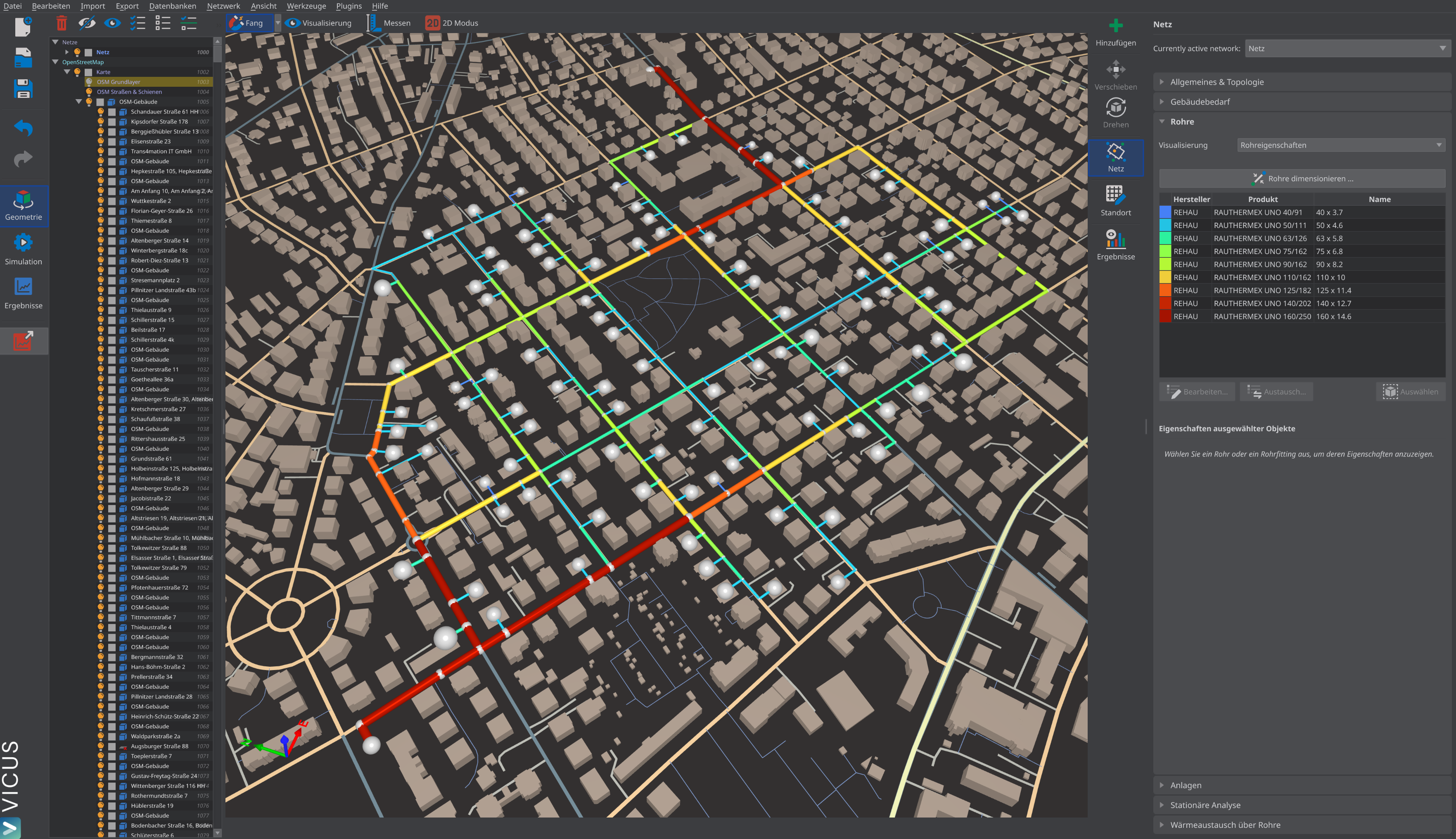
The multitude of interactions — hydraulics, ground temperature, seasonal balance, pump energy — makes a purely analytical design impractical beyond a certain network size. Simulation software such as VICUS Districts enables coupled thermo-hydraulic calculations that account for the dynamic behavior of the ground. In this way, passive and active network concepts can be compared, heat sources sized realistically, and pump electricity consumption assessed over a full year of operation.
Conclusion
Dimensioning a low-temperature district heating network requires a fundamentally different approach compared to conventional district heating networks — with VICUS Districts the aspects described above can be combined in a coupled annual simulation. The small temperature spread, high volume flows and ground coupling make careful hydraulic design indispensable. The choice between a passive and an active network has far-reaching consequences for investment and operation. The long-term ground balance and pump electricity as an efficiency metric deserve particular attention. Modern simulation tools help to master these complex interdependencies and to design a system that is optimal both technically and economically.
Further reading: Low-Temperature District Heating: Fundamentals — basic concepts of 5GDHC networks, Pipe Dimensioning in District Heating Networks — general pipe sizing methods applicable to low-temperature networks, Pressure Loss Calculation in District Heating Networks — hydraulic design fundamentals for network planning, Heating Curves — temperature control and its impact on network operation.
References and Standards
- Buffa, S. et al. (2019): 5th generation district heating and cooling systems: A review of existing cases in Europe. Renewable and Sustainable Energy Reviews, 104, pp. 504–522.
- AGFW FW 524 — Hydraulic Calculation of Hot Water District Heating Networks
- Boesten, S.; Ivens, W.; Provost, M. (2019): 5GDHC: An integrated design approach for sustainable district energy systems. REHVA Journal, 2019(1).
Frequently Asked Questions
How does dimensioning a 5GDHC network differ from conventional district heating?
What is the difference between passive and active low-temperature district heating networks?
How much pump electricity do 5GDHC networks consume?
Related Articles
What is cold district heating? Operating principles, planning and benefits of 5GDHC networks
How do prosumer concepts work in district heating networks? Heat feed-in, bidirectional networks and operating models
An honest comparison of the advantages and disadvantages of low-temperature district heating networks (5GDHC) for planners and decision-makers
Disclaimer: The content of this page is for general information purposes only and does not constitute legal, planning or engineering advice. All information is provided without guarantee. Despite careful research, VICUS Software GmbH assumes no liability for the accuracy, completeness or timeliness of the information provided. Third-party product names and trademarks are mentioned for informational purposes only and are the property of their respective owners.