BEW Funding – Key to Climate-Neutral Heat Supply
Everything about the German federal funding for efficient district heating networks: requirements, rates and application
Table of Contents
The Federal Funding for Efficient District Heating Networks (BEW) is Germany’s most important funding program for climate-neutral district heating: feasibility studies receive up to 50% funding (max. 2 million EUR), while investments in new construction and transformation are funded at up to 40% (max. 100 million EUR). Key requirements include a minimum 75% share of renewable energy, a maximum supply temperature of 95 °C for new networks, and a decarbonization roadmap to 2045. The program covers all project phases from planning through to operating cost subsidies over 10 years.
What is BEW Funding?
BEW supports the construction of new district heating networks with high shares of renewable energy as well as the decarbonization of existing networks. The goal: climate-neutral heat supply by 2045.
The Four Funding Modules
Module 1: Feasibility Studies
- Funding level: Up to 50% of costs
- Maximum amount: 2 million euros
- Purpose: Planning and conception of district heating networks
Module 2: Systemic Funding
- Funding level: Up to 40% of eligible costs
- Purpose: New construction of district heating networks or transformation of existing networks
Module 3: Individual Measures
- Funding level: Depending on the measure
- Purpose: Individual investments to improve existing networks
Module 4: Operating Cost Subsidies
- Funding level: Up to 90% of additional costs
- Duration: Up to 10 years
- Purpose: Support for operating large heat pumps and solar thermal systems
Requirements for Funding
- Minimum size: The district heating network must supply at least 16 buildings or building units.
- Renewable energy: At least 75% of the heat must come from renewable sources.
- Transformation plan: For existing networks, a transformation plan is required.
- Economic viability: The economic viability of the project must be demonstrated.
How VICUS Districts Helps with Funding
With VICUS Districts, you can:
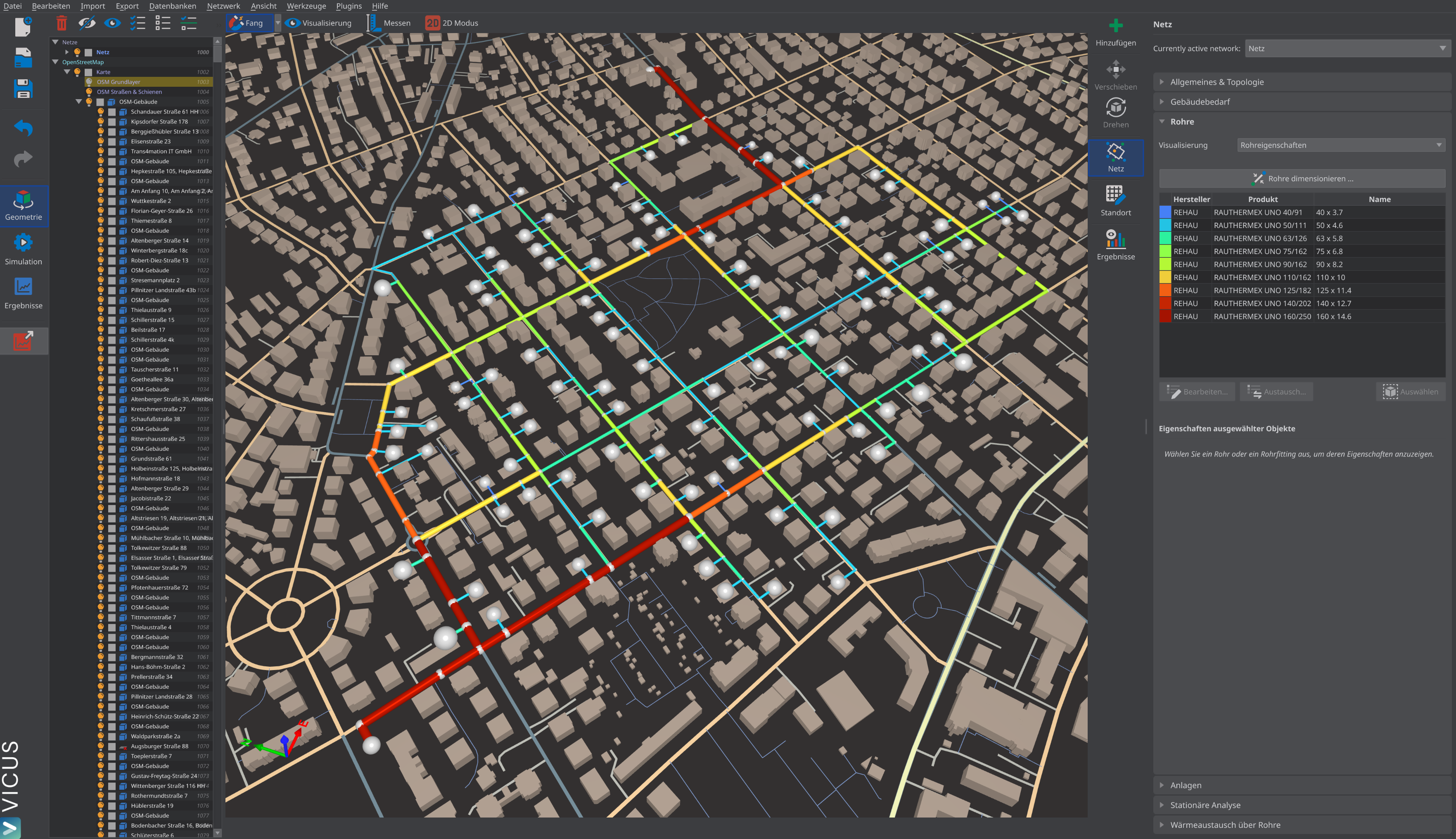
- Create feasibility studies: Detailed network planning and simulation for Module 1
- Demonstrate economic viability: Calculate investment costs and operating costs
- Develop transformation plans: Analyze existing networks and plan decarbonization
- Document funding requirements: Export calculation results for funding applications
Application Process
Applications are submitted through the Federal Office for Economic Affairs and Export Control (BAFA). Early planning is important as funds are limited.
Conclusion
BEW funding offers significant financial support for the transformation of heat supply. With professional planning software like VICUS Districts, you can efficiently meet the requirements and maximize your chances of receiving funding.
Further reading: Economic Analysis According to VDI 2067 — the cost calculation method used in feasibility studies, Low-Temperature District Heating: Fundamentals — a network type eligible for BEW funding, Linear Heat Density — an economic viability indicator used in funding evaluation.
References and Standards
- BAFA (2024): Federal Funding for Efficient District Heating Networks (BEW) — Funding Guidelines. Federal Office for Economic Affairs and Export Control.
- BMWK (2022): Directive for Federal Funding for Efficient District Heating Networks (BEW). Federal Ministry for Economic Affairs and Climate Action.
- AGFW FW 308 — Technical-economic parameters of district heating supply
Frequently Asked Questions
What is BEW funding and who can apply?
What are the requirements for BEW funding?
How does the BEW operating cost subsidy for heat pumps work?
Related Articles
Methodology for the economic analysis of district heating networks according to VDI 2067: net present value, annuity and annual costs
Tariff structure, heat supply contracts, and technical connection requirements: Contractual foundations of thermal networks
Disclaimer: The content of this page is for general information purposes only and does not constitute legal, planning or engineering advice. All information is provided without guarantee. Despite careful research, VICUS Software GmbH assumes no liability for the accuracy, completeness or timeliness of the information provided. Third-party product names and trademarks are mentioned for informational purposes only and are the property of their respective owners.