Prosumers in District Heating Networks
How do prosumer concepts work in district heating networks? Heat feed-in, bidirectional networks and operating models
What you will learn in this article:
- Feed-in types and hydraulic integration
- Bidirectional networks: challenges and benefits
- Operating models and billing concepts
Table of Contents
Prosumers are network participants that both consume and feed in heat — for example from solar thermal systems, industrial waste heat or cooling processes. They unlock their full potential in low-temperature district heating networks (5GDHC), where the low temperature levels make feed-in from diverse sources straightforward and enable bidirectional energy flows between heating and cooling.
What is a prosumer in a district heating network?
A prosumer is a network participant who alternates between consuming heat and feeding heat into the network. Unlike a pure producer (e.g. a combined heat and power plant), the prosumer switches operating modes depending on the availability of its own heat source and its own demand.
Typical examples include:
- Residential buildings with solar thermal systems that feed surplus heat into the network in summer
- Commercial operations with process waste heat, which deliver heat continuously or at times
- Data centers, whose cooling produces waste heat at 30 to 60 °C year-round
- Buildings with active cooling that deliver heat to the network via the heat pump in summer
The prosumer concept is particularly relevant for low-temperature district heating networks (5GDHC), where the low temperature level makes feed-in from a wide variety of sources easy. But prosumer models are also being adopted increasingly in conventional low-temperature networks (4th generation).
Feed-in types: hydraulic variants
The type of feed-in depends on where in the network the heat is injected and at what temperature it is available. Two basic feed-in principles can be distinguished:
Supply-to-return feed-in
In this variant, the prosumer draws water from the supply line, cools it through its own heat demand and feeds the remaining heat — which is not fully cooled — into the return line. In practice, this variant is rarely used as a true prosumer feed-in, because it raises the return temperature and thus degrades the efficiency of the overall system.
Return-to-supply feed-in
The far more common and more efficient variant: the prosumer draws water from the return line, heats it using its own heat source, and feeds it back into the supply line at supply-line temperature. The feed-in temperature must at least match the network supply temperature:
The injected thermal power is calculated as:
where is the mass flow, is the specific heat capacity of water and is the temperature spread.
Bidirectional networks
In bidirectional networks, the direction of flow in the pipes can change. This is typical for low-temperature district heating networks: in winter, the brine flows from the central heat source to the buildings, while in summer the direction can locally reverse when buildings feed cooling heat into the network. The hydraulic design of such networks is demanding, because changing pressure conditions and variable flow directions have to be taken into account.
A characteristic feature of bidirectional networks is the absence of a clearly defined supply and return line. Instead, one often speaks of a warm and a cold pipe, whose temperatures shift seasonally.
Typical prosumer heat sources
Solar thermal
Solar thermal systems on building roofs or open ground produce substantial heat surpluses in summer, which can far exceed a building’s own demand. With a typical yield of 350 to 500 kWh/ma and a summer heat demand that is almost entirely driven by domestic hot water, a multi-family house with 20 m of collector area can easily produce seasonal surpluses of several MWh.
Feeding this heat into the network requires a heat exchanger for hydraulic separation as well as controls that ensure feed-in only takes place when the temperature level is sufficient.
Industrial and commercial waste heat
Many commercial operations generate waste heat at usable temperature levels: bakeries (oven exhaust at 80 to 150 °C), supermarkets (refrigeration systems at 30 to 45 °C) or data centers (server waste heat at 35 to 60 °C). The challenge lies in the temporal matching of waste heat availability and network demand, and in the temperature lift required if the waste heat level is below the network supply temperature.
Cooling as a heat source
In low-temperature district heating networks, active cooling of a building automatically gives rise to a heat feed-in: the heat pump extracts heat from the building and delivers it to the network. This mechanism is one of the central advantages of the prosumer concept — the waste heat from cooling is not wasted to the environment but becomes available as a heat source for other buildings.
Challenges in prosumer networks
Hydraulic complexity
With every additional prosumer, the hydraulic complexity of the network grows. Decentralized producers dynamically change the pressure conditions and mass flows in the network. Careful simulation is necessary to ensure that all participants are always adequately supplied. In networks with many prosumers in particular, situations can arise in which more heat is being fed in than consumed — the network then requires either storage or a means of throttling back.
Temperature management
In conventional networks, the prosumer feed-in temperature must reach the network supply temperature. With a weather-compensated operating mode (outdoor-temperature-dependent supply temperature), this requirement varies over the year. In winter, at high supply temperatures (e.g. 80 °C), many low-temperature sources cannot feed in directly. Low-temperature district heating networks avoid this problem thanks to their inherently low network temperatures.
Metering and billing concepts
Every prosumer connection requires a bidirectional heat meter that records both consumption and feed-in. Billing calls for clear contractual arrangements: at what price is injected heat remunerated? How are grid charges apportioned to producers? These questions are less standardized than in the electricity sector to date and require individual agreements between the network operator and the prosumer.
Operating models
In practice, several models have become established:
- Fixed-price remuneration: the network operator pays a fixed price per kWh for injected heat, typically 2 to 5 ct/kWh depending on the temperature level and temporal availability.
- Heat contracting: a contractor builds and operates the feed-in installation (e.g. solar thermal) on the prosumer’s roof and feeds directly into the network.
- Cooperative model: the network participants are also the owners of the network and share costs and revenues among themselves.
Simulation and planning of prosumer networks
Planning district heating networks with prosumers requires a dynamic thermo-hydraulic simulation that captures variable feed-in and extraction over the full course of the year. Steady-state design calculations are not sufficient because the changing operating states have a strong influence on network hydraulics.
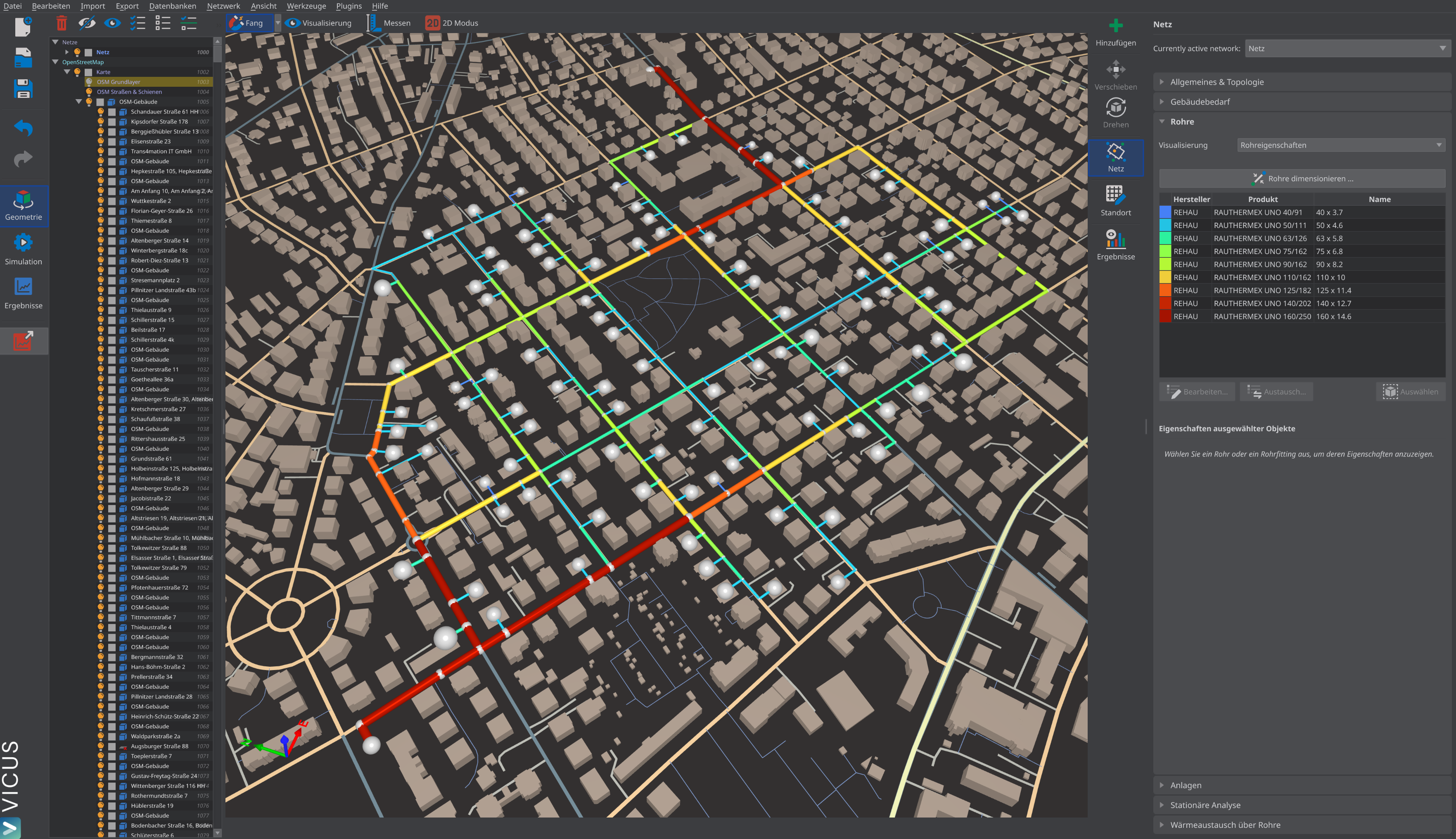
Software such as VICUS Districts makes it possible to simulate such networks, including bidirectional flows and decentralized producers. This allows critical operating states to be identified early on and the sizing of pipes, pumps and storage to be optimized.
Conclusion
Prosumer concepts make district heating networks more flexible, more efficient and more future-proof. They unlock the use of decentralized heat sources — from solar thermal to waste heat to heat rejected by cooling — and turn passive consumers into active network partners. It is particularly in low-temperature district heating networks that prosumers realize their full potential, because the low network temperatures facilitate feed-in from a wide variety of sources. With VICUS Districts, the resulting bidirectional load flows can be simulated over an entire year. The hydraulic complexity, however, calls for careful planning and simulation to ensure stable and efficient network operation.
Further reading: Low-Temperature District Heating: Fundamentals — basic concepts of 5GDHC networks where prosumers thrive, Advantages and Disadvantages of Low-Temperature District Heating — evaluating the system that enables prosumer operation, Network Temperatures in District Heating Networks — temperature requirements for feed-in and consumption, Sizing of Heat Transfer Stations — connection design for bidirectional stations.
References and Standards
- Buffa, S. et al. (2019): 5th generation district heating and cooling systems: A review of existing cases in Europe. Renewable and Sustainable Energy Reviews, 104, pp. 504–522.
- Bünning, F. et al. (2018): Bidirectional low temperature district energy systems with agent-based control. Applied Energy, 209, pp. 502–515.
- Lund, H. et al. (2014): 4th Generation District Heating (4GDH). Energy, 68, pp. 1–11.
Frequently Asked Questions
What is a prosumer in a district heating network?
How does prosumer feed-in work in district heating networks?
What challenges arise with prosumer networks?
Related Articles
What is cold district heating? Operating principles, planning and benefits of 5GDHC networks
Special considerations for designing low-temperature district heating networks: passive vs. active networks, pressure loss criteria and ground coupling
An honest comparison of the advantages and disadvantages of low-temperature district heating networks (5GDHC) for planners and decision-makers
Disclaimer: The content of this page is for general information purposes only and does not constitute legal, planning or engineering advice. All information is provided without guarantee. Despite careful research, VICUS Software GmbH assumes no liability for the accuracy, completeness or timeliness of the information provided. Third-party product names and trademarks are mentioned for informational purposes only and are the property of their respective owners.