Thermo-Hydraulic Simulation: A Deep Dive
Fundamentals of thermo-hydraulic simulation in district heating networks: methods, models and application
Table of Contents
A thermo-hydraulic simulation simultaneously solves pressure, flow, and temperature distributions across a district heating network over time, capturing the physical coupling where temperature-dependent fluid properties affect flow resistance and heat transport. It is essential for modern networks with multiple feed-in points, bidirectional flows, or low operating temperatures, where decoupled calculations produce inaccurate results. The hydraulic model is solved as a stationary system using Newton-Raphson iteration, while the thermal transport equations are integrated dynamically with the CVODE solver.
Why Coupled Simulation?
In a district heating network, hydraulics and thermal behavior influence each other:
- Temperature affects fluid properties: Water density and viscosity change with temperature, impacting pressure loss calculation. At 20°C, water has a significantly different viscosity than at 90°C.
- Flow affects heat transport: The flow velocity determines how quickly heat is transported and how large the heat losses are.
- Heat losses affect temperature: The cooling in the network depends on pipe dimensions, insulation, and residence time.
These interactions make decoupled calculations insufficient for modern network planning.
Mathematical Foundations
Hydraulic Calculation
The hydraulic calculation is based on the fundamental equations of pipe hydraulics:
- Continuity equation: Mass conservation at nodes
- Momentum equation: Pressure losses due to friction and local resistances
- Newton-Raphson method: Iterative solution of the nonlinear system of equations
Thermal Calculation
The thermal side requires solving transport equations:
- Advection-diffusion equation: Heat transport in the fluid
- Heat transfer: Heat losses to the environment
- CVODE solver: Numerical integration of differential equations
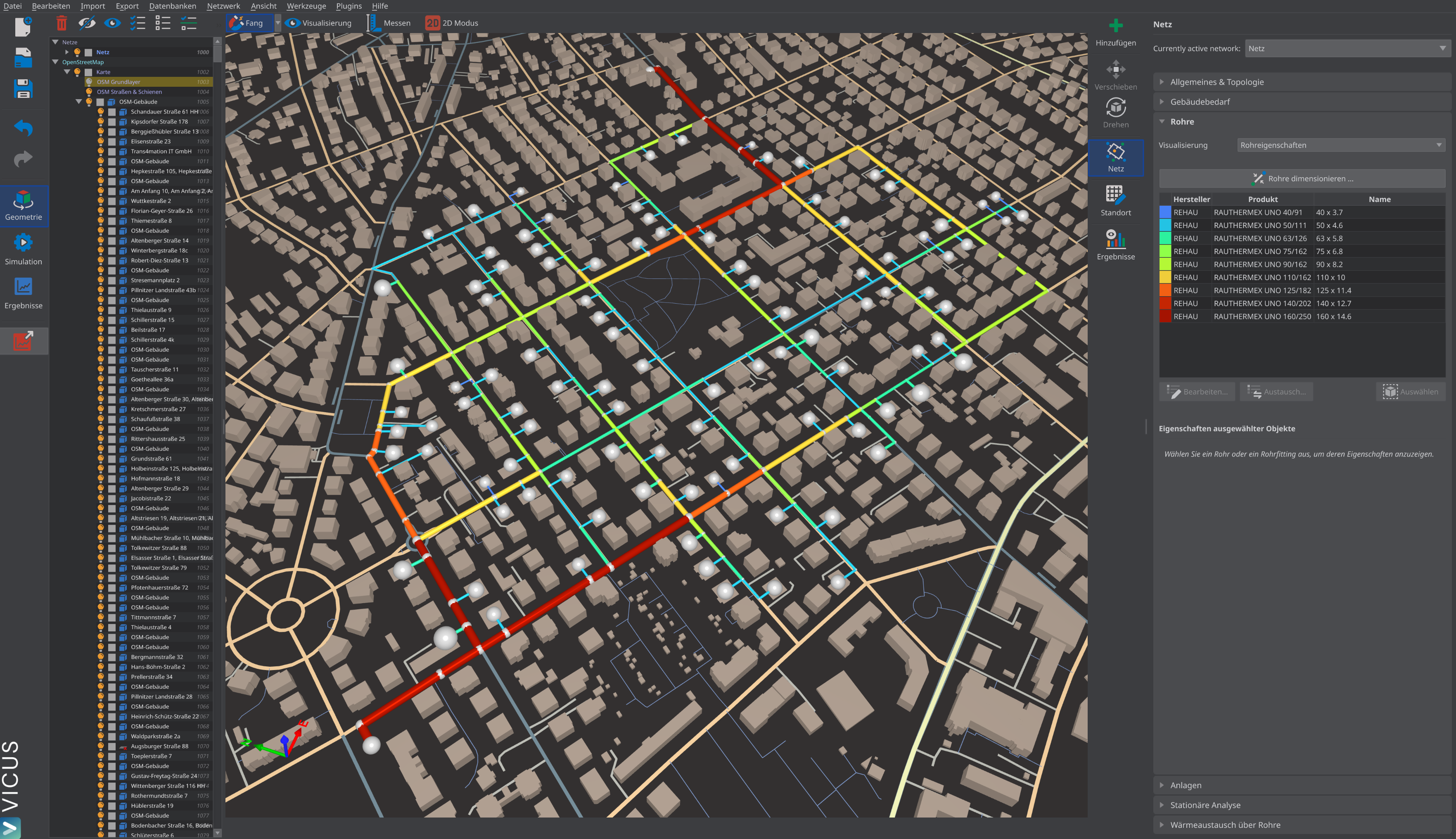
Implementation in VICUS Districts
VICUS Districts uses a fully coupled approach:
- Initialization: Steady-state calculation for initial values
- Time step: Hydraulic solution at current temperature distribution
- Thermal integration: Solution of heat transport equations
- Iteration: Feedback between hydraulics and thermal behavior
Advantages of This Approach
- High accuracy: Precise representation of dynamic effects
- Stability: Robust numerical methods
- Efficiency: Optimized algorithms for fast calculations
Practical Applications
Design of Control Strategies
Dynamic simulation enables investigation of:
- Critical point control (see network control)
- Variable supply temperature via different network operating modes
- Load forecasting and control
Operational Optimization
Analysis of:
- Pump operation and energy consumption
- Thermal energy storage integration
- Source management with multiple feed-ins
Network Expansion
Planning of:
- Extensions to existing networks
- Integration of new heat generation sources
- Transformation to lower network temperatures
Conclusion
Thermo-hydraulic simulation is indispensable for planning modern district heating networks. It enables precise predictions of network behavior and is the foundation for economically and technically optimized solutions.
Further reading: Pressure Loss Calculation in District Heating Networks — the static calculation basis that thermo-hydraulic simulation extends, Pipe Dimensioning in District Heating Networks — sizing inputs derived from simulation results, Pump Sizing in District Heating Networks — pump modelling within the coupled simulation, Dimensioning Low-Temperature District Heating Networks — applying thermo-hydraulic simulation to 5GDHC systems.
References and Standards
- AGFW FW 524 — Hydraulic Calculation of Hot Water District Heating Networks
- Benonysson, A.; Bøhm, B.; Ravn, H. F. (1995): Operational optimization in a district heating system. Energy Conversion and Management, 36(5), pp. 297–314.
- Nussbaumer, T.; Thalmann, S. (2016): Planungshandbuch Fernwärme. EnergieSchweiz / Swiss Federal Office of Energy.
Frequently Asked Questions
What is a thermo-hydraulic simulation?
When is a dynamic network simulation needed?
Which software is suitable for district heating network simulation?
Related Articles
Network operating modes in district heating networks: sliding, constant, and sliding-constant operation. Operating principles, advantages and disadvantages compared.
Pressurization systems in thermal networks: open and closed systems, expansion volume and make-up water
Pressure diagram, operating pressures and pressure conditions in thermal networks: MOP, critical point and total pressure
Control concepts for thermal networks: differential pressure control, critical point and control with multiple feed-in points
Disclaimer: The content of this page is for general information purposes only and does not constitute legal, planning or engineering advice. All information is provided without guarantee. Despite careful research, VICUS Software GmbH assumes no liability for the accuracy, completeness or timeliness of the information provided. Third-party product names and trademarks are mentioned for informational purposes only and are the property of their respective owners.